



Lavandula oil/extract: properties, uses, pros, cons, safety
Lavandula oil/extract is a practical designation that may refer to different ingredients obtained from species of the genus Lavandula, particularly Lavandula angustifolia, Lavandula hybrida, and Lavandula intermedia. In cosmetics it may indicate either a lavender essential oil, rich in volatile odorant components, or a lavender plant extract, obtained with solvents such as water, glycerin, glycols, alcohol, or hydroalcoholic mixtures.
From a cosmetic standpoint, the most important point is regulatory: Regulation (EU) 2023/1545 included Lavandula hybrida oil/extract, Lavandula intermedia oil/extract, and Lavandula angustifolia oil/extract in Annex III, entry 360, with the obligation to indicate “Lavandula Oil/Extract” on the label when the concentration exceeds 0.001% in leave-on products and 0.01% in rinse-off products. This obligation is in addition to the possible declaration of individual allergens naturally present, such as Linalool and Linalyl Acetate, when they exceed their respective thresholds.
Description
Lavender is an aromatic plant of the Lamiaceae family, long used in perfumery, cosmetics, detergency, and herbal preparations. In the cosmetic field, however, it is essential to distinguish between essential oil and extract.
Lavender essential oil is the volatile fraction obtained mainly from flowers or flowering aerial parts. It is used primarily as a perfuming ingredient, masking agent, and sensory component. Its olfactory profile is floral, herbaceous, fresh, lavender-like, slightly balsamic, and clean. The main odorant components are generally linalool and linalyl acetate, with variable amounts of lavandulyl acetate, terpinen-4-ol, lavandulol, 1,8-cineole, camphor, β-ocimene, and other terpenes.
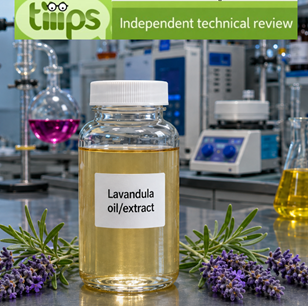
Lavender extract, on the other hand, may have a very different composition depending on the solvent, plant part, and extraction process. An aqueous or glycolic extract may contain mainly more polar compounds, aromatic traces, flavonoids, phenolic acids, and non-volatile plant fractions. Consequently, it should not be assessed as automatically equivalent to the essential oil.
Production process
Lavender essential oil is produced mainly by steam distillation of the flowering tops or flowering aerial parts. Steam passes through the plant material, carries the volatile molecules, and after condensation allows separation of the essential oil from the aqueous phase. The final profile depends on botanical species, variety, altitude, climate, harvest period, drying, distillation method, and storage.
Lavender extracts are instead obtained by maceration, percolation, hydroglycolic extraction, hydroalcoholic extraction, glycerin extraction, or other extraction systems. Composition changes greatly depending on the solvent: a glycerin extract is not equivalent to an alcoholic extract, and a dry extract is not equivalent to an essential oil.
After extraction, the usual steps include filtration, standardization, microbiological control, residual solvent control, verification of color, odor, pH, density, assay, and, for essential oils, GC-MS analysis of the volatile profile.
Main compounds present
In Lavandula angustifolia essential oil, the most characteristic components are:
linalool;
linalyl acetate;
lavandulyl acetate;
terpinen-4-ol;
lavandulol;
1,8-cineole;
camphor;
β-ocimene;
limonene;
other minor monoterpenes and sesquiterpenes.
In non-volatile extracts, more polar compounds and plant fractions may instead be present, such as flavonoids, phenolic acids, tannins, and other water-soluble or hydroalcohol-soluble substances. However, the actual composition must always be verified on the supplier’s technical data sheet, because “Lavandula extract” alone does not define the solvent, drug/extract ratio, plant part, or assay.
From an allergological standpoint, the most relevant components are mainly Linalool and Linalyl Acetate, both subject to individual label declaration above threshold. Lavender oil/extract as a natural group is also now subject to declaration as “Lavandula Oil/Extract” above threshold according to Annex III.
Identification data and specifications
| Characteristic | Value | Note |
|---|---|---|
| Practical name | Lavandula oil/extract | general designation, not always precise INCI |
| Most common species | Lavandula angustifolia | true lavender / lavender |
| Other relevant species | Lavandula hybrida; Lavandula intermedia | lavandin |
| Botanical family | Lamiaceae | aromatic family |
| Essential oil INCI | Lavandula Angustifolia Flower Oil; Lavandula Angustifolia Oil | depends on the entry used |
| Extract INCI | Lavandula Angustifolia Flower Extract; Lavandula Angustifolia Flower/Leaf/Stem Extract | depends on plant part and solvent |
| CosIng Ref. Flower Extract | 57058 | Lavandula Angustifolia Flower Extract |
| CosIng Ref. Flower Oil | 96168 | Lavandula Angustifolia Flower Oil |
| CosIng Ref. Flower/Leaf/Stem Oil | 91325 | Lavandula Angustifolia Flower/Leaf/Stem Oil |
| Indicative Annex III CAS | 84776-65-8 / 8000-28-0 / 90063-37-9 | for Lavandula angustifolia oil/extract in Annex III |
| Indicative Annex III EC | 283-994-0 / - / 289-995-2 | according to Reg. (EU) 2023/1545 |
| Main cosmetic functions | perfuming, masking, skin conditioning, tonic, cleansing/deodorant depending on entry | vary between oil and extract |
| EU restriction | Annex III, entry 360 | declaration “Lavandula Oil/Extract” above threshold |
| Leave-on threshold | 0.001% | mandatory label declaration above threshold |
| Rinse-off threshold | 0.01% | mandatory label declaration above threshold |
| Food use | flavouring / botanical in specific contexts | non-nutritional |
Indicative physicochemical properties
| Characteristic | Essential oil | Extract |
|---|---|---|
| Appearance | mobile, oily liquid | liquid, solution, dry extract, or glycolic extract |
| Color | colorless to pale yellow | light yellow to brown, depending on solvent |
| Odor | intense, floral, lavender-like, herbaceous | weaker or variable |
| Water solubility | very low / insoluble | variable; often good if hydroglycolic or aqueous |
| Solubility in alcohol | good | variable |
| Volatility | high | low or moderate |
| Main components | linalool, linalyl acetate, terpenes | polar compounds, plant fractions, possible aromatic traces |
| Stability | sensitive to oxygen, light, and heat | depends on solvent and preservatives |
| Main technical risk | oxidation and fragrance allergens | microbiology, preservation, solvent, and residual allergens |
| Formulation function | perfuming/masking | skin conditioning, botanical, tonic, sensory support |
Food
In the food sector, lavender may be used as an aromatic plant or as a component of flavourings, but Lavandula oil/extract should not be described as a nutrient. Lavender flowers may be used in small amounts in infusions, confectionery products, flavoured honey, liqueurs, aromatic preparations, and herbal mixtures.
The essential oil, when used in food, requires a specific food grade, very controlled dosages, and regulatory compliance. It should not be confused with cosmetic or aromatherapy use. Food assessment must consider purity, composition, use limits, possible allergens, and safety of intake.
From a nutritional standpoint, the judgment is straightforward: the interest is aromatic and sensory, not health-related. Any traditional or phytotherapeutic uses must be separated from cosmetic assessment and not turned into unauthorized claims.
Cosmetics
In cosmetics, lavender essential oil is used mainly as a perfuming ingredient and masking agent. It may appear in creams, cleansers, soaps, shampoos, conditioners, deodorants, body products, bath products, perfumes, hair products, and “natural” cosmetics where a recognizable floral-herbaceous note is desired.
Lavender extracts are more often used as supporting botanical ingredients, with functions such as skin conditioning, tonic, deodorant, cleansing, or sensory function, depending on the INCI entry and supplier documentation. However, they should not automatically be presented as calming, curative, or anti-inflammatory in the finished product without adequate experimental support.
The central regulatory point is allergen labeling. Annex III of the European Cosmetics Regulation, as amended by Regulation (EU) 2023/1545, includes entry 360 for Lavandula hybrida/intermedia/angustifolia oil/extract. Presence must be indicated as “Lavandula Oil/Extract” when it exceeds:
0.001% in leave-on products;
0.01% in rinse-off products.
In addition, individual components such as Linalool, Linalyl Acetate, Limonene, Geraniol, Coumarin, or other allergens possibly present must be assessed and declared if they exceed their respective thresholds.
Pros
It has a pleasant, floral, herbaceous, and clean olfactory profile.
The essential oil is very useful as a natural perfuming ingredient and masking agent.
Extracts can add a botanical and sensory component to the formula.
It is a highly recognizable raw material appreciated by consumers.
It can be used in skin care, hair care, cleansers, body products, and perfumery.
Its compositional profile is well studied, especially for Lavandula angustifolia essential oil.
EU regulation now provides a clearer framework for labeling as Lavandula Oil/Extract above threshold.
Cons
It is not a nutritional food ingredient: its value in food is only aromatic.
In cosmetics it is now subject to declaration as Lavandula Oil/Extract above threshold.
It naturally contains fragrance allergens such as Linalool and Linalyl Acetate.
Oxidized essential oil may increase the risk of skin sensitization.
Composition varies greatly depending on species, origin, harvest, distillation, solvent, and storage.
Not all extracts are equivalent: essential oil, glycolic extract, aqueous extract, and dry extract have very different profiles.
Claims such as “calming”, “anti-inflammatory”, or “rebalancing” must be supported by data on the finished product, not inferred from the botanical name alone.
Safety, regulatory aspects, and environment
From a cosmetic standpoint, Lavandula oil/extract requires a more cautious assessment than its natural image might suggest. The main risk is skin sensitization, especially for the essential oil and for oxidized or poorly stored materials. Linalool and linalyl acetate are characteristic components of lavender and are among the substances to be carefully controlled for allergen labeling.
European regulation does not prohibit cosmetic use of lavender, but it imposes transparency obligations. Annex III entry 360 requires the indication “Lavandula Oil/Extract” above the established thresholds. In addition, Regulation (EU) 2023/1545 expanded the list of fragrance allergens to be declared individually, with the general thresholds of 0.001% leave-on and 0.01% rinse-off.
From a technical standpoint, for correct use it is advisable to request from the supplier:
updated SDS;
certificate of analysis;
GC-MS for the essential oil;
allergen declaration;
IFRA certificate, if used as a fragrance;
data on Linalool, Linalyl Acetate, Limonene, Geraniol, Coumarin, and other allergens;
data on peroxides, oxidation, and storage;
precise indication of botanical species, plant part, solvent, and extraction ratio;
declaration of compliance with the EU Cosmetics Regulation.
As a concentrated raw material, the essential oil may be irritating and sensitizing, while the extract may have a more or less gentle profile depending on solvent, preservatives, and composition. Safety must therefore always be assessed on the finished product, considering concentration, product category, area of application, frequency of use, exposure of sensitive subjects, and the presence of other fragrances or essential oils.
From an environmental standpoint, lavender is a plant raw material, but real sustainability depends on cultivation, irrigation, yield, distillation, energy consumption, solvents, transport, packaging, and product destination. Essential oils often have a low yield relative to plant biomass, so botanical origin alone is not sufficient to define the environmental profile as favorable.
Conclusion
Lavandula oil/extract is a widespread and recognizable group of cosmetic ingredients, useful mainly for fragrance, masking, botanical component, and sensory support. The essential oil has a strong and characteristic olfactory profile; the extract may instead contribute in a more botanical, less volatile way, strongly dependent on the solvent used.
Professional assessment must clearly distinguish essential oil, extract, botanical species, plant part, and commercial grade. The most important regulatory point is the obligation to declare “Lavandula Oil/Extract” above 0.001% in leave-on products and 0.01% in rinse-off products, in addition to the possible declaration of individual allergens present.
In a well-designed formula and with complete supplier documentation, lavender can be a favorable and functional ingredient. The points to control are composition, oxidation, allergens, IFRA, SDS, COA, actual concentration in the finished product, botanical species, type of extract, and compliance with the European Cosmetics Regulation.

