



Disodium cetearyl sulfosuccinate: properties, uses, pros, cons, safety
Disodium Cetearyl Sulfosuccinate is an anionic surfactant belonging to the sulfosuccinate family. It is used mainly in cosmetics as a cleansing agent, emulsifier, foaming agent, foam booster, hydrotrope, and skin conditioning ingredient. Its descriptive chemical name is Butanedioic acid, sulfo-, C-C16-18-alkyl esters, disodium salt, meaning a disodium salt of C16-C18 alkyl esters of sulfosuccinic acid.
Description
This is a technical-cosmetic raw material, not a food ingredient. From a chemical standpoint, it is a disodium salt of a half ester of cetearyl alcohol with sulfosuccinic acid. The term “cetearyl” normally indicates a C16-C18 fatty alcohol fraction, linked to cetyl alcohol and stearyl alcohol or to a similar mixture of fatty chains.
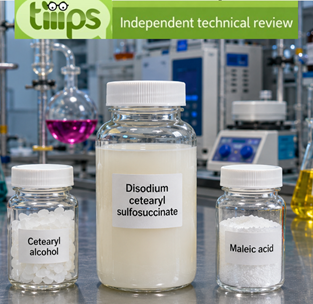
The structure contains a long-chain lipophilic portion and an anionic sulfosuccinate head. This combination allows the compound to reduce surface tension, disperse dirt and fatty components, support foam formation, and contribute to the stability of emulsified systems. In formulation practice, it is more accurate to describe it as a mild/moderate anionic surfactant compared with some classic sulfates, but real tolerability always depends on the finished product, pH, concentration, and the overall surfactant system.
Production process
Industrially, Disodium Cetearyl Sulfosuccinate is obtained starting from cetearyl alcohol or C16-C18 fatty alcohol fractions, which are esterified with a derivative of maleic acid or sulfosuccinic acid and then subjected to sulfonation/neutralization to obtain the disodium salt. The result is a technical mixture of sulfosuccinate esters with C16-C18 alkyl chains.
After synthesis, the usual steps include neutralization, purification, pH control, active matter control, verification of residual salts, solvents, organic impurities, color, odor, and formulation compatibility. Commercial grades may be supplied as a paste, solution, dispersion, or component of surfactant blends.
Main compounds present
In the commercial grade, the main component is Disodium Cetearyl Sulfosuccinate. Since it derives from a C16-C18 cetearyl fraction, it should not be interpreted as a completely unique single molecule, but as a technical mixture of closely related components.
Small amounts may be present, including:
residual cetearyl alcohol;
inorganic salts;
water, in solution or paste grades;
sulfosuccinate ester fractions with different C16/C18 distribution;
possible impurities or process-related by-products.
For this reason, in formulation it is important to distinguish between INCI name, actual active matter, commercial form, pH, salt content, and compatibility with other surfactants.
Identification data and specifications
| Characteristic | Value | Note |
|---|---|---|
| INCI name | Disodium Cetearyl Sulfosuccinate | cosmetic designation |
| Descriptive chemical name | Butanedioic acid, sulfo-, C-C16-18-alkyl esters, disodium salt | technical definition |
| Chemical category | anionic surfactant / sulfosuccinate | disodium salt of sulfosuccinic ester |
| CAS | 91697-07-3 | identifier reported by INCI/COSMILE databases |
| EC | 294-268-8 | reported European reference |
| CosIng / COSMILE Ref. | 75817 | reference reported in INCI databases |
| Molecular formula | not applicable as a single formula | C16-C18 technical mixture |
| Molecular weight | variable | depends on fatty-chain distribution |
| Cosmetic functions | cleansing, foaming, skin conditioning, surfactant-cleansing, surfactant-emulsifying, surfactant-foam boosting | functions reported by COSMILE |
| Other reported functions | hydrotrope, emulsifying, foam boosting | reported in technical-cosmetic databases |
| Food use | not relevant | not a food additive |
Indicative physicochemical properties
| Characteristic | Indicative value | Note |
|---|---|---|
| Appearance | paste, solution, dispersion, or waxy solid | depends on commercial grade |
| Color | white, cream, or pale yellow | variable according to supplier |
| Odor | mild, characteristic | depends on purity and matrix |
| Ionic nature | anionic | sulfosuccinate head |
| Water solubility/dispersibility | good or moderate depending on grade | may require heating or co-surfactants |
| Compatibility | good with many anionic, non-ionic, and amphoteric surfactants | to be verified in the final formula |
| Use pH | generally compatible with mild cleansers | to be adjusted according to the system |
| Foam | good / improvable in blends | foam-boosting function |
| Cleansing effect | moderate-good | depends on concentration and blend |
| Formulation sensitivity | electrolytes, pH, water hardness, and co-surfactants | to be verified with stability testing |
Food
Disodium Cetearyl Sulfosuccinate has no relevant food role. It is not a nutrient, not a flavouring, and not a commonly used food additive. Its interest concerns mainly cosmetics, personal care, and cleansing formulations.
For food assessment, therefore, the judgment is straightforward: the food focus is not relevant. Its function is technical-formulation-related, not nutritional.
Cosmetics
In cosmetics, Disodium Cetearyl Sulfosuccinate is used as a cleansing surfactant, emulsifier, foaming agent, foam booster, hydrotrope, and skin conditioning ingredient. COSMILE reports functions such as cleansing, foaming, skin conditioning, surfactant-cleansing, surfactant-emulsifying, and surfactant-foam boosting.
It may be present in facial cleansers, shower gels, shampoos, mild cleansers, formulas for sensitive skin, cleansing emulsions, cream cleansers, hair products, and formulations where cleansing, foam, and good stability must be combined. The C16-C18 fraction also makes it interesting as a supporting ingredient in systems that are more structured than shorter-chain sulfosuccinates.
Compared with sulfate surfactants such as Sodium Lauryl Sulfate, sulfosuccinates are often perceived as milder, but this should not be turned into an absolute rule. Even a surfactant considered “mild” may become irritating if used at high concentration, at an unsuitable pH, without mitigating co-surfactants, or in formulas intended for highly compromised skin.
Pros
It is an anionic surfactant useful for cleansing, foam, and emulsification.
It can contribute to milder cleansing than systems based only on aggressive sulfates.
It has multiple functions: cleansing, foaming, emulsifying, foam boosting, hydrotrope, and skin conditioning.
It can help stabilize emulsions and complex cleansing systems.
It is suitable for rinse-off products such as shampoos, facial cleansers, and shower gels.
It may be useful in formulas requiring creamier foam and better sensory compatibility.
It is not a fragrance allergen and has no perfuming function.
Cons
It is not a food ingredient and has no nutritional value.
It is not a dermatological cosmetic active: its function is mainly cleansing and formulation-related.
As an anionic surfactant, it may contribute to irritation or dryness if the formula is too concentrated or poorly balanced.
Performance depends greatly on pH, concentration, co-surfactants, electrolytes, and water hardness.
Actual composition may vary depending on the C16/C18 ratio and commercial grade.
It may not be ideal in completely anhydrous formulas or systems requiring very high lipophilicity.
As a concentrated raw material, it requires handling care, especially for eyes and skin.
Safety, regulatory aspects, and environment
From a cosmetic standpoint, Disodium Cetearyl Sulfosuccinate does not appear, in the sources consulted, among ingredients with a specific restriction comparable to preservatives, UV filters, or fragrance allergens. However, this does not mean that any use is automatically safe: safety must always be assessed in the finished product, considering concentration, product category, pH, contact with eyes and mucous membranes, frequency of application, and the presence of other surfactants.
The Cosmetic Ingredient Review, in its re-review of sulfosuccinates, describes Disodium Cetearyl Sulfosuccinate as the disodium salt of a half ester of cetearyl alcohol with sulfosuccinic acid and links it to functions such as surfactant-cleansing agent, emulsifying agent, foam booster, and hydrotrope. For the related family of alkyl PEG sulfosuccinates, the CIR concluded that the ingredients assessed are safe in the practices of use and concentration considered, when formulated to be non-irritating; this principle is useful as a general reference for the family, but it does not replace the specific assessment of the individual finished product.
The most realistic cosmetic risk is irritation, not systemic toxicity: like many surfactants, it may alter the hydrolipid film or increase the feeling of dryness if the formula is too degreasing. In products for the eye area, children, sensitive skin, or frequent use, it is advisable to verify the formula with tolerability tests, ocular compatibility testing when relevant, and microbiological challenge testing if the product is aqueous.
From an environmental standpoint, assessment depends on biodegradability, use concentration, product type, and fate in wastewater. Since it is a surfactant used mainly in rinse-off products, it is important to consider the aquatic profile of the finished product and the supplier’s documentation. The C16-C18 fatty chains may derive from vegetable, animal, or mixed sources: the actual origin must be verified in the technical data sheet and producer declaration.
Conclusion
Disodium Cetearyl Sulfosuccinate is a technical cosmetic ingredient useful mainly as an anionic cleansing surfactant, emulsifier, foaming agent, foam booster, hydrotrope, and supporting ingredient for skin conditioning. Its main value emerges in cleansing products and emulsified systems where good formulation compatibility, foam, stability, and a softer sensory profile than more aggressive anionic systems are required.
Correct assessment requires distinguishing between the INCI name and the actual commercial grade: active matter, pH, solvents, salt content, C16/C18 ratio, impurities, and physical form can change performance. In a well-designed formula it is generally a favorable and functional ingredient; the points to control are concentration, pH, compatibility with other surfactants, skin/eye tolerability, SDS, COA, and behavior in the finished product.

