



C9-12 Alkane: properties, uses, pros, cons, safety
C9-12 Alkane is a mixture of saturated alkanes with carbon chains generally ranging from 9 to 12 carbon atoms. In cosmetics it can be used as a solvent, hair conditioning agent, emollient, general skin conditioning agent, and light occlusive, depending on the commercial grade and the formula in which it is used. Compared with longer-chain mixtures, such as C13-15 Alkane, it tends to have a lighter, more volatile profile and is more suitable for “dry touch” formulas or textures designed to imitate part of the sensory profile of volatile silicones.
The most important regulatory point is that, if the material can be traced to a petroleum fraction such as Distillates (petroleum), hydrotreated middle, entry 875 of Annex II to the Cosmetics Regulation (EC) No 1223/2009 may be relevant. This entry prohibits these distillates unless the full refining history is known and it can be shown that the substance from which they are produced is not carcinogenic. Entry 875 reports CAS 64742-46-7 and EC 265-148-2.
Description
This is a technical-cosmetic raw material, not a food ingredient. From a chemical standpoint, it belongs to the family of saturated hydrocarbons, meaning compounds made only of carbon and hydrogen, without double bonds. This structure makes it low-reactive and oxidation-stable, but its assessment must not stop at the simple description “alkane”: for this type of ingredient, origin, refining process, purity grade, residual aromatic profile, and supplier documentation are decisive.
The main function of C9-12 Alkane is to improve formula distribution, reduce greasiness and stickiness, help solubilize or disperse lipophilic ingredients, and provide a light, dry, silky, and smooth feel. It may also perform a superficial occlusive function, but generally in a lighter way than waxes, heavy oils, petrolatum, or highly film-forming emollients.
Production process
C9-12 Alkane may derive from different supply chains. In some cases, it may be obtained from hydrocarbon fractions of petroleum origin through distillation, hydrogenation/hydrotreatment, separation of carbon-chain cuts, and purification. In this scenario, it becomes essential to verify whether the raw material falls, directly or by documentary analogy, within the substances referred to in Annex II/875 of the European Cosmetics Regulation. The decisive condition is the availability of the complete refining history and proof that the starting substance is not carcinogenic.
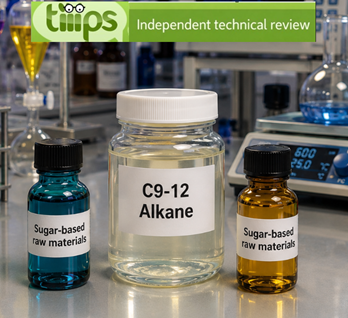
In other modern commercial grades, C9-12 Alkane may be marketed as naturally derived, bio-based, or as an alternative to volatile silicones. One commercial example is SilSense Bio 5 Emollient, indicated as C9-12 Alkane and described by the manufacturer as a volatile, biodegradable, naturally derived emollient suitable for skin care, sun care, hair care, and color cosmetics. These claims, however, are linked to the individual commercial grade and cannot be automatically generalized to the entire INCI C9-12 Alkane.
After production, the usual steps include purification, control of the boiling range, verification of volatility, color, odor, density, viscosity, flash point, and impurity profile. For cosmetic use, the absence or strict control of undesirable aromatic fractions, critical petroleum impurities, residual odor, and substances that may affect the safety classification of the raw material is particularly important.
Main compounds present
The commercial material consists mainly of C9-C12 alkanes, linear and/or branched depending on the production process and supplier specification. Since it is a technical mixture, there is no single molecular formula. Nonanes, decanes, undecanes, dodecanes, and related isomers may be present.
It is important to distinguish between C9-12 Alkane, C9-12 Isoalkane/Isoalkanes, and broader petroleum hydrocarbon mixtures. Although some sensory properties may be similar, regulatory compliance and toxicological assessment can vary greatly according to composition, origin, and documentation.
In the case of grades traceable to CAS numbers or petroleum substances included in entry 875, compliance must not be assumed: it must be supported by technical documents demonstrating complete refining and the absence of a carcinogenic profile in the substance from which the material is derived.
Identification data and specifications
| Characteristic | Value | Note |
|---|---|---|
| INCI name | C9-12 Alkane | cosmetic designation |
| Chemical category | saturated alkanes / light hydrocarbons | C9-C12 mixture |
| Chemical description | mixture of alkanes with 9-12 carbon atoms | no single formula |
| Molecular formula | not applicable as a single formula | technical mixture |
| Molecular weight | variable | depends on the C9-C12 distribution |
| CosIng Ref. | 55157 | reference reported by INCI databases |
| Cosmetic functions | solvent; hair conditioning; skin conditioning - emollient; skin conditioning - miscellaneous; skin conditioning - occlusive | to be verified according to regulatory/supplier source |
| Functions confirmed by COSMILE | skin conditioning - emollient; solvent | COSMILE describes the ingredient as a mixture of saturated alkanes |
| Possible critical reference | CAS 64742-46-7, if applicable to the grade | linked to Annex II/875 for hydrotreated middle petroleum distillates |
| Regulatory restriction to consider | Annex II/875 Reg. EC 1223/2009 | prohibited unless complete refining history and non-carcinogenicity are demonstrated |
| Technical origin | petrochemical, synthetic, or naturally derived depending on grade | to be verified on SDS/COA/supplier dossier |
| Food use | not relevant | not a food additive |
COSMILE describes C9-12 Alkane as a mixture of saturated alkanes and reports the functions skin conditioning - emollient and solvent. SpecialChem reports CosIng reference 55157 and describes the ingredient as a solvent useful for dissolving other ingredients and improving texture and spreadability.
Indicative physicochemical properties
| Characteristic | Indicative value | Note |
|---|---|---|
| Appearance | clear liquid | in fluid cosmetic grades |
| Color | colorless or almost colorless | important for make-up and skin care |
| Odor | low or almost absent | strongly dependent on purity |
| Water solubility | insoluble | hydrocarbon behavior |
| Compatibility with oils | good | useful in fatty phases and anhydrous systems |
| Density | about 0.75 g/cm³ | indicative value from technical sheets |
| Viscosity | about 1.4 cSt at 25 °C | very fluid liquid |
| Refractive index | about 1.415-1.435 | indicative technical data |
| Flash point | about 61-65 °C | requires attention as a raw material |
| Boiling range | about 140-220 °C | depends on carbon-chain distribution |
A technical sheet for a commercial C9-12 Alkane grade reports density of about 0.75 g/cm³, viscosity of about 1.40 cSt, refractive index 1.415-1.435, and flash point 61-65 °C; these values are useful as formulation references, but they do not replace the technical sheet of the grade actually purchased.
Cosmetics
In cosmetics, C9-12 Alkane is used mainly as a lipophilic solvent, light emollient, volatile carrier, skin conditioner, and, in some cases, as a support for hair conditioning. It helps disperse or dissolve lipophilic ingredients, improves formula uniformity, and can contribute to a smoother, fresher, less sticky texture.
It may appear in make-up, foundations, concealers, primers, sunscreens, eye products, sticks, hair products, light oil serums, dry oils, and silicone-alternative formulas. In make-up products it can support even application and pigment dispersion. In sunscreens it can help the spreadability of the lipophilic phase. In hair products it can give a lighter effect than heavy oils, contributing to softness, frizz control, and dry sensoriality.
The occlusive function should be interpreted with caution: C9-12 Alkane may contribute to a superficial lipid film and help reduce the feeling of dryness, but it is not a heavy occlusive like petrolatum, highly structured waxes, or very viscous oils. It is more accurate to define it as a light/volatile occlusive, with an effect that depends on the formula and the residual amount after evaporation.
Pros
It provides a light, dry, and silky touch, useful in make-up, sunscreens, hair care, and skin care.
It works as a lipophilic solvent for oily ingredients, esters, UV filters, pigments, and some oil-soluble actives.
It can improve spreadability, uniformity, and non-greasy feel.
It can contribute to skin conditioning as a light emollient.
In hair formulas it can contribute to softness, smoothness, and less heaviness compared with heavier oils.
It may perform a light occlusive function by forming or contributing to a superficial film.
In adequately documented grades, it can be used as a sensory alternative to some volatile silicones.
Because it is saturated, it is less prone to oxidation than many unsaturated lipids.
Cons
It is not a food ingredient and has no nutritional value.
It is not a dermatological cosmetic active: its function is mainly technical-sensory.
Since it is a mixture, composition and behavior may vary greatly between suppliers.
The possible connection with Annex II/875 makes it essential to verify origin, refining, and non-carcinogenicity of the starting substance.
If the material is of petroleum origin, the INCI name alone is not enough to consider it compliant: specific SDS, COA, and regulatory declarations are required.
The relatively low flash point compared with longer alkanes requires attention during production, storage, and transport.
Volatility can improve sensoriality, but may also reduce the residual emollient effect if the formula is not well balanced.
Not all grades are naturally derived, bio-based, biodegradable, or more sustainable.
Safety, regulatory aspects, and environment
From a cosmetic standpoint, C9-12 Alkane can be a low-concern ingredient when used in suitable, purified, compliant cosmetic grades and correctly assessed in the finished product. However, for this ingredient, safety must not be assessed only on the basis of the chemical family “saturated alkanes”: the decisive point is the traceability of the commercial grade.
Entry 875 of Annex II to the EU Cosmetics Regulation concerns Distillates (petroleum), hydrotreated middle, prohibited unless the full refining history is known and it can be shown that the substance from which they are produced is not carcinogenic. This point is essential because the entry is not equivalent to an absolute ban on every cosmetic alkane, but imposes a strong documentary condition for the petroleum fractions concerned.
In practice, to use C9-12 Alkane correctly in cosmetics, it is advisable to request at least the following from the supplier:
updated SDS;
certificate of analysis;
declaration of compliance with Regulation (EC) No 1223/2009;
clarification on the possible applicability of Annex II/875;
declaration on the complete refining history, if relevant;
evidence that the starting substance is not carcinogenic;
data on residual aromatics, impurities, origin, and CLP classification of the raw material.
As a raw material, some grades may have hazard classifications related to flammability, aspiration hazard, or the aquatic environment, typical of certain hydrocarbon mixtures. This mainly concerns industrial handling and does not automatically imply the same level of risk in the finished cosmetic product, but it must be considered during production.
From an environmental standpoint, the profile depends greatly on origin. A petrochemical grade, a synthetic grade, and a naturally derived grade may have different impacts. The label “silicone alternative” or “naturally derived” does not automatically mean better sustainability: data are needed on origin, biodegradability, volatility, emissions, aquatic impact, and fate of the finished product.
Conclusion
C9-12 Alkane is a useful cosmetic ingredient as a light solvent, volatile emollient, skin conditioner, hair conditioner, lipophilic carrier, and, in some formulas, a light occlusive. Its strength is the ability to lighten oil-based formulas, improve spreadability, and leave a drier, less greasy feel.
However, the correct assessment must be more cautious than a simple sensory description. The key point is the possible applicability of entry 875 of Annex II to the Cosmetics Regulation 1223/2009 for hydrotreated middle petroleum distillates. If the commercial grade is linked to this family or to relevant CAS numbers, its use is acceptable only if the supplier documents the complete refining history and demonstrates that the substance from which it derives is not carcinogenic.
In a well-designed formula and with a properly documented raw material, C9-12 Alkane can be a favorable and versatile ingredient. The points to check are origin, commercial grade, SDS, COA, Annex II/875 compliance, flash point, impurity profile, compatibility with pigments/filters/oils, and behavior in the finished product.

