



Plant-based lactic acid: properties, uses, pros, cons, safety
Definition
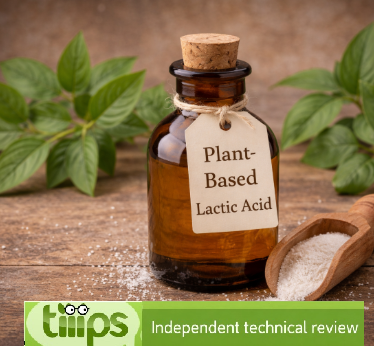
Plant-based lactic acid is an organic acid obtained through fermentation of plant-based carbohydrate-rich substrates, such as sugars or starches derived from corn, beet, sugar cane, cassava, or other plant matrices. Chemically, it corresponds to lactic acid (C₃H₆O₃), also known as 2-hydroxypropanoic acid, and in the food sector it is identified as E270.
From a practical point of view, the term “plant-based” mainly indicates the origin of the fermented substrate and the absence of animal-derived raw materials in production, rather than a chemical difference compared with lactic acid obtained from other sources. The final compound remains the same, while the supply chain, commercial positioning, and purity specifications may differ.
In food applications, plant-based lactic acid is used as:
an acidifier,
a pH corrector,
an acidity regulator,
a processing aid for sensory profile and, in some contexts, for the microbiological stability of the finished product.
Production process
The production process of plant-based lactic acid generally includes:
Selection of the carbohydrate-rich plant raw material.
Possible hydrolysis/saccharification of starches to obtain fermentable sugars.
Fermentation by selected microorganisms, which transform sugars into lactic acid.
Purification, with separation of biomass and impurities.
Possible concentration and standardization.
Packaging in liquid form or as a solution with a defined strength.
From an industrial point of view, the process is aimed at achieving high purity, batch stability, and compliance with food additive specifications.
Key controls concern:
purity,
concentration/strength,
possible distribution between L, D, or DL forms,
contaminants,
microbiological profile of the production process,
compliance with regulatory specifications.
Key constituents
Commercial plant-based lactic acid is generally a very simple matrix compared with other food ingredients, because it consists mainly of the active substance in an aqueous solution.
Lactic acid: main and functionally defining component.
Favorable aspect: provides acidity, regulates pH, and contributes to the sensory profile of the finished product.
Less favorable aspect: high doses may make the taste too aggressive or alter sensory balance.Water: often present as the carrier in commercial liquid forms.
Favorable aspect: facilitates dosing, mixing, and industrial use.
Less favorable aspect: the actual concentration of the product must always be considered in formulation.Lactate / ionized forms: present in equilibrium depending on pH and formulation.
Favorable aspect: they participate in the acid-base behavior of the matrix.
Less favorable aspect: their practical effect depends on the food system into which the acid is incorporated.Residual process impurities (generally very low, if the product is compliant):
Favorable aspect: if well controlled, they do not affect product functionality.
Less favorable aspect: quality depends on the effectiveness of purification and the supplier’s specification.
Important technical note
Lactic acid exists in L(+), D(-), or DL stereochemical forms. In food applications, specifications and use depend on product compliance and applicable regulations.
Identification data and specifications
| Characteristic | Value | Note |
|---|---|---|
| Ingredient name | Plant-based lactic acid | Lactic acid obtained by fermentation of plant substrates |
| Chemical name | Lactic acid / 2-hydroxypropanoic acid | Food additive E270 |
| Origin | Fermentation of plant raw materials | E.g. sugars or starches from plant sources |
| Nature | Organic acid | Often available as a liquid solution |
| Key component | Lactic acid | Main acidifying substance |
| Molecular formula | C₃H₆O₃ | Standard chemical data |
| Molecular weight | 90.08 g/mol | Standard chemical value |
| Allergen | No (intrinsically, typically) | Still verify supplier specification and supply chain |
| Calories | Generally negligible under normal technological use | Impact depends on dosage, usually low |
| Key parameters | Purity, concentration, pH, stereoisomerism, regulatory compliance | Quality and suitability drivers |
Indicative physicochemical properties
| Characteristic | Indicative value | Note |
|---|---|---|
| Physical state | Liquid (in the most common commercial forms) | Sometimes concentrated aqueous solution |
| Color | Colorless → slightly yellowish | Depends on purity grade |
| Odor | Weak / characteristic | Usually not strongly pronounced |
| Taste | Acidic | Clean, sharp |
| pH | Acidic | Strongly dependent on concentration |
| Water solubility | High / complete | Very easy to incorporate into aqueous systems |
| Stability | Good if properly stored | Must be protected according to supplier specification |
| Typical critical issues | Over-acidification, taste imbalance, corrosiveness on unsuitable surfaces | Depend on concentration and conditions of use |
Main uses
Food use
Plant-based lactic acid is used in many food applications, including:
beverages,
baked goods,
plant-based preparations,
sauces and dressings,
preserves and acidified products,
products where pH correction or stabilization is required.
It is used especially when a clean acidity, good solubility, and a raw material consistent with plant-based formulations or plant-origin supply chains are desired.
Industrial use
The main industrial drivers are:
consistent acidification,
ease of dosing,
high solubility,
predictability in formulation,
good integration into liquid or semi-liquid systems.
Nutrition and health
From a nutritional point of view, plant-based lactic acid is normally not used for caloric or plastic contribution, but for a technological function. Its practical effect on the consumer therefore depends mainly on the finished product in which it is included.
Pros
Very useful as an acidifier and pH corrector.
Easily integrated into many food matrices.
Can be consistent with plant-based formulations.
Generally used in limited technological amounts.
Cons
Excessive dosage may make the product too acidic.
Must be managed precisely in formulation in order not to alter the sensory profile.
The term “plant-based” does not automatically imply nutritional advantages compared with other chemically identical forms.
Portion note
Plant-based lactic acid is generally used in technological amounts, so the direct nutritional impact per serving is normally very low. Evaluation should always be made on the finished product.
Safety (allergens, contraindications)
Allergens: it is not typically considered a major intrinsic allergen; however, it remains important to verify the supplier specification and the supply chain.
Safety of use: it must be dosed correctly, because high concentration may compromise taste and compatibility with some matrices.
Quality and purity: the product must comply with the applicable regulatory specifications for food use.
Storage and shelf-life
Store in a tightly closed container, under conditions consistent with the supplier’s specification.
Key points:
avoid contamination during use,
close the container properly after use,
protect the product from conditions incompatible with declared stability,
use materials and equipment compatible with acidic products.
Labelling
On the label it may appear as:
lactic acid,
E270,
possibly, at commercial or technical level, plant-based lactic acid if the manufacturer wishes to highlight the origin of the supply chain.
Elements to evaluate:
consistency between commercial designation and technological function,
compliance with applicable additive regulations,
correct use of the designation in the finished product.
Functional role and rationale for use
Plant-based lactic acid is chosen to combine:
effective acidification,
pH control,
good solubility,
a generally clean acidic sensory profile,
compatibility with plant-based formulations or with requirements for plant-derived raw material origin.
In formulation it is mainly an ingredient with a technological function.
Formulation compatibility
The main points are:
dosage: strongly affects acidity and sensory perception;
final pH: central for stability and taste;
interaction with other matrix ingredients;
compatibility with liquid and semi-liquid processes;
attention to contact materials in the presence of acidic products.
Safety, regulation, and quality
GMP/HACCP management is recommended with control of:
purity,
concentration,
pH,
regulatory compliance,
absence of relevant contaminants,
traceability of raw material and batch.
For practical quality, the following are crucial:
batch consistency,
predictability of acidification,
good storage stability,
correct technical documentation.
Conclusion
Plant-based lactic acid is a functional ingredient widely used in food applications as an acidifier and pH regulator. Chemically, it corresponds to lactic acid (E270) and, when declared as “plant-based,” it mainly highlights the fermentative origin from plant-based substrates. Its practical value depends on purity, batch consistency, ease of dosing, and correct integration into the finished product.
Mini-glossary
Acidifier: ingredient that increases the acidity of a food matrix.
Acidity regulator: substance used to control or modify pH.
Fermentation: microbial process that transforms sugars into other compounds, such as lactic acid.
E270: code for lactic acid as a food additive.
L(+), D(-), DL: stereochemical forms of lactic acid.
GMP/HACCP: good manufacturing practices and food safety self-control system.

