



Durum wheat Russello semolina: properties, uses, pros, cons, safety
Definition
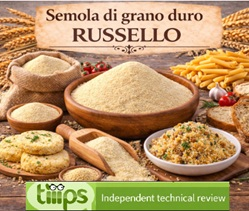
Durum wheat Russello semolina is a semolina obtained by milling durum wheat Triticum durum (botanical family Poaceae), specifically referring to the traditional Sicilian population/variety known as Russello. In practice, it is a semolina with a strong territorial and sensory identity, often appreciated for pronounced cereal-like notes and good performance in baked goods and pasta, although variability can occur depending on harvest year, growing area, and milling choices.
Compared with “standard” industrial semolina, Russello semolina may show greater variability in particle size, protein content, and rheological behavior. It contains gluten, therefore it is not suitable for people with celiac disease.
Production process
The production process of Russello durum wheat semolina generally includes:
Cleaning and selection of the grain (removal of foreign bodies, foreign seeds, dust).
Possible conditioning (adjusting grain moisture to optimize endosperm separation).
Milling of durum wheat with roller systems, progressive separation of endosperm and bran fractions.
Sifting/bolting and selection of semolina (the typical granular fraction), with possible standardization.
Packaging with moisture control and protection from oxidation/pests.
Key controls include moisture, ash, protein, gluten (quality/strength), particle size, cereal-chain contaminants, and storage stability (odor, absence of pests).
Key constituents
Russello durum semolina is a cereal matrix composed mainly of starch, with a significant presence of proteins (gluten), plus minor lipids, minerals, and vitamins in variable amounts.
Starch: quantitatively predominant component.
Favorable aspect: provides structure and an energy base; in pasta it contributes to texture and cooking performance.
Less favorable aspect: it remains a starchy base; metabolic impact depends on recipe and portion size.Durum wheat proteins (gluten): crucial for dough strength and, especially, for pasta.
Favorable aspect: support structure and “bite” (pasta) and provide strength in many processes.
Less favorable aspect: performance strongly depends on protein quality; some batches may require hydration and mixing adjustments.Mineral fraction (ash): linked to extraction rate and presence of more external grain particles.
Favorable aspect: contributes to a “richer” semolina profile.
Less favorable aspect: higher values may influence color and technological variability.Lipids (minor fraction, but present):
Favorable aspect: contribute to sensory profile.
Less favorable aspect: may increase sensitivity to oxidation during storage (especially if storage conditions are not optimal).Natural pigments (carotenoids, variable):
Favorable aspect: contribute to the typical straw-yellow to amber tone of many durum semolinas.
Less favorable aspect: may degrade with light/oxygen and prolonged storage.B vitamins (variable):
Favorable aspect: micronutrient contribution typical of cereal matrices.
Less favorable aspect: sensitive to storage and processing.
Identification data and specifications
| Parameter | Value | Note |
|---|---|---|
| Ingredient name | Russello durum wheat semolina | Semolina from Triticum durum “Russello” (supply chain/territory may affect the profile) |
| Botanical name | Triticum durum | Botanical family: Poaceae |
| Plant part | Caryopsis (mainly endosperm) | Semolina is obtained mainly from endosperm |
| Nature | Granular (semolina) | Coarser than flour, typical of durum wheat |
| Key components | Starch, proteins (gluten), ash/minerals, minor lipids | Variable profile by harvest year and milling |
| Allergen | Yes (gluten) | Not suitable for celiac disease |
| Calories | Indicatively ~330–370 kcal/100 g | Variable with moisture and specification |
| Molecular formula | Not applicable | Complex mixture |
| Molecular weight | Not applicable | Complex mixture |
| Key parameters | Moisture, ash, protein, gluten, particle size, microbiology | Quality and batch consistency drivers |
Indicative physicochemical properties
| Parameter | Indicative value | Note |
|---|---|---|
| Physical state | Semolina (granular) | Fine → medium depending on milling |
| Color | Straw yellow → amber yellow | Depends on pigments and ash |
| Odor | Cereal-like | Off-notes indicate improper storage |
| Water solubility | Not soluble | Forms dough; starch gelatinizes during cooking |
| Water absorption | Medium | Depends on protein, particle size, and starch damage |
| Rheological behavior | Variable | Gluten quality drives workability and strength |
| Stability | Good if dry and protected | Critical: moisture, pests, oxidation |
| Typical issues | Batch variability; dough too tenacious or too slack if not adjusted | Depends on supply chain and milling conditions |
Main uses
Food use
Russello durum wheat semolina is mainly used for:
Fresh pasta and, in some cases, artisanal dry pasta, with attention to hydration and mixing time.
Bread and baked goods based on durum wheat (loaves, rolls, flatbreads), often with a rustic sensory profile and strong crust development.
Traditional semolina-based preparations (regional doughs and typical baked goods).
Breadsticks, crackers, taralli and baked snacks, where semolina provides structure and crispness.
Industrial use
Main industrial drivers are consistency of particle size, stability of protein profile, and predictable performance in processing (mixing, forming, drying/baking).
Nutrition and health
Russello durum semolina is a cereal base with a predominant carbohydrate contribution and a significant protein fraction. Real nutritional evaluation depends on the finished product (pasta, bread, biscuits), the recipe, and the portion size.
Pros
Good suitability for pasta and many durum-wheat baked goods.
Often distinctive sensory profile, with noticeable cereal-like notes.
Can offer a supply chain with strong territorial identity, useful for product differentiation.
Cons
Contains gluten and is not suitable for celiac disease.
Possible batch variability (harvest year, area, milling), requiring process adjustments.
If poorly stored, it may lose sensory quality or develop oxidative off-notes.
Portion note
Portion should be assessed on the finished product (pasta or bread), considering the consumed amount, meal pairing, and consumption frequency.
Safety (allergens, contraindications)
Allergens: contains gluten (gluten-containing cereal).
Celiac disease: contraindicated.
Supply-chain quality: controls for typical cereal contaminants, microbiological load, and proper storage are important to avoid pests and deterioration.
Storage and shelf-life
Store in a cool, dry place, protected from light and heat, with the package tightly closed. Semolina is sensitive to moisture and pests: stock rotation and suitable packaging improve stability.
Labelling
On the label, it typically appears as “durum wheat semolina” or “Russello durum wheat semolina” (if the supply chain declares it). Allergen (gluten) information must be managed correctly.
Functional role and rationale for use
Russello durum semolina is selected to combine structure (pasta and doughs), sensory performance, and supply-chain identity. In professional applications, it is advisable to adjust hydration and mixing based on the batch (protein, particle size, water absorption).
Formulation compatibility
The main practical points are:
adjust hydration according to particle size;
manage mixing time to avoid overdeveloped or underbound doughs;
in breadmaking, consider blending with other flours to modulate volume and softness.
Safety, regulation, and quality
GMP/HACCP management with specifications for moisture, ash, protein/gluten, microbiology, and batch traceability. Clear specifications reduce technological variability and complaints.
Conclusion
Russello durum wheat semolina (Triticum durum, botanical family Poaceae) is a semolina with strong sensory identity and good suitability for pasta and durum-wheat baked goods. The main technical drivers are particle size, protein/gluten quality, hydration management, and proper storage.
Mini-glossary
Semolina: granular fraction obtained by milling durum wheat.
Caryopsis: cereal grain.
Ash: indicator of mineral fraction and extraction rate.
Gluten: protein complex influencing dough structure.
GMP/HACCP: good manufacturing practices and food safety self-control system.

