



Cellulose Acetophthalate: properties, uses, pros, cons, safety
Cellulose Acetophthalate, best known as Cellulose acetate phthalate is a chemical compound, one of tge most effective and most widely used polimers for pH controlled release.
The name defines the structure of the molecule:
- Cellulose is the basic molecule, a polysaccharide consisting of a linear chain of different hundreds or thousands of D-glucose units linked by β(1→4).
- Acetate refers to the acetyl groups attached to some hydroxyl groups in the cellulose molecule. The acetyl group is a functional group derived from acetic acid, with formula -COCH3.
- Phthalate refers to the phthalate groups attached to certain hydroxyl groups of the cellulose molecule. A phthalate group is a functional group derived from phthalic acid, with the formula -C6H4(COOH)2.
The synthesis process takes place in different steps:
- Preparation. Cellulose is a natural polymer found in the cell walls of plants. It can be extracted from wood or cotton pulp through a process involving the removal of non-cellulosic impurities, typically using a combination of mechanical and chemical treatments.
- Acetylation. Cellulose is reacted with acetic anhydride in the presence of a catalyst such as sulfuric acid. This process introduces acetate groups onto cellulose molecules, forming cellulose acetate.
- Phthalation. Cellulose acetate reacts with phthalic anhydride. This introduces phthalate groups onto cellulose acetate, forming cellulose acetate phthalate.
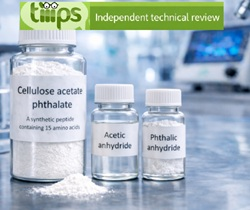
It occurs as a fine vwhite power.
What it is used for and where
Medical
An active pharmaceutical excipient, an anionic polymer composed of phthalic acid and acetate used in medicine to obtain sequential release of drugs, biomolecules, peptides and proteins and has a bacteriostatic effect (1), functions as a stabilizing agent in the preparation of Pseudolatex, a colloidal dispersion useful for encapsulation and controlled drug release.
It is used in oral tablets where it is allowed up to 70mg per tablet (2).
It also has a microbicidal and inactive HIV-1 effect, herpes simplex 1 and 2 and cytomegalovirus, Neisseria gonorrhoeae, Trichomonas vaginalis, Haemophilus ducreyi and Chlamydia trachomatis in vitro (3).
Cellulose Acetophthalate or Phthalate Cellulose Acetate has been used for decades as enteric coating films in oral pills, such as Aspirin. It has proven to possess a powerful antiviral activity and an efficacy against herpes (4).
It produces phthalic acid and acetic acid as hydrolysis products, it has a delayed action to acids (5).
Micronized, has proven to be the only microbial candidate with the ability to rapidly remove HIV-1 adsorption from physiological fluids and make the virus non-infectious (6). In addition, it did not interfere with the CD4 binding virus. Since CD4 is the primary cell receptor for HIV-1, it was interesting to study its HIV-1 binding and its consequences, including variations in glycoprotein gp41 conformation within viral particles (7).
Oral drug delivery is always the preferred form of delivery. The main problem with oral drug delivery is first pass metabolism. This becomes a major problem when drug needs to reach to the lower part of the gastrointestinal tract. To overcome this problem, targeted drug delivery systems are being developed. The aim of the research was to give a site and time controlled drug delivery to colon. To achieve this aim, a compression coated drug delivery system containing chitosan and cellulose acetate phthalate was designed and optimized (8).
A simple composite electrospun nanofiber of cellulose acetate phthalate (CAP)-polyethylene glycol (PEG) loaded with tetrahydrocurcumin (THC) was developed in this study, and the in vitro diffusion of THC was evaluated. The nanofibers were characterized by scanning electron microscopy, powder X-ray diffraction (PXRD), Fourier-transform infrared spectroscopy (FT-IR), and differential scanning calorimetry (DSC). The formulated nanofiber (NF) with THC has smooth morphology with diameter of around 300-500 nm. The complete entrapment and dispersion of THC was observed from the results of PXRD and DSC due to the loss of THC crystalline property. Further, FT-IR demonstrated that the vibration bands for the polymers used were dominant over the THC, and the vibrational bands of THC were not observed from the final formulation. The drug entrapment by the final CAP + PEG NF was found to be 95.5% with the high swelling index. From the in vitro release study, it was found that the formulated THC-loaded CAP + PEG NF has followed anomalous mechanism, demonstrating both diffusion and swelling controlled modes. The drug release extended up to 12 h with a final cumulative release of 94.24% (9).
Cosmetics
Film-forming agent. It produces, upon application, a very thin continuous film with an optimal balance of cohesion, adhesion and stickiness on skin, hair or nails to counteract or limit damage from external phenomena such as chemicals, UV rays and pollution.
Where to buy Cellulose acetate phthalate: Galeno.it Via Leopardi 17 59015 Carmignano Prato Italia
For information: toll-free number 800 913 346 Tel. +39 55 87 19 921 - 928 - 929
info@galeno.it
The most relevant studies on this chemical compound have been selected with a summary of their contents:
Cellulose acetate phtalate studies
Typical optimal characteristics of Cellulose acetate phthalate as commercial product :
| Appearance | White amorphous powder |
| Solubility (Turbidity) 5% solution in Acetone | Clear to slight opalescent |
| Solubility (Colour) 5% solution in Acetone | Colourless |
| Sulphated Ash | max. 0.1% |
| Acetyl content | 19 - 24% |
| Phthalyl content | 30 - 36% |
| Acidity (C8H6O4) | max. 3% |
| Water (KF) | max. 5% |
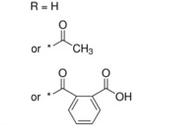
- Molecular Formula: C116H116O64
- Molecular Weight: 2534.12
- CAS: 9004-38-0
- MDL number MFCD00072769
- NACRES SB.52

