



Toasted whole wheat: properties, uses, pros, cons, safety
Definition
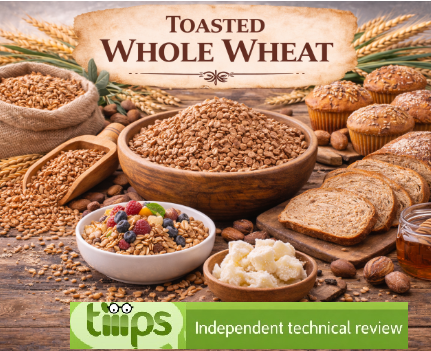
Toasted whole wheat consists of whole kernels of Triticum aestivum (family Poaceae) used in whole form (endosperm + bran + germ) and subjected to controlled toasting (more or less intense) before being used as such or before any subsequent milling. Compared with untoasted wheat, toasting lowers moisture, develops stronger cereal/toasted notes, and can partly modify technological functionality (e.g., behaviour during soaking or as inclusions). It contains gluten.
Production process
The supply chain includes cleaning and sorting the wheat (removal of foreign bodies and defective kernels), then toasting in continuous or batch ovens with defined time/temperature settings to reach the target colour and aroma. After toasting, rapid cooling follows, then optional cracking (cracked wheat) or milling if a specific particle size is required, and packaging in barrier materials. Critical controls include final moisture, toasting uniformity, broken fraction/dust, and sensory stability.
Key constituents
The matrix contains starch, wheat proteins (gliadins and glutenins, i.e., gluten), dietary fibre (bran), lipids (germ) and variable micronutrients. Toasting generates and intensifies aroma and colour compounds associated with browning reactions (Maillard-type), increasing nutty/caramel notes depending on intensity.
Practical note: germ presence maintains a lipid fraction that can undergo oxidation; overly intense toasting can increase bitter notes and reduce aromatic “cleanliness”.
For more information: Wheat
Identification data and specifications
| Parameter | Value | Note |
|---|---|---|
| Ingredient name | Toasted whole wheat | Supplied as kernels, cracked, or milled after toasting |
| Botanical name | Triticum aestivum | Family: Poaceae |
| Plant part | Whole caryopsis | Endosperm + bran + germ |
| Nature | Toasted cereal (solid) | Possible further processing into grits/flour |
| Key parameters | Moisture, toasting degree/colour, broken fraction/dust, microbiological load, oxidative stability, particle size (if milled) | Quality and consistency drivers |
| Allergen | Yes: gluten (wheat) | Not suitable for coeliac disease |
| Caloric value | Typically ~330–380 kcal/100 g | Depends on moisture and form (kernel/derivative) |
Physico-chemical properties (indicative)
| Property | Indicative value | Note |
|---|---|---|
| Physical state | Solid (kernels/grits/flour) | More brittle after toasting |
| Colour | Golden → brown | Increases with toasting intensity |
| Odour | Toasted cereal, nutty | Bitter notes suggest over-toasting |
| Water solubility | Insoluble | Soaking/cooking softens the kernel |
| Water uptake | Medium | Depends on kernel integrity and toasting |
| Stability | Good if dry and protected | Key risks: oxidation (germ), odour uptake |
| Typical criticalities | Aroma variability, dustiness, rancidity | Driven by batch and storage |
Main uses
Food
Used as an inclusion in muesli, granola, snacks and bars, crunchy toppings, and baked goods where a stronger “toasted cereal” note is desired. In some applications it can be rehydrated/cooked (as kernels or cracked) for grain salads and cereal-based dishes, although toasting influences time and sensory outcome. If milled after toasting, it can be used as an aromatic component in flour blends for bread and biscuits/cookies, giving a stronger signature than untoasted flours.
Industrial use
Used as a standardised inclusion for texture and flavour in breakfast cereals, bars, fillings and baked goods. Industrial drivers: toasting uniformity, moisture control, resistance to breakage during mixing, and flavour stability over shelf-life.
Nutrition and health
Compared with refined wheat products, the whole form retains more fibre and a higher share of micronutrients associated with the outer layers. However, it remains a carbohydrate-based ingredient containing gluten; overall impact depends on recipe and portion. Toasting mainly changes sensory profile rather than energy density, while it can affect starch digestibility depending on intensity and subsequent processing (soaking/cooking).
Pros
It retains whole grain fractions (more fibre than refined options) and delivers a toasted flavour profile useful for characterisation without added flavourings. In inclusions (muesli/bars) it enhances crispness and perceived complexity.
Cons
It contains gluten and is contraindicated for coeliac disease. If consumed in highly sweetened products (granolas/bars), the “health” profile can worsen due to the recipe. In addition, heavy toasting can introduce bitterness and reduce sensory acceptability.
Serving note
Serving size depends on use (cereal inclusion, bar, baked good). To assess impact, consider actual inclusion level in the finished product and overall composition (sugars, fats, fibre).
Safety (allergens, contraindications)
Allergen: gluten (wheat). Contraindicated for coeliac disease. Toasting reduces moisture and improves stability, but does not replace management of typical cereal contaminants, foreign bodies and pests. In industrial supply chains, moisture control and packaging are decisive to prevent flavour loss and oxidative defects.
Storage and shelf-life
Store in a cool, dry place, away from light and heat, tightly closed, with moisture and oxygen barrier protection. The ingredient is sensitive to moisture uptake (loss of crispness) and—due to germ presence—to oxidation over time. Stock rotation and controlled temperatures help preserve “clean” toasted notes.
Labelling
Declare “toasted whole wheat” (or equivalent wording) and highlight the allergen wheat/gluten. In composite products, ingredient order and any claims (“whole”, “toasted”) should be consistent with recipe and applicable requirements.
Functional role and rationale for use
Its main role is sensory and textural: it provides toasted notes and—when used as an inclusion—crunch and “cereal” identity. Whole grain fractions increase water uptake and “body” compared with refined inclusions. If milled, it can act as an “aromatic signature” in flour blends, although toasting may reduce some natural enzymatic activity and modify rheology compared with untoasted flours.
Formulation compatibility
In bars and cereals, compatibility depends on binder moisture: prolonged contact with wet phases reduces crunch; lipid coatings/barriers can help. In baked goods, the chosen particle size (kernels/cracked/flour) governs texture and handling: toasted flours tend to brown faster and deliver stronger aromas, requiring process tuning to avoid excessive darkening or bitterness.
Safety, regulatory and quality
GMP/HACCP management supports control of contaminants, traceability, foreign bodies and stability. Clear specifications for toasting degree (colour), moisture and oxidation reduce variability and waste, especially in industrial breakfast cereal and bar applications.
Conclusion
Toasted whole wheat (Triticum aestivum) is a whole-grain, gluten-containing ingredient designed to deliver toasted notes and crunchy texture in inclusions and blends. Key drivers are toasting uniformity, moisture control, oxidative stability (germ presence) and gluten allergen management. Nutritional value depends primarily on the finished product and the consumption context.
Mini-glossary
Maillard: reactions between reducing sugars and nitrogen-containing components that generate colour and toasted/caramel aromas.
Whole grain: retains bran and germ, with higher fibre and minerals than refined products.
Gluten: protein complex (gliadins + glutenins) providing dough structure.
Oxidation: lipid degradation causing rancid notes and flavour loss.
Particle size: kernels/cracked/flour size affecting hydration and texture.
GMP/HACCP: good manufacturing practices (GMP) and the hazard analysis and critical control points (HACCP) system for food safety.

