



Natural olive extract (Olea europaea)
Definition
Natural olive extract is derived from Olea europaea (family Oleaceae) and, in industrial practice, refers to a complex mixture obtained from a specific plant part (most often leaves, fruit, or pulp) through extraction with suitable solvents (water, ethanol, glycols, or hydro-alcoholic/hydro-glycolic systems), followed by filtration and standardization. Its functional composition is mainly driven by polyphenols (e.g., oleuropein and derivatives), with minor fractions (flavonoids, phenolic acids) and, depending on the starting matrix, residual lipid components.
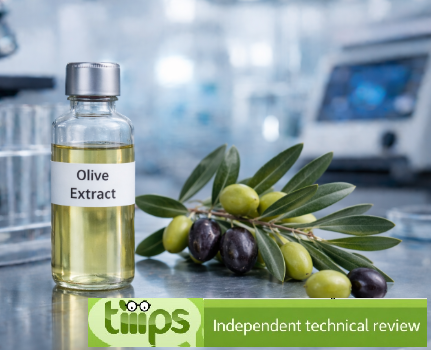
Uses span several fields: food (when the extract is food grade and standardized in polyphenols), cosmetics (skin conditioning and antioxidant support), medical/pharmaceutical (use as a support ingredient in non-medicinal products, where permitted and with suitable specifications), and industrial use (functional ingredient supply and “nature-based” formulations).
Production process
Production follows a typical botanical-extract scheme: selection and preparation of biomass (cleaning, controlled drying, milling), extraction with solvent (often under mild conditions to limit oxidative degradation), solid/liquid separation, clarification and concentration, then optional standardization (e.g., polyphenol/oleuropein content) and stabilization (pH adjustment, addition of hydro-glycolic carriers, compatible antioxidants, or preservatives, if included in the commercial grade). For cosmetic grades, supply as a solution in a carrier is common; for food grades, it may be supplied as a powder (spray-dried on a support) or as a concentrated liquid extract, according to the manufacturer’s specification.
Identification data and specifications
| Characteristic | Value | Note |
|---|---|---|
| Ingredient name (common use) | Natural olive extract | Commercial naming may vary |
| Botanical name | Olea europaea | Family: Oleaceae |
| Plant part | Leaves / fruit / pulp | Defines composition and functions |
| Nature | Complex botanical extract | Composition depends on process and standardization |
| INCI functions (indicative) | Skin conditioning; antioxidant support; skin protecting | Depends on plant part and extract type |
| Commercial form | Solution / concentrate / powder | Often a solution in a hydro-glycolic carrier |
| Typical specifications | Polyphenol or marker assay; microbiological limits; solvent residues | Common markers: oleuropein/derivatives, total polyphenols |
| CAS / EC number | Not unique | Depends on supplier definition and standardization |
| Caloric value | Not significant in cosmetic use | In food use depends on matrix and total solids content |
Physicochemical properties (indicative)
| Characteristic | Indicative value | Note |
|---|---|---|
| Physical state | Liquid (solution) or powder | Depends on commercial grade |
| Solubility | Variable; often good in aqueous phase with carrier | Glycolic grades improve miscibility |
| Stability | Good if protected from light/oxygen and with controlled pH | Sensitive to polyphenol oxidation and thermal stress |
| Formulation interactions | Possible sensitivity to electrolytes/polymers and preservative systems | May cause haze or color shifts |
| Key constituents (representative) | Polyphenols: oleuropein, hydroxytyrosol, tyrosol; flavonoids: luteolin, apigenin; phenolic acids: caffeic acid, ferulic acid | Actual profile depends on plant part and process |
| Variability note | Medium–high | Seasonality, origin, extraction method, and standardization influence it |
Main uses
Food
When produced as a food-grade material, olive extract is used as a functional ingredient intended to provide polyphenols or standardized phenolic fractions. Practical applications include supplements, beverages, and food matrices where an antioxidant contribution or a “botanical” positioning aligned with Mediterranean tradition is desired. Food formulation requires attention to taste/bitterness, oxidative stability, compatibility with pH, and the presence of metals (which can accelerate oxidation), as well as compliance with limits for solvents and contaminants.
Cosmetics
In cosmetics, natural olive extract is mainly used in leave-on products (serums, creams, light emulsions, eye contour) and in some mild rinse-off products, targeting skin conditioning and support for surface protection against oxidative stress. Practical performance depends on the extract type (leaves vs fruit), the carrier, and the formula’s ability to keep the polyphenolic fraction stable while avoiding darkening, off-odors, or loss of perceived activity.
INCI functions
Skin conditioning.
Medical and pharmaceutical
In medical/pharmaceutical contexts, the extract may appear as a support component in non-medicinal products or as a raw material for further processing, always subject to specifications, regulatory framework, and intended use. In these contexts, marker standardization, microbiological control, and traceability are critical.
Industrial use
Used as a “nature-based” ingredient in lines focused on botanical antioxidants, barrier systems, and functional complexes with humectants and film formers. In practice, the final outcome is often driven by commercial-grade quality and the management of oxidative stability throughout shelf-life.
Functional role and use rationale
The formulation value of natural olive extract derives primarily from its polyphenolic fraction, which can contribute to protection against superficial oxidative phenomena and to a better perception of more comfortable, well-cared-for skin. In cosmetics, the effect is typically more consistent with a support (co-active) role than with being a single performance “driver”, because the extract works synergistically with emollients, humectants, film formers, and barrier systems. Observed performance depends strongly on dose, stability within the matrix, packaging, and use conditions.
Formulation compatibility
Generally compatible with O/W emulsions and aqueous or hydro-glycolic gels, but it requires practical verification for pH (avoid extremes), presence of electrolytes and polymers that may cause haze, and compatibility with the preservative system. In transparent systems, the main criticality is managing clarity and color over time. In products containing metals or trace metals, it is useful to evaluate chelation strategies and barrier packaging to limit oxidation.
Pros and cons
Pros
Functional support based on polyphenolic fractions with a clear “natural” positioning.
Good versatility in cosmetics, especially in leave-on products aimed at skin feel and surface protection.
Possibility of standardization on markers (e.g., polyphenols/oleuropein) to improve reproducibility.
Cons
Intrinsic variability linked to origin, plant part, and process; without standardization, repeatability may be reduced.
Sensitivity to oxidation, with risk of color/odor changes and loss of perceived performance.
Formulation compatibility is not always straightforward in transparent or high-ionic-strength systems, with possible haze.
Safety, regulatory, and environment
Allergen
Not a typical fragrance allergen. However, as a botanical extract, it may contain traces of minor components that can trigger reactivity in predisposed individuals; tolerability should be evaluated on the finished product.
Contraindications
Use caution on very sensitive or compromised skin, especially in high-percentage leave-on products and in potentially unstable formulas (haze/precipitation), because instability can worsen comfort and potential irritation.
Regulatory/claim note
Claim coherence (e.g., “antioxidant”, “protective”) depends on standardization, use level, and the technical evidence available for that specific commercial quality within the finished matrix. The safety assessment of the finished cosmetic product remains central under the applicable regulatory framework.
Formulation troubleshooting
Darkening over time: reduce oxidative stress (barrier packaging, metal control), optimize pH, and evaluate compatible chelating systems.
Haze in gels/solutions: review carrier and order of addition, modulate electrolytes, verify compatibility with polymers and preservatives.
Off-odor: batch quality control, oxidative management, and review of the stabilization system of the commercial grade.
Cultivation
Olea europaea is a species typical of the Mediterranean basin, cultivated in environments with good sunlight exposure and well-drained soils. Biomass quality (leaves or fruits) may vary depending on cultivar, season, and agronomic practices, factors that influence polyphenol composition and therefore extract variability.
Conclusion
Natural olive extract (Olea europaea) is a multifunctional botanical raw material whose practical value depends primarily on plant part, extraction process, and marker standardization of phenolic fractions. In cosmetics it fits coherently as a skin conditioning ingredient and as support for surface-level protection, but to achieve stable and reproducible results it is essential to control commercial-grade quality, oxidative stability, compatibility with pH/electrolytes/polymers, and packaging choice. Final assessment must always be performed on the finished product, verifying stability, sensoriality, and tolerability as a function of concentration and formulation matrix.
Mini-glossary
INCI: International nomenclature used to declare cosmetic ingredients on product labels.
Carrier: vehicle (often hydro-glycolic) that solubilizes and stabilizes the extract and facilitates dosing.
Polyphenols: family of plant phenolic compounds with potential antioxidant contribution.
Standardization: definition of an assay/marker to reduce batch-to-batch variability and make performance more predictable.

