



Ethyl vanillin: properties, uses, pros, cons, safety
Ethyl Vanillin is a synthetic aromatic compound (“vanillin-like”) used in cosmetics mainly as a fragrance ingredient to deliver a sweet, vanilla-like, rounded profile. In formulation, it has a practical role in improving olfactory pleasantness, masking undesirable base notes from raw materials (e.g., surfactant bases, certain actives with characteristic odors), and increasing the sensorial acceptance of the finished product.
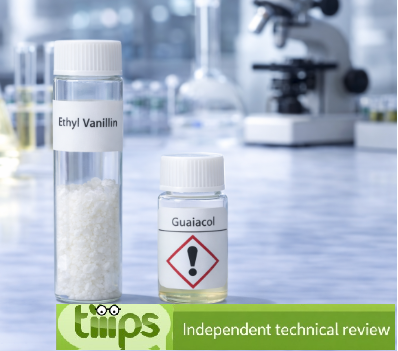
Definition
Ethyl Vanillin is an aromatic phenolic aldehyde (a substituted benzaldehyde-type structure) with higher odor potency than vanillin. In cosmetics it is typically used at low levels, either within a fragrance or as a character note to build gourmand/creamy profiles or to “soften” floral/woody accords.
Production process and key constituents
Ethyl Vanillin is a synthetic aromatic compound, used primarily as a flavor/fragrance material (more intense than natural vanillin).
How it is produced (in brief)
It is obtained via chemical synthesis, not by extraction from vanilla. The most common industrial route involves:
the ethylation of an aromatic phenolic precursor,
followed by a controlled oxidation to obtain the final aromatic aldehyde (ethyl vanillin).
Ingredients / raw materials used
In simplified terms, the process uses:
Guaiacol or similar aromatic phenolic compounds (petrochemical- or lignin-derived)
Ethylating agents (to introduce the ethoxy group)
Oxidizing agents
Catalysts and process solvents (removed from the final product)
Key note
The final product is chemically identical regardless of the origin of the raw materials, and it is standardized for food, cosmetic, and pharmaceutical use.
Main uses
Cosmetics
Primary use as a fragrance component in leave-on and rinse-off products (cleansers, body products, some make-up bases and fragranced skincare), where a perceivable and stable odor is desired, or where base odors need to be covered.
INCI functions
Fragrance. It plays a very important role in the formulation of cosmetic products as it provides the possibility of enhancing, masking or adding fragrance to the final product, increasing its marketability. It is able to create a perceptible pleasant odour, masking a bad smell. The consumer always expects to find a pleasant or distinctive scent in a cosmetic product.
Soothing. Ingredient with the task of restoring moisture to the skin, helping in the healing process of irritation, inflammation and skin disorders.
Industrial use
Raw material for perfumery/fragrances and, more broadly, as an odor-masking ingredient in various consumer applications (depending on internal manufacturer policies and the applicable sector regulations).
Identification data and specifications
| Characteristic | Value | Note |
|---|---|---|
| Name | Ethyl Vanillin | Common use name |
| CAS number | 121-32-4 | Substance identifier |
| EC number (EINECS) | 204-464-7 | EU identifier |
| Molecular formula | C9H10O3 | Pure substance data |
| Molecular weight | 166.17 g/mol | Indicative value |
| Main function | fragrance | Improves/masks odors, shapes the fragrance profile |
| Other reported function | soothing | To be interpreted as sensorial comfort |
Chemical-physical properties (indicative)
| Characteristic | Indicative value | Note |
|---|---|---|
| Physical state | crystalline solid (powder) | Typical of the pure substance |
| Color | white / off-white | Grade and batch dependent |
| Odor | sweet, vanilla-like, creamy | Character note |
| Water solubility | low | Typical of relatively low-polarity aromatics |
| Solubility in organic solvents | good | Typically compatible with ethanol and fragrance solvents |
| Melting point | ~76 °C | Indicative, useful for processing |
| Stability | generally good, but sensitive to light/air over time | Manage via packaging and, if needed, fragrance antioxidants |
Functional role and mechanism of action
The action is mainly sensorial: Ethyl Vanillin contributes to the olfactory phase of the product and improves the user experience. As a masking note, it reduces the perception of undesirable base odors. The “soothing” function should be interpreted as support to perceived comfort, typically achieved indirectly through the overall sensorial experience, not through a pharmacological action.
Formulation compatibility
Ethyl Vanillin is often easier to handle in systems with an appropriate fragrance vehicle (ethanol, suitable solvents, fragrance bases). In emulsions or cleansers it may require correct solubilization to prevent haze or separation, depending on the surfactant system and concentration. Olfactory stability depends on pH, presence of oxidants, and storage conditions.
Pros and cons
Pros
Intense, recognizable vanilla-like odor even at low levels.
Useful to mask base odors and improve finished-product pleasantness.
Versatile across many olfactory families (gourmand, creamy, powdery, soft woody).
Cons
If overdosed it can become overly sweet or intrusive and weigh down the fragrance profile.
May require attention to solubility in aqueous systems.
As a concentrated raw material, it should be handled with good safety practices to avoid irritation (especially eyes).
Safety, regulatory, and environmental aspects
When handling the neat substance, some SDS classify hazards mainly related to eye irritation. In cosmetics, use levels are typically far lower than the neat material, but safety must always be assessed on the finished product and the intended use context.
Allergen.
It is not typically included among the classic “fragrance allergens” of the historical EU labeling list; however, as with many odorants, irritation or sensitization cannot be excluded in predisposed individuals depending on dose and matrix.
Regulatory attention.
For fragrance use, it is standard practice to follow IFRA guidance and supplier documentation (IFRA statement and specifications), especially when the ingredient is used within a complex fragrance.
Formulation troubleshooting
Odor too strong or overly gourmand.
Action: reduce dose; balance with fresh or woody notes; adjust the fragrance base.
Haze in aqueous or cleansing formulas.
Action: review the solubilizer; optimize order of addition; consider a pre-solubilized vehicle/fragrance.
Olfactory instability over time.
Action: improve packaging barrier; control light and headspace; evaluate fragrance antioxidants and base compatibility.
Conclusion
Ethyl Vanillin is a widely used perfumery raw material in cosmetics to deliver a sweet vanilla-like profile and for odor masking. It is technically effective, but requires correct dosage balancing and appropriate solubilization and stability management within the system. Safety must be evaluated on the finished product, with appropriate handling practices for the concentrated material.
Mini-glossary
Odor masking. The perceived reduction of base odors through notes that cover or harmonize the accord.
IFRA. A voluntary reference standard for the safe use of fragrance ingredients across product categories.

