



Agaricus blazei Murrill extract: properties, uses, pros, cons, safety
(Agaricaceae)
Extract of Agaricus blazei Murrill (often indicated as ABM) is a preparation obtained from fungal material (in practice: fruiting body and/or mycelium, depending on the manufacturer) through aqueous or hydroalcoholic extraction, followed by concentration and drying. In the food sector it is mainly used in dietary supplements positioned as “functional”, where the key technical aspects are standardization, contaminant control, and batch-to-batch repeatability.
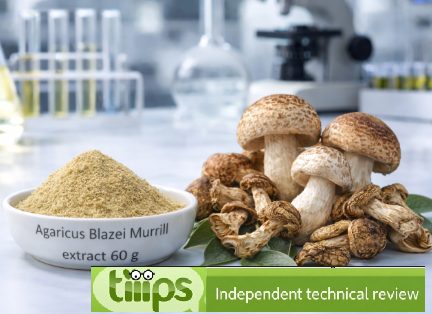
Operational taxonomic note: in the market, “Agaricus blazei” is often used to refer to strains also marketed as Agaricus subrufescens (synonymy and usage are not always consistent). Practically, for a robust dossier what matters is what is declared in the technical sheet/SDS, including the part used and strain traceability.
Definition
It is a variable-composition mixture: not a single molecule, but a set of constituents extracted from the fungal matrix. Final composition depends on:
Part of the fungus used (fruiting body vs mycelium).
Extraction system (water, hydroalcoholic, temperature/time conditions).
Raw material/solvent ratio and concentration/drying process.
Any standardization to markers (e.g., total polysaccharides or β-glucans, where declared).
Operationally, performance in a formula depends mainly on the commercial grade: flowability (powders), solubility/haze (liquids), colour/odour, and microbiological limits.
Main uses
Food.
Used as an ingredient for dietary supplements (powders, capsules, tablets, liquid extracts) with a “mushroom/functional” positioning, often associated with polysaccharides and mushroom fractions. Technical robustness requires marker definition and specifications for contaminants (metals, pesticides where applicable, mycotoxins where relevant for the supply chain) and microbiology.
Cosmetics - INCI Functions.
Skin conditioning agent. It is the mainstay of topical skin treatment as it has the function of restoring, increasing or improving skin tolerance to external factors, including melanocyte tolerance. The most important function of the conditioning agent is to prevent skin dehydration, but the subject is rather complex and involves emollients and humectants that can be added in the formulation.
Key constituents
Composition is process-dependent. In practical terms, constituents most often cited for Agaricus extracts include:
Cell-wall polysaccharides (including β-glucans and related fractions).
Lipid/sterol components (e.g., ergosterol and derivatives, depending on material and process).
Proteins/peptides and minor phenolic fractions, grade-dependent.
For formulators, the main operational focus is: declared markers (if present), moisture profile, flowability, and contaminant controls.
Nutritional use note and bioactive compounds
In the supplement context, interest is linked to structural mushroom components (polysaccharides/β-glucans) and minor fractions, but variability is high. For a technically defensible positioning, over-generalization should be avoided: what matters is actual dose, standardization, and coherence of finished-product documentation.
Energy (calories)
At typical supplement use levels (mg to low g/day), the energy contribution is generally negligible and is not an operational primary parameter compared with quality, purity, and contaminant control.
Identification data and specifications
| Caratteristica | Valore |
|---|---|
| Name (common use) | Extract of Agaricus blazei Murrill (ABM) |
| Family | Agaricaceae |
| Raw material (typical) | Fruiting body and/or mycelium (grade-dependent) |
| Substance type | Variable-composition extract (mixture) |
| Standardization (possible) | Total polysaccharides and/or β-glucans, if declared by the manufacturer |
| Molecular formula | Not applicable (mixture) |
| Molecular weight | Not applicable as a single value (mixture) |
| Taxonomic note | In commerce it may be associated with strains also labelled as Agaricus subrufescens; verify technical sheet/SDS |
Indicative physico-chemical properties
| Caratteristica | Valore indicativo | Nota |
|---|---|---|
| Appearance | Powder / liquid extract | Depends on carrier and process |
| Solubility | Variable | In water, hazy/colloidal systems are common; verify technical sheet |
| Hygroscopicity | Possible | Impacts flow and caking; barrier packaging can help |
| Light/oxygen stability | Variable | Possible organoleptic drift; accelerated tests recommended |
| Thermal stability | Sensitive to prolonged stress | Validate if used in thermal processes or beverages |
| Critical parameters | Moisture, microbiology, markers (if present), contaminants | Main drivers of quality and repeatability |
Functional role and practical mechanism of action
In supplements, the role is that of a “functional mushroom” ingredient where perceived performance and technical defensibility depend on standardization and quality. From a formulation standpoint, the main impact concerns matrix behaviour (solubility/haze), stability, and per-serving dose consistency.
Formulation compatibility
In powders and tablets, key issues are flowability, blend uniformity, and moisture control. In liquids, haze, sedimentation, and time stability become central; it is often useful to define an appearance target (clarity vs opalescence) and validate it in real packaging. In all cases, supplier variability makes a specification with markers and acceptance criteria essential.
Use guidelines
Dose depends on grade and product positioning. Good practice includes: defining markers and specifications, controlling microbiology and contaminants, validating accelerated stability and final packaging performance, and setting organoleptic (odour/colour) and physical (flowability or suspension behaviour) acceptance criteria.
Quality, grades, and specifications
Variability across grades can be significant. Robust control includes: identity and traceability of the raw material (species/part/strain), standardization (if intended), microbiological limits consistent with dosage form, and contaminant control (heavy metals; agricultural residues where applicable; targeted evaluation of supply-chain risks). Adoption of GMP (good manufacturing practice; benefit: reduces variability and contamination) and HACCP (hazard analysis and critical control points; benefit: identifies and controls food-safety risks) supports traceability and repeatability.
Safety, regulatory, and environment
Safety must be assessed on the finished product considering dose, duration of use, and target population. For mushroom extracts, practical topics include: microbiological quality, contaminants, and compositional variability. In the EU, regulatory status may depend on the part used (e.g., mycelium vs fruiting body) and the history of consumption; for some preparations, public documents consider them novel food when a significant history of consumption before 15 May 1997 is not demonstrated.
Allergen.
Not typically classified as a labelling allergen, but individual allergic reactions to mushrooms or to process residues are possible.
Contraindications (brief).
Use caution in individuals with liver disease or on therapies with potential hepatotoxicity: case reports of severe liver injury have been described in oncology patients taking Agaricus extracts in complex therapy contexts; causality is not always unequivocal, but warrants prudence. Prudence is also appropriate in immunosuppression or chronic therapies, with professional evaluation for continuous use.
Formulation troubleshooting
Haze/sedimentation in liquids.
Action: define an appearance target, optimize dispersion and viscosity, evaluate a grade with different particle size or extraction process, and validate with accelerated stability testing.
Powder caking and poor flowability.
Action: control moisture, use barrier packaging, optimize particle size and storage conditions.
Perceptible batch-to-batch variability.
Action: strengthen marker and contaminant specifications, introduce incoming controls, and qualify suppliers with more standardized processes.
Conclusion
Extract of Agaricus blazei Murrill (ABM) is a variable-composition raw material mainly used in supplements. Robust use depends on: clear raw material identity (species/part/strain), standardization (if intended), contaminant and microbiology control, and stability validation in the finished formula. The safety section warrants a prudent approach, including a concise note on individual allergenicity and attention to liver-related concerns reported in specific literature contexts.
Mini-glossary
β-glucans. Polysaccharides of the fungal cell wall often used as standardization markers, with variability linked to species and process.
Novel food. Food/ingredient without a significant history of consumption in the EU before 15 May 1997, subject to an authorization procedure.
GMP. Good manufacturing practice; benefit: reduces variability and contamination through controlled manufacturing practices.
HACCP. Hazard analysis and critical control points; benefit: systematic prevention and control of food-safety hazards through critical control points.

