



Agaricus blazei Murrill: properties, uses, pros, cons, safety
(Agaricus subrufescens)
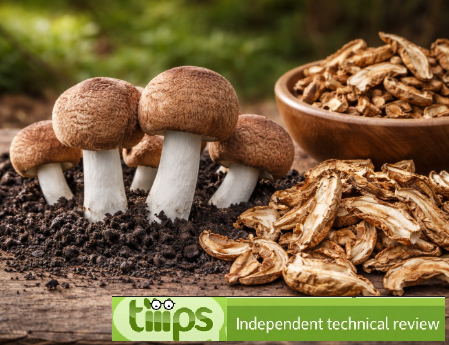
“Agaricus blazei Murrill” is a widely used commercial and popular-science name for a mushroom cultivated as a functional food; in modern taxonomy, however, it is often considered a misapplied name and is commonly referred back to Agaricus subrufescens (usage synonyms include Agaricus brasiliensis and, in some sources, A. rufotegulis). It is also known as the “almond mushroom” (almond-like odour) and, in Japan, “himematsutake.” It is a basidiomycete in the Agaricaceae family, with a fruiting body that is edible for most consumers.
Botanical framework
Kingdom: fungi
Phylum: basidiomycota
Order: agaricales
Family: agaricaceae
Genus: agaricus
Species (current taxonomic reference): agaricus subrufescens
Nomenclatural note: “agaricus blazei murrill” is frequently treated as a commercial designation or a historically applied name for this taxonomic complex.
Mushroom characteristics
Ecology: saprotrophic; grows on litter and decomposing organic matter; under cultivation it requires composted substrates and controlled conditions.
Fruiting body: fleshy cap with a cuticle often described as fibrillose/squamulose; free gills; chocolate-brown spore print typical of the genus Agaricus.
Sensory profile: odour/aroma often described as “almond-like” in many descriptions of the taxon.
Variability: morphology and yield are influenced by strain and cultivation conditions; the literature highlights notable phenotypic variability.
Chemical composition and structure
Composition depends on the matrix (fruiting body vs mycelium), strain, substrate, and processing (drying, aqueous or hydroalcoholic extraction, standardisation). The main classes and representative molecules reported for A. subrufescens / “A. blazei” are summarised below.
Structural and immunomodulatory polysaccharides (cell wall): β-glucans, typically β-(1→3) with β-(1→6) branching (a recurring pattern in fungal polysaccharides), often cited as a key fraction for “biological response modifier” activity; proteoglycans and polysaccharide–protein complexes are also reported in some studies as bioactive fractions, depending on extraction method.
Sterols and steroid-like derivatives: ergosterol, a typical fungal sterol frequently listed among major lipophilic constituents; blazein, a steroid/ergostane-type compound isolated and studied in cellular models, described in chemical databases as an ergostane-related sterol.
Natural hydrazines in the genus Agaricus: agaritine, a characteristic compound of several Agaricus species; for A. subrufescens, the literature discusses the need to consider safety aspects related to agaritine and derivatives, also as a function of processing (cooking/drying) and dose when taken as extracts.
Lipids and fatty acids: linoleic acid is frequently detected in mushroom lipid profiles and is also reported in work on “A. blazei”; other complex lipids and monoacylglycerols are described in compound-isolation studies, with strong dependence on matrix and analytical approach.
Phenolics and small polar molecules: phenolic compounds (broad category) are often mentioned in reviews as part of the hydrophilic fraction; the detailed profile varies substantially across studies and extraction procedures.
Uses and benefits
Food use: consumed as an edible mushroom (fruiting body) and as powder/extract in functional products.
Immune support (marketed claims): many products are promoted for immune modulation; clinical evidence is heterogeneous and strongly dependent on preparation (mycelium vs fruiting body), dose, and standardisation.
Biomedical research: reviews and studies (preclinical and some clinical) address possible immunomodulatory effects and inflammatory parameters; interpretation requires caution due to differences among extracts and study designs.
Applications
Supplements and functional products: capsules/powders/extracts (often aqueous) with variable standardisation; some products are multi-mushroom blends.
Research and quality control: quantification of polysaccharides (β-glucans), sterol profile (ergosterol), and specific markers; assessment of contaminants and microbiological standards according to supply chain requirements.
Traditional and modern food use: used as food and as a dehydrated ingredient in preparations, with meaningful differences between “whole mushroom” products and concentrated extracts.
Cultivation
Substrate and technique: cultivation on compost (a model similar to other Agaricus species), with mycelial incubation followed by controlled fruiting.
Critical variables: strain selection, compost quality, temperature, humidity, and aeration; these factors influence yield and metabolite profile.
Plant part used: fruiting body for food; mycelium for certain powders/extracts, with a chemical profile not directly overlapping with the fruiting body.
Environmental and safety considerations
Allergens and tolerability: as with other edible mushrooms, it may cause reactions in sensitive individuals; some sources describe the possibility of allergic responses in a minority of consumers.
Liver: clinical case reports and discussions exist regarding possible hepatic events associated with “A. blazei” products (often in supplement contexts); causality assessment can be complex (multi-ingredient products, comorbidities, extract variability).
Agaritine: safety considerations also apply to agaritine and derivatives; available data often distinguish between traditional food consumption and intake of concentrated extracts.
EU regulatory aspects (mycelial form): European documents have highlighted the distinction between fruiting body with a history of use and dried mycelium powder, for which novel-food qualification has been discussed when an equivalent consumption history is not established.
Good practice: prefer products with traceability, contaminant controls (microbiology, metals, pesticides), and clear labelling of the utilised material (fruiting body vs mycelium) and standardisation.
Synonyms
agaricus blazei murrill (commercial usage name)
agaricus subrufescens (taxonomic reference)
agaricus brasiliensis (usage synonym)
himematsutake; “almond mushroom”

