Euphorbia cerifera (Candelilla)
La candelilla è una pianta arbustiva semisucculenta del genere Euphorbia (famiglia Euphorbiaceae), tipica di aree aride e semi-aride tra Messico settentrionale e Stati Uniti sud-occidentali. In tassonomia moderna, Euphorbia cerifera è comunemente trattata come sinonimo di Euphorbia antisyphilitica; in ambito industriale e commerciale, entrambe le denominazioni sono usate in relazione alla cera di candelilla, una cera vegetale dura che ricopre fusti e parti aeree con funzione protettiva contro la disidratazione.
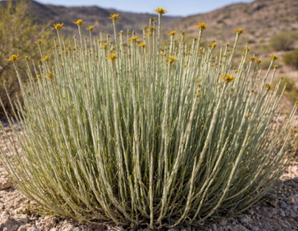
Inquadramento botanico
Caratteristiche della pianta
Portamento: arbusto o suffrutice con fusti sottili, eretti e densamente cespugliosi; aspetto “quasi afillo” (foglie ridotte o poco evidenti in molte fasi).
Superficie cerosa: fusti e parti aeree sono ricoperti da uno strato ceroso evidente, prodotto come barriera fisica contro evaporazione e stress ambientali.
Habitat: ambienti aridi, suoli poveri e drenanti, forte insolazione, escursioni termiche marcate.
Riproduzione e crescita: sviluppo lento-moderato in condizioni desertiche, con produzione di cera favorita da stress idrico e radiazione elevata.
Composizione chimica e struttura
La “cera di candelilla” è una miscela complessa di frazioni lipidiche ad alto peso molecolare. La composizione varia in funzione di area di raccolta, stagione, età della pianta e grado di raffinazione.
Idrocarburi lineari (n-alcani): frazione generalmente dominante; catene tipiche C29–C33.
Componenti rappresentativi degli n-alcani: nonacosano (C29), n-hentriacontano (C31) spesso indicato come componente principale, tritriacontano (C33).
Esteri cerosi ad alto peso molecolare: esteri di alcoli e acidi grassi a lunga catena, responsabili di parte della durezza e della coesione del film.
Acidi grassi liberi: frazione acida che contribuisce a comportamento reologico e interazioni con oli e burri in formulazione.
Alcoli grassi liberi: alcoli a lunga catena che partecipano alla struttura cristallina della cera.
Resine e frazione triterpenica: quota resinosa associata a esteri triterpenici e composti triterpenici pentaciclici; contribuisce a adesività, lucentezza e “tack” della cera.
Distribuzione percentuale indicativa: spesso descritta come prevalenza di idrocarburi, seguiti da esteri, frazione resinosa e quote minori di acidi e alcoli liberi; i valori esatti dipendono dallo standard considerato e dalla raffinazione.
Usi e benefici
Funzione tecnologica: cera vegetale dura usata per aumentare consistenza, punto di fusione operativo, stabilità termica e lucentezza di miscele lipidiche.
Alternativa vegetale: spesso impiegata come alternativa o coadiuvante rispetto a cera d’api e altre cere naturali, in formulazioni “vegan”.
Proprietà di barriera: forma un film continuo con effetto protettivo e riduzione della perdita d’acqua nelle matrici cosmetiche e in alcune applicazioni alimentari.
Applicazioni
Cosmetica: rossetti, stick, lip balm, mascara, prodotti anidri e W/O, cere per capelli, balsami solidi; impiego per struttura, scorrevolezza, lucentezza e stabilità.
Alimentare: agente di rivestimento e lucidante; impiego come additivo E902 in specifiche applicazioni (glazing).
Farmaceutica e parafarmaco: basi cerose e stick, rivestimenti protettivi, sistemi semisolidi dove serve un elevato contributo strutturante.
Industriale: lucidanti, cere protettive e formulazioni dove è utile una cera dura con buona compatibilità in miscele.
Coltivazione
Ambiente: coltivazione/gestione tipica di aree aride con pieno sole e forte drenaggio.
Suolo e acqua: preferisce suoli poveri e drenanti; irrigazioni limitate, evitando ristagni.
Gestione della biomassa: la resa in cera è legata a condizioni ambientali e a pratiche di raccolta/gestione delle parti aeree, con attenzione alla rigenerazione delle piante.
Considerazioni ambientali e di sicurezza
Pianta (lattice): come molte Euphorbia, può produrre lattice irritante; il contatto con pelle e soprattutto occhi può causare irritazione significativa.
Cera di candelilla: generalmente considerata idonea per usi cosmetici e alimentari secondo standard applicabili; in soggetti sensibili può comunque contribuire a irritazioni da contatto in formulazioni ad alta percentuale o in caso di pelle reattiva.
Allergeni e sensibilizzazioni: non è tipicamente classificata come allergene primario, ma sono possibili reazioni individuali; in cosmetica si gestisce con buone pratiche formulative e valutazioni di sicurezza del prodotto finito.
Aspetti ambientali: filiere basate su raccolta in aree desertiche richiedono gestione responsabile della risorsa vegetale e pratiche di prelievo che evitino depauperamento locale.
Bibliografia__________________________________________________________________________
Ekakitie, E. (2024). EUPHORBIA CERIFERA CERA (CANDELILA) EMOLLIENT PROPERTIES, USES AND EFFECTIVENESS IN SKINCARE PRODUCTS. Journal of Knowledge Learning and Science Technology ISSN: 2959-6386 (online), 3(3), 225-234.
Abstract. Candelila wax, derived from Euphorbia cerifera cera, is a natural and sustainable component that has a wide range of uses in cosmetic products. This review article explores the chemical composition, extraction techniques, and attributes of Candelila wax, with a focus on its distinctive qualities that make it highly useful in the cosmetic business. Candelila wax has been extensively studied and researched, and these studies have shown that it is highly useful in skincare. It has been found to provide significant benefits in terms of moisturizing the skin, protecting it, and improving the function of the skin barrier. The emollient and moisturizing qualities of this substance enhance skin hydration, while its film-forming capacity creates a protective barrier against environmental stresses. In addition, the non-comedogenic properties and potential anti-inflammatory effects of Candelila wax make it highly suitable for a range of skin types, including those that are sensitive or prone to acne. The future outlook for Candelila wax in cosmetics entails investigating the potential benefits of combining it with other natural substances, creating new and advanced methods of delivering it, and embracing sustainable methods of sourcing and processing. By conducting meticulously planned clinical trials, the effectiveness and safety of the substance may be verified, thereby establishing robust scientific proof for its use in skincare products. By recognizing the possibilities of Candelila wax, we may explore environmentally responsible and skin-conscious cosmetic procedures that align with the changing tastes of mindful customers. By utilizing the potent properties of this natural substance, the cosmetic industry can lead the path towards a more environmentally friendly and enduring future in the field of skincare products.
Hong, X., Zhao, Q., Chen, J., Ye, T., Fan, L., & Li, J. (2022). Fabrication and characterization of oleogels and temperature-responsive water-in-oil emulsions based on candelilla (Euphorbia cerifera) wax. Food Chemistry, 397, 133677.
Abstract. Developing novel fats with zero trans and low saturated fatty acids represents a research hotspot in the colloid field today. Herein, natural candelilla (Euphorbia cerifera) wax was used as an oleogelator to construct oleogel systems, and can make strong oleogels at low concentrations (3 wt%). These oleogels were further employed as continuous phases to fabricate surfactant-free W/O emulsions with excellent stability (at least 30 days). Microstructural observation confirmed that the stability of emulsions was attributed to the interface and bulk phase crystallization of wax. All oleogels and emulsions were pseudoplastic fluids whose gel properties could be tuned via regulating oleogelator concentration. Water content also influenced the emulsion rigidity, denoting the droplets acted as “active fillers”. Additionally, the emulsions displayed a temperature-responsive property, beneficial in mimicking the “fat-like” melt-in-the-mouth effect. These findings greatly enrich the formulation of surfactant-free W/O emulsions, providing technical support for the development of novel fats.
Oliver, G., & Kenzie, F. (2024). Euphorbia Cerifera and Candelilla Wax: Natural Emollients with Moisturizing Effects and Skin Barrier Protection in Skincare Products.
Abstract. Euphorbia Cerifera, commonly known as the Candelilla plant, is a key source of Candelilla wax, a natural emollient widely used in skincare formulations. Candelilla wax, derived from the leaves of Euphorbia Cerifera, is renowned for its exceptional moisturizing properties and its ability to enhance skin barrier function. This wax is composed of long-chain hydrocarbons, fatty acids, and esters, which contribute to its emollient and film-forming characteristics. These properties make it an ideal ingredient for moisturizing creams, lotions, lip balms, and other skincare products. The primary mechanism through which Candelilla wax exerts its moisturizing effect is by forming a protective barrier on the skin's surface. This barrier helps to prevent transepidermal water loss (TEWL), thereby maintaining skin hydration. Additionally, Candelilla wax is known for its stability and high melting point, which enhances the texture and longevity of skincare products. Unlike synthetic emollients, Candelilla wax is non-comedogenic and hypoallergenic, making it suitable for sensitive skin types. Moreover, the natural origin and eco-friendly nature of Candelilla wax have contributed to its popularity in the clean beauty industry. As consumers increasingly seek sustainable and environmentally friendly skincare options, Candelilla wax offers a plant-based alternative that aligns with these values. Research has also indicated that Candelilla wax may have potential antioxidant properties, further contributing to its protective effects on the skin.




