



Pinene
Synonyms: pinene, α-pinene, β-pinene (isomers); “pin-2(3)-ene” (regulatory denomination for specific isomers)
INCI / functions: antifoaming, fragrance (perfuming component)
Definition
Pinene is a monoterpene (terpene hydrocarbon) that may be supplied as a single isomer (e.g., α-pinene) or as an isomeric mixture (mainly α- and β-pinene) depending on origin and commercial specification. From a compositional standpoint, the ingredient consists primarily of pinene isomers (C₁₀H₁₆), with possible controlled trace levels of other terpenes or supply-chain related impurities (within grade specifications). In formulation it is used mainly as an odorant component (resinous/balsamic note) and, in certain systems, as a technical antifoaming aid or as a solvent/functional ingredient in industrial applications.
Food: potential use as a flavor/technical component in specific contexts (typically at trace levels, depending on category and applicable requirements).
Cosmetics: fragrance (pine/resin profile) and, where relevant, antifoaming contribution in specific systems.
Medicine: the most prominent effects of α- and β-pinene, namely their cytogenetic, gastroprotective, anxiolytic, cytoprotective, anticonvulsant, anticancer, neuroprotective.
Pharmaceutical: possible use as a technical component in non-sterile preparations or as an intermediate/auxiliary, only with appropriate grades and dossiers.
Industrial use: use as a solvent, component in technical perfumery, and intermediate for terpene derivatives/resins (sector specification-dependent).
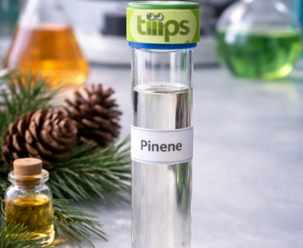
Calories (energy value)
| Metric | Value |
|---|---|
| Energy value (100 g) | ~900 kcal (indicative estimate for terpene hydrocarbons; not a “nutritional” use parameter) |
| Technical note | In practice it is used at very low levels (aromatic/technical function), therefore the energy impact on the finished product is negligible |
Identification data and specifications
| Parameter | Value |
|---|---|
| INCI name (CosIng) | Pinene |
| Molecular formula | C₁₀H₁₆ |
| Molar mass | 136.24 g/mol (reference for pinene isomers) |
| CAS number (Pinene / α-pinene, commonly reported) | 80-56-8 |
| EC number (associated) | 201-291-9 |
| Note on grades and isomerism | Detail |
|---|---|
| β-pinene (often sold as a specific substance) | CAS 127-91-3; EC 204-872-5 |
| Practical approach | in purchasing and documentation, always verify whether the material is α-pinene, β-pinene, or an isomeric mixture (“pinene”), because purity, odor profile, and SDS can differ |
Key constituents
| Class | Main components | Technical note |
|---|---|---|
| Monoterpenes (C₁₀H₁₆) | α-pinene and/or β-pinene | primary driver of odor and physical behavior |
| Minor components (grade-dependent) | other terpenes in traces | can influence odor profile and oxidation stability |
| Controlled traces | process/supply-chain impurities within specification | relevant for QC and safety, not for the primary function |
Physicochemical and safety-relevant properties (practical focus)
| Property | Indicative value |
|---|---|
| Physical state | liquid |
| Flammability | flammable liquid (flammable vapors) |
| Solubility | practically insoluble in water; soluble in many organic solvents |
| Reactivity | can react with strong oxidizers; tends to oxidize in air over time (grade-dependent) |
Functional role in formulation
| Function | What it does in the formula | Operational notes |
|---|---|---|
| Fragrance | contributes a resinous/balsamic note | check compatibility with the fragrance base and oxidation stability |
| Antifoaming (certain systems) | may reduce foam in specific matrices | effect is highly matrix- and concentration-dependent; dedicated antifoams may be more efficient |
Formulation compatibility
| System / variable | Compatibility | Control notes |
|---|---|---|
| Emulsions and surfactant systems | to be assessed | may affect odor, haze, and stability (depends on solubilization) |
| Polymers/gels | to be verified | can impact viscosity and transparency if not properly solubilized |
| Packaging | caution | terpenes may interact with some plastics/seals: run compatibility testing |
| Oxidation | critical | air/light exposure may alter odor and generate oxidative by-products (manage with antioxidants and appropriate storage) |
Use guidelines (indicative)
| Context | Typical range | Technical note |
|---|---|---|
| Cosmetics (as fragrance component, within a fragrance compound) | trace – 0.1% (order of magnitude) | actual dose depends on the fragrance concentrate and desired profile |
| Technical/industrial applications | variable | define per specification, process safety, and VOC/flammability requirements |
Quality, grades and specifications
| Parameter | Detail |
|---|---|
| Typical grades | technical/industrial; perfumery; sometimes tighter specs for regulated uses |
| Recommended controls | purity/isomer ratio, GC profile, peroxides/oxidation markers (if applicable), trace metals, water, color/odor |
| Documentation | up-to-date CoA and SDS are essential for safety and batch-to-batch repeatability |
Safety, regulation and environment
| Aspect | Operational guidance |
|---|---|
| Main hazards | flammable, possible skin irritation, possible skin sensitization, aspiration hazard if swallowed; may be very toxic to aquatic life (grade-dependent) |
| PPE and vapor management | ensure suitable ventilation; avoid ignition sources; gloves/eye protection according to risk assessment |
| Storage | tightly closed containers, cool place, away from heat/flames; minimize air/light exposure to reduce oxidation |
| Environment | avoid release; manage residues as hazardous waste according to classification and local regulation |
Formulation troubleshooting
| Issue | Possible cause | Corrective actions |
|---|---|---|
| Odor drift / “oxidized” note | terpene oxidation | reduce headspace oxygen, use compatible antioxidants, barrier packaging, cool/dark storage |
| Haze in aqueous formulas | insufficient solubilization | use suitable solubilizers, pre-dilute, optimize addition order and temperature |
| Packaging attack | polymer incompatibility | accelerated testing, switch material (e.g., glass or compatible plastics), reduce concentration |
| Insufficient antifoam performance | non-optimal ingredient choice | evaluate dedicated antifoams (silicone/non-silicone) and optimize dose/mode of use |
Conclusion
Pinene is a monoterpene used mainly as a fragrance component (and,িৱ in some cases, as an antifoaming aid), supplied either as a specific isomer or as an isomeric mixture. Robust use depends primarily on correct safety management (flammability, vapors) and stability control (oxidation, packaging compatibility), together with careful grade selection (α, β, or mixture) supported by CoA and SDS.

