



PVPP
Crosslinked polyvinylpolypyrrolidone – (crosslinked PVP, insoluble)
Synonyms: crospovidone, crospolyvidone, PVPP, polyvinylpolypyrrolidone, Kollidon® CL, Polyplasdone® XL; E1202 / INS 1202 (food use)
INCI / functions: absorbent, anti-caking, binder; pharmaceutical use: superdisintegrant
Definition
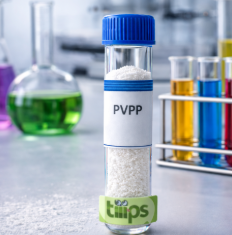
PVPP is an insoluble, crosslinked form of polyvinylpyrrolidone (PVP): a polymer built from N-vinyl-2-pyrrolidone units, “locked” into a three-dimensional network through crosslinking. From a compositional standpoint, it consists mainly of crosslinked PVP polymer chains (a polymeric matrix), with controlled trace levels of process residues (for example residual monomer and oxidizing species in traces) depending on grade and specifications. The key technical feature is that, although insoluble, it rapidly absorbs water and swells, generating an expansion force that promotes disintegration of tablets and compacts and improves flow/anti-caking performance in powder blends.
Calories (energy value)
| Metric | Value |
|---|---|
| Energy value (100 g) | Not practically significant at typical use levels (technological use, not nutritional) |
| Technical note | Insoluble, high-molecular-weight polymer: the energy impact on the finished product is typically negligible |
Identification data and specifications
| Parameter | Value |
|---|---|
| Name | PVPP |
| Chemical nature | crosslinked PVP (insoluble, strongly hydrophilic polymer) |
| Common chemical synonym | crosslinked 1-vinyl-2-pyrrolidone homopolymer |
| CAS number (practical note) | often listed as 25249-54-1; in some pharmacopoeial/supplier documentation 9003-39-8 may also appear (historical association with PVP) |
| EC / EINECS number (reported in some databases) | 607-660-4 (associated with CAS 25249-54-1) |
| Food additive | E1202 / INS 1202 (PVPP) |
| Property | Indicative values |
|---|---|
| Appearance | white to off-white, free-flowing powder |
| Odor | none to nearly none |
| Solubility | practically insoluble in water and most solvents |
| Behaviour in water | rapid wicking and swelling (imbibition + swelling) |
| Hygroscopicity | may be hygroscopic (manage moisture during storage) |
| Parameter | Technical note |
|---|---|
| Types (pharma) | commonly available as Type A and Type B (main difference: particle size distribution) |
| Controlled impurities (pharma/food) | residues (e.g., residual monomer), peroxides, ash/residue, trace metals, per grade specifications |
Functional role and clarification “superdisintegrant / absorbent / anti-caking”
| Function | What it does in the formulation | Typical use |
|---|---|---|
| Superdisintegrant (pharma) | accelerates disintegration via wicking and swelling without forming strong gels | tablets, ODT, capsules, granules |
| Absorbent | absorbs aqueous/oily phases and reduces perceived greasiness | powders, make-up, oil-containing systems |
| Anti-caking | improves flow and reduces agglomeration in blends | powders, compacts, premixes |
| Binder (supporting role) | contributes to cohesion and mechanical robustness (in synergy) | compacts and powder-based systems |
Formulation compatibility
| System / variable | Compatibility | Control notes |
|---|---|---|
| Powder systems | generally excellent | assess flow, moisture uptake, and caking risk during storage |
| Emulsions/dispersion systems | to be assessed | may increase apparent viscosity and change sensorial feel; verify stability and sedimentation |
| Electrolytes/salts | generally compatible | ionic environment can affect wetting/dispersion: bench testing recommended |
| Surfactants | often compatible | monitor foam/sensory effects if used in cleansing systems |
| Sensitive actives | generally inert | check only in specific cases (undesired adsorption of actives/preservatives) |
Use guidelines (indicative)
| Application | Typical range | Technical note |
|---|---|---|
| Tablets (pharma, superdisintegrant) | 2–5% (typical order) | depends on compression force, porosity, excipients, and target disintegration time |
| Orally disintegrating tablets (ODT) | 2–10% (typical order) | optimize with wetting/disintegration tests and friability |
| Make-up/powders (absorbent/anti-caking) | 0.5–10% | depends on oil load and sensorial target (matte, “dry touch”) |
| Compacts (cohesion support) | 0.5–5% | balance with primary binders to avoid fragility/dusting |
| Topic | Good practices |
|---|---|
| Incorporation | blend uniformly; avoid localized “weak spots” that affect compaction performance |
| Moisture control | manage RH and packaging: moisture uptake can affect flow and performance |
| Performance verification | measure disintegration time, hardness, friability, and batch-to-batch uniformity |
Typical applications
Pharmaceutical: superdisintegrant for tablets and ODT; supports rapid wetting and disintegration.
Food (PVPP, E1202): technological adsorbent/processing aid in specific applications (e.g., clarification and stabilization in beverages, where applicable).
Cosmetic: powders and make-up as absorbent and anti-caking, supporting a “dry” sensory profile.
Quality, grades and specifications
| Topic | Detail |
|---|---|
| Grades | cosmetic, pharmaceutical (with dedicated monographs/tests), food grade (E1202) |
| Critical variables | particle size distribution (Type A/B), swelling capacity, moisture content, flowability |
| Typical controls (pharma) | specific impurities (e.g., residual monomer), peroxides, ash/residue, trace metals, performance parameters |
| Documentation | supplier CoA and specifications are essential to align performance and limits |
Safety, regulation and environment
| Topic | Operational guidance |
|---|---|
| Use safety | generally low toxicity at use levels; dust may irritate eyes and respiratory tract |
| Allergens | not typically associated with allergenicity; always assess the finished formula |
| Cosmetic regulatory status | usable under general rules and GMP; verify finished product compliance |
| Food | classified as E1202 / INS 1202 under applicable conditions of use |
| Environment | manage dust and residues; avoid uncontrolled dispersion during manufacturing |
Formulation troubleshooting
| Issue | Possible cause | Corrective actions |
|---|---|---|
| Slow disintegration (pharma) | insufficient dose, high compression, low porosity | increase dose, optimize compression force, balance with other disintegrants |
| Fragile/dusty compacts | binder system not optimally balanced | retune primary binders, adjust particle size grade, optimize process moisture |
| Caking in powders | elevated humidity, inadequate packaging | improve packaging barrier, control RH, add/optimize anti-caking strategy |
| Undesired adsorption of actives | high surface area/affinity | assess compatibility, reduce dose, change grade, or adjust incorporation strategy |
Conclusion
PVPP is an insoluble, crosslinked PVP polymer, mainly composed of a hydrophilic polymer network that rapidly absorbs water and swells. This property makes it a reference superdisintegrant in pharmaceuticals and an effective absorbent/anti-caking agent in powder systems. Grade selection (notably Type A/B particle size), moisture control, and performance validation on the real finished product are the decisive factors for consistent, repeatable results.

