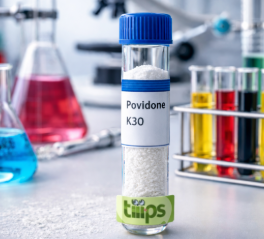
Povidone K30
Polyvinylpyrrolidone (PVP) K30 – (water-soluble polymer, K≈30 grade)
Synonyms: PVP K30, povidone K30, polyvinylpyrrolidone K30, poly(1-vinyl-2-pyrrolidone)
INCI / functions: film former, hair fixative, binder, suspension stabilizer, support for dispersibility and solubilization of actives/powders
Definition
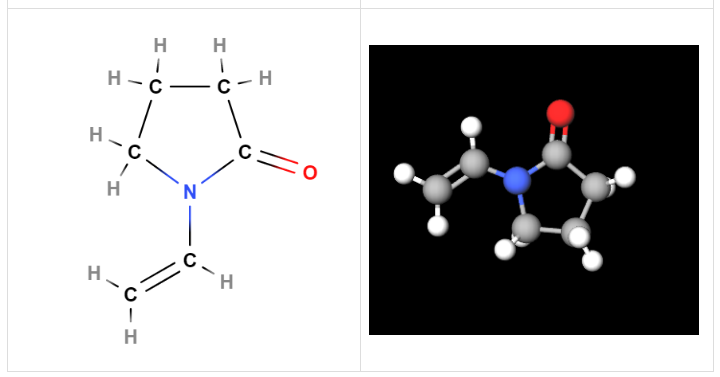
Povidone K30 is a polyvinylpyrrolidone (PVP) grade characterized by a K-value around 30 (an index correlated with intrinsic viscosity and, in practical terms, with molecular weight). From a compositional standpoint, the ingredient consists mainly of PVP polymer chains (repeating units derived from N-vinyl-2-pyrrolidone), with possible trace levels of residual monomer (vinylpyrrolidone) and process-related impurities/auxiliaries (e.g., peroxides in traces) within the specification limits of the selected grade (cosmetic or pharmaceutical). In formulations it behaves as a film-forming and binding polymer, improves cohesion of solid or dispersed systems, and supports physical stability thanks to its strong affinity for water and its ability to interact with surfaces and particulates.
Calories (energy value)
| Metric | Value |
|---|---|
| Energy value (100 g) | Not practically significant at typical use levels (technological use, not nutritional) |
| Technical note | High-molecular-weight polymer: in cosmetic use and as an excipient, the energy impact on the finished product is generally negligible |
Identification data and specifications
| Parameter | Value |
|---|---|
| Name | Povidone K30 |
| INCI | PVP (the “K30” designation is a supply/grade specification) |
| Chemical nature | hydrophilic polymer, nonionic (strongly polar) |
| CAS number | 9003-39-8 |
| EC number | 618-363-4 |
| K-value (indicative, 1% in water) | ~27–33 (often 29–32 for many K30 grades) |
| Molecular weight (order of magnitude, indicative) | ~40,000 Da (method-dependent; the “K” remains the practical selection criterion) |
| Property | Indicative (typical) |
|---|---|
| Appearance | white to off-white powder |
| Odor | none to slight |
| Solubility | very soluble in water; variable compatibility in hydroalcoholic systems depending on the water/alcohol ratio and grade |
| Hygroscopicity | moderate–high (tends to absorb moisture) |
| pH (5% solution in water, indicative) | ~3.0–5.0 (depends on grade and specification) |
| Clarity (aqueous solutions) | generally clear if properly hydrated and compatible with the system |
| Quality parameter | Control limits / values (examples, typical pharma grade, indicative) |
|---|---|
| Water (KF) | ≤ 5.0% |
| Sulfated ash | ≤ 0.1% |
| Nitrogen (on anhydrous basis) | ~11.5–12.8% |
| Residual vinylpyrrolidone (HPLC) | very low (order of ≤ 0.001% in some specifications) |
| Peroxides (as H₂O₂) | very low (order of ≤ 0.04% in some specifications) |
Functional role and clarification “film former / hair fixative / binder”
| Function | What it does in the formulation | Typical use |
|---|---|---|
| Film former | forms a continuous, transparent film that improves uniformity and performance | hair styling, make-up, film-forming treatments |
| Hair fixative | increases hold and resistance to humidity (grade-dependent) | sprays, gels, mousses |
| Binder | increases cohesion of powders/compacts and adhesion between particles | compacts, pressed powders; also tablets (pharma) |
| Suspension stabilizer | helps keep solids/pigments dispersed (in synergy with rheology) | opaque cleansers, make-up, aqueous suspensions |
| Solubilization/dispersibility support | may improve wetting and handling of particulates/actives | dispersions and multi-solvent systems |
Formulation compatibility
| System / variable | Compatibility | Control notes |
|---|---|---|
| Aqueous systems | generally excellent | re-check viscosity after 24–48 h (full hydration) |
| Hydroalcoholic systems | often good | alcohol can reduce hydration/viscosity; verify low-temperature clarity |
| Electrolytes/salts | to be assessed | high salinity can reduce rheological performance and suspension stability |
| Surfactants | generally compatible | potential effects on foam/sensory profile; run stability testing |
| Other film formers | often synergistic | tack risk if total polymer solids are high: optimize the blend |
Use guidelines (indicative)
| Application | Typical range | Technical note |
|---|---|---|
| Hair styling (gels, mousses, sprays) | 0.5–10% | K30 is a practical balance between hold and sensoriality; assess tack/flaking |
| Make-up (mascara, primer, foundation) | 0.2–5% | supports adhesion and uniform film; check compatibility with salts/pigments |
| Opaque cleansers / rinse-off | 0.1–2% | suspension support and feel; verify interference with electrolytes |
| Pressed powders (binder) | 0.5–5% | depends on compression and target pick-up/release |
| Pharmaceutical use (excipient) | variable | used as binder and stabilizer/dispersant; select a compliant grade |
| Topic | Good practices |
|---|---|
| Dispersion in water | add slowly under agitation to prevent lumps; allow hydration and re-check |
| Tack management | if sticky: reduce dose, introduce a co-film former/plasticizer, re-balance solvents |
| Stability | stress tests (heat/cool cycles, centrifuge) for separation and rheology drift |
Typical applications
Hair care: fixatives (gels, mousses, sprays) with a transparent film and good hold.
Make-up: supports adhesion, wear, and film uniformity (mascara/primers/bases).
Powder/pigment systems: helps dispersion and cohesion (with appropriate rheology).
Pharmaceutical: excipient as binder and stabilizer/dispersant in solid dosage forms and suspensions.
Quality, grades and specifications
| Topic | Detail |
|---|---|
| Differences between “K” grades | K-value drives viscosity, film strength, and sensoriality (higher K → “stronger” film, but higher tack/flaking risk if not balanced) |
| Cosmetic grade | focus on organoleptic profile, impurities, and film performance |
| Pharmaceutical grade | tighter controls on impurities/residues (e.g., monomers, peroxides), moisture, ash, and compliance with applicable monographs |
| Typical CoA parameters | K-value, solution viscosity, water, ash, nitrogen (anhydrous basis), specific residues |
Safety, regulation and environment
| Topic | Operational guidance |
|---|---|
| Use safety | generally low toxicity at use levels; dust may irritate eyes and respiratory tract |
| Allergenicity | not typically associated with sensitization; always assess the finished formula |
| EU cosmetics | usable under general rules and GMP; verify finished product compliance |
| Environment | water-soluble polymer: manage effluents and residues according to good practice; avoid uncontrolled dust dispersion |
Formulation troubleshooting
| Issue | Possible cause | Corrective actions |
|---|---|---|
| Lumps / “fish eyes” | incomplete wetting, rapid addition | slow sprinkling addition, higher shear, hydration time |
| Sticky film (tack) | high dose, humidity, unbalanced polymer blend | reduce dose, add co-polymers/plasticizer, re-balance solvents |
| Flaking | film too rigid or high polymer solids | increase plasticization, reduce solids, re-balance film formers |
| Haze in hydroalcoholic systems | solvent incompatibility / water–alcohol ratio | re-tune solvent ratio, introduce a compatible co-solvent |
| Viscosity drift over time | progressive hydration or salt interference | standardize maturation time, reduce electrolytes, optimize addition order |
Conclusion
Povidone K30 is a widely used PVP grade valued for its film-forming and binding profile, offering a practical balance between performance and formulation manageability. Being mainly composed of polyvinylpyrrolidone polymer chains (with tightly controlled trace process residues), it is versatile in hair styling, make-up, and dispersed systems. Real-world performance depends primarily on hydration, solvent ratio (especially in hydroalcoholic systems), electrolyte load, and overall polymer blend balance.