



Jaguar F-PACE
Country of production
The Jaguar F-PACE is produced in the United Kingdom, at the Solihull (England) plant. In December 2025, the last F-PACE rolled off the line, with Jaguar indicating that demand would be managed through remaining stock thereafter.
Short description
The F-PACE is Jaguar’s premium “upper-range” SUV: more grand touring in character than a pure off-roader, with a driving experience focused on precision, quietness, and high-speed stability. Inside it emphasizes an elegant, well-insulated environment, modern infotainment, and a chassis calibration that often feels more “car-like” than some rivals tuned primarily for soft comfort. The engine lineup combines mild-hybrid diesel and petrol units, a plug-in hybrid, and the high-performance SVR.
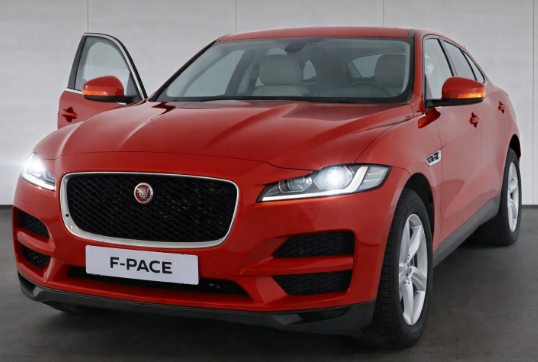 | 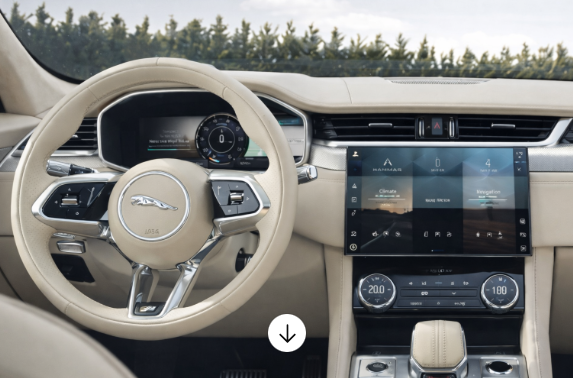 |
Powertrain and performance
| Spec | D165 MHEV | D200 MHEV | D300 MHEV | P400 MHEV | P400e PHEV | P575 SVR |
|---|---|---|---|---|---|---|
| Engine / layout | 2.0 diesel | 2.0 diesel | 3.0 diesel | 3.0 petrol | 2.0 petrol + electric | 5.0 V8 petrol |
| Power | 163 hp (120 kW) | 204 hp (150 kW) | 300 hp (221 kW) | 400 hp (294 kW) | 404 hp (297 kW) | 575 hp (423 kW) |
| Max torque | 380 Nm | 430 Nm | 650 Nm | 550 Nm | 640 Nm | 700 Nm |
| 0–100 km/h | 10.1 s | 8.2 s | 6.4 s | 5.4 s | 5.3 s | 4.0 s |
| Top speed | 195 km/h | 210 km/h | 230 km/h | 250 km/h | 240 km/h | 286 km/h |
| Combined consumption | 6.3–6.7 L/100 km (WLTP) | 6.3–6.8 L/100 km (WLTP) | 7.2–7.6 L/100 km (WLTP) | 9.5–10.0 L/100 km (WLTP) | 1.7–1.8 L/100 km (WLTP, battery charged) | 12.0 L/100 km (WLTP) |
| Electric range | — | — | — | — | up to 64 km (WLTP) | — |
| Battery (usable) | — | — | — | — | 15.39 kWh | — |
| Charging (P400e) | — | — | — | — | AC 7 kW: ~2h30 (100%) / DC 50 kW: ~30 min (80%) | — |
Dimensions and capacity
| Specification | Value |
|---|---|
| Length | 4,747 mm (4,762 mm for SVR) |
| Width (mirrors folded) | 2,071 mm |
| Width (mirrors out) | 2,175 mm |
| Height | 1,664 mm (1,670 mm for SVR) |
| Wheelbase | 2,874 mm |
| Trunk (behind 2nd row) | 613 L (“solid” VDA) / 793 L (“liquid”) |
| Max trunk (behind 1st row) | 1,440 L (solid) / 1,842 L (liquid) |
| Max towing (indicative) | up to 2,400 kg (varies by engine) |
(Note: cargo-area configuration can vary by model/engine and market.)
Main trims and indicative pricing
| Version | From (€) |
|---|---|
| D165 AWD AT | ~68,200 |
| D200 AWD AT | ~71,300 |
| D300 AWD AT | ~85,200 |
| P400e AWD AT | ~86,900 |
| P400 AWD AT | ~98,900 |
| P575 SVR | ~121,500 |
(Indicative pricing: may vary by model year, promotions, options, and on-the-road fees. Given the end of production, availability may depend on stock and market conditions.)
Maintenance and early service (indicative costs)
(Estimates for a premium SUV: high variability by official network, city, and service packages.)
| Intervention | Typical cost (€) |
|---|---|
| Annual service / 15–20,000 km (diesel/petrol) | 450–900 |
| Annual service (PHEV) | 350–750 |
| Front brake pads | 350–750 |
| Front discs + pads | 900–1,800 |
| Cabin filter | 80–180 |
| Tire (each, larger sizes) | 220–450 |
| 12 V auxiliary battery (if needed) | 200–450 |
Pros
“Jaguar-like” driving feel: strong blend of stability, precision, and high-speed comfort.
Full lineup with diesel and petrol MHEV, PHEV for urban/commuting use, and SVR for top-end performance.
Strong cargo capacity for the segment (VDA measurement).
P400e: useful certified EV range for daily trips and charging support including DC (where available).
Cons
End of production: purchasing new may depend on stock availability and pre-configured cars.
Running costs consistent with the premium segment (tires, brakes, insurance; SVR especially).
Consumption: on the more powerful versions (P400/SVR) real-world figures can increase notably.
P400e: as with many plug-ins, best results require frequent charging and battery-friendly usage.
In summary
The Jaguar F-PACE remains a premium SUV with a clear identity: more dynamic and road-focused than many alternatives, with a long-distance touring calibration and a broad powertrain range. For all-round everyday use, the diesel MHEV versions are often the most rational compromise; the P400e makes sense if you can charge regularly; the SVR is a niche choice for those who want a high-performance SUV and accept higher costs and consumption. With production ending in late 2025, the market progressively becomes more dependent on availability and stock.
Verdict — Jaguar F-PACE (Model year 2025 / end of production 2025)
Mid-to-large premium SUV · Engines (market-dependent): mild-hybrid diesel D165/D200/D300 (AWD), petrol P250 (AWD), mild-hybrid petrol P400 (AWD), plug-in hybrid P400e (AWD), range-topper SVR V8 (AWD) · 8-speed automatic · 0–100 km/h from 10.1 s (D165) to 4.0 s (SVR 575 Edition) · Top speed from 195 km/h to 286 km/h
The Jaguar F-PACE has been one of the brand’s most successful interpretations of the SUV formula: elegant British design, a commanding driving position, and a chassis tuning that—compared with many rivals—keeps a more driver-oriented character (consistent steering feel, good body control, and a solid, planted impression). In model year 2025, the offer is essentially the final chapter of the model’s lifecycle: production has ended, and purchasing typically revolves around remaining stock and Approved/enterprise channels, with availability and trims varying significantly by country and dealer network.
Inside, the layout is modern and clean, with the Pivi Pro infotainment on an 11.4" curved display, rational controls, and a “quiet premium” ambience rather than a theatrical one. Space is suitable for family and travel use, with a usable boot and a convincing sense of quality, particularly in higher specifications.
Key technical points:
Engine range and performance:
D165 AWD MHEV: 0–100 km/h 10.1 s, top speed 195 km/h.
D200 AWD MHEV: 0–100 km/h 8.2 s, top speed 210 km/h.
D300 AWD MHEV: 0–100 km/h 6.4 s, top speed 230 km/h.
P250 AWD: 0–100 km/h 7.3 s, top speed 217 km/h.
P400 AWD MHEV: 0–100 km/h 5.1 s, top speed 250 km/h.
P400e AWD PHEV: 0–100 km/h 5.3 s, top speed 240 km/h.
SVR (editions/markets): up to 286 km/h and 0–100 km/h 4.0 s (SVR 575 Edition).
Transmission and drivetrain: AWD across the range and an 8-speed automatic, tuned for comfort and smooth progression (rather than sharp, track-style shifts).
Infotainment and connectivity: Pivi Pro with 11.4" curved display, voice assistant support (market-dependent), and OTA software updates.
2025 positioning: end-of-cycle model; the real value depends heavily on stock availability, incentives on remaining units, and specification level (ADAS, audio system, wheels, suspension).
| Category | Where it shines | Where it holds steady | Where it falls short |
|---|---|---|---|
| Design & image | Elegant, recognizable silhouette; premium road presence | Styling has aged well without excess | Cabin is less “theatrical” than some newer rivals |
| Comfort & space | Strong travel/family balance; relaxed high seating | Solid perceived quality | No third row; it is a true 5-seater, not a 7-seater |
| Driving dynamics | Steering and chassis feel more engaging than the average SUV | Convincing motorway stability | Weight and size show up in very spirited driving |
| Efficiency & running | P400e is compelling if you can charge | Diesel MHEV makes sense for high mileage | SVR is passion-led: consumption and costs match a V8 |
| Infotainment & ADAS | Modern, well-integrated 11.4" Pivi Pro | Strong equipment on higher trims | Features and packs can be market- and spec-dependent |
| Costs & buying in 2025 | Potential opportunities via stock/Approved | Value strongly linked to engine and equipment | End of production: color/trim choice may be limited |
Who it is for
Buyers who want a premium SUV with understated style, enjoyable road manners, and a broad engine range (from diesel MHEV to PHEV), and who are comfortable with an “end-of-series” approach: choosing the right car (specification and history) matters more than configuring a brand-new order.
Who should consider alternatives
If your priority is the newest platform with a long product cycle ahead, or maximum next-generation efficiency (highly advanced full-hybrids or the latest BEVs), it is more coherent to focus on models with ongoing production and clearer medium-term update continuity.
Recommended configuration
P400e if you can charge regularly: the most balanced option for mixed urban and extra-urban use, with already strong performance and practical EV running where it matters.
D200/D300 if you do a lot of motorway driving and want range and long-distance ease, with responsive performance and a true “thousand-kilometre” touring mindset.
SVR only if you explicitly want the V8 experience (sound, character, and pace), accepting the corresponding costs and compromises.

