

Hello, Guest!


  Objects Tiiips Categories
Levistico
"Descrizione"
by Al222 (23254 pt)
2025-Nov-25 19:01

Levistico (Levisticum officinale)


Descrizione
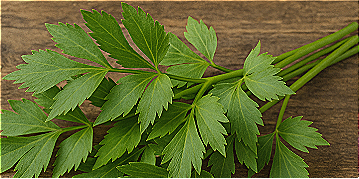
Il levistico (Levisticum officinale, famiglia Apiaceae) è una pianta erbacea perenne, dall’aspetto simile al sedano ma di dimensioni maggiori, con fusto robusto che può superare 1,5–2 m di altezza. Le foglie sono grandi, verde intenso, profondamente incise e molto aromatiche; i fiori, giallo-verdognoli, sono riuniti in ombrelle. Tutta la pianta (foglie, piccioli, semi e radici) è commestibile e possiede un aroma intenso che ricorda sedano, prezzemolo e lievi note speziate. È utilizzata come erba aromatica in zuppe, brodi, piatti di carne e preparazioni tradizionali dell’Europa centrale e del nord.

Valori nutrizionali indicativi per 100 g (foglie fresche)

  • Energia: circa 45–60 kcal

  • Acqua: ≈ 80–85%

  • Carboidrati: 6–8 g

    • zuccheri: 1–2 g

  • Proteine: 3–4 g

  • Grassi totali: 0.5–1 g

    • SFA (grassi saturi, da limitare nel complesso della dieta): tracce

    • MUFA (grassi monoinsaturi, generalmente favorevoli al profilo lipidico): tracce

    • PUFA (grassi polinsaturi, coinvolti in funzioni cellulari e antinfiammatorie): tracce

  • Fibre alimentari: 3–5 g

  • Vitamine: soprattutto vitamina C, vitamina A (β-carotene), vitamina K, alcune vitamine del gruppo B

  • Minerali: potassio, calcio, ferro, magnesio, manganese

I valori possono variare in base a varietà, suolo, clima e stadio di raccolta.


Principali sostanze contenute

  • Olio essenziale (in foglie, semi e radici): ftalidi (es. ligustilide), cumarine, α-terpineolo, eugenolo, altre molecole aromatiche.

  • Polifenoli: flavonoidi (quercetina, rutina e derivati), acidi fenolici.

  • Carotenoidi: β-carotene e altri pigmenti con attività provitaminica A.

  • Vitamine idrosolubili: acido ascorbico (vitamina C), alcune vitamine del gruppo B.

  • Sali minerali: in particolare potassio, con presenza di calcio e ferro.

  • Composti amaricanti e sostanze aromatiche responsabili del tipico sapore “di sedano intenso”.


Processo di produzione

  • Coltivazione: semina o trapianto di piantine in primavera, in suoli fertili, freschi e ben drenati, in posizioni soleggiate o di mezz’ombra.

  • Cure colturali: irrigazione regolare, controllo delle infestanti, eventuale concimazione organica; la pianta è perenne e ricaccia ogni anno.

  • Raccolta:

    • foglie e piccioli tagliati più volte durante la stagione vegetativa;

    • semi raccolti a fine estate quando le ombrelle sono mature;

    • radici raccolte in autunno da piante di 2–3 anni.

  • Post-raccolta: cernita, lavaggio delicato, asciugatura superficiale.

  • Trasformazione: uso fresco, essiccazione (foglie e semi), surgelazione, estrazione di oli essenziali, produzione di condimenti e insaporitori.

  • Confezionamento: in mazzetti, vaschette, buste essiccate o contenitori per spezie.


Proprietà fisiche

  • Aspetto: cespo eretto, con foglie pennate, brillanti, di spessore medio.

  • Colore: verde intenso per le parti aeree; radici biancastre-giallognole.

  • Odore: molto aromatico, simile a sedano e prezzemolo, con note calde e speziate.

  • Densità: bassa, elevato contenuto d’acqua nelle parti fresche.

  • Sensibilità: le foglie appassiscono e anneriscono facilmente se disidratate o schiacciate.


Proprietà sensoriali e tecnologiche

  • Aroma: deciso, erbaceo, con toni di sedano concentrato e lieve nota di lievito/brodo.

  • Sapore: intenso, sapido-aromatico, leggermente amaro se usato in eccesso.

  • Comportamento in cottura:

    • le foglie resistono discretamente alla cottura in liquidi (zuppe, brodi);

    • l’aroma dell’olio essenziale è parzialmente volatile → preferibile aggiungerlo a fine cottura per piatti delicati;

    • buone prestazioni in surgelazione e in essiccazione per miscele di erbe;

    • i semi sono aromatici e adatti a aromatizzare pani, formaggi, salumi.


Impieghi alimentari

  • Foglie fresche in zuppe, minestre, brodi, stufati, soprattutto di carne o legumi.

  • Aromatizzazione di piatti di patate, insalate, salse e ripieni.

  • Semi usati come spezia per pane, salumi, formaggi e liquori.

  • Radici utilizzate in alcune cucine tradizionali in zuppe o come ortaggio aromatico.

  • Componenti di dado vegetale, miscele per brodo e condimenti in polvere.


Nutrizione e salute

  • Fonte di composti antiossidanti (polifenoli, carotenoidi, vitamina C) utili alla protezione delle cellule dallo stress ossidativo.

  • Il contenuto di potassio può contribuire all’equilibrio elettrolitico nell’ambito di una dieta equilibrata.

  • Le tradizioni erboristiche attribuiscono al levistico proprietà digestive, carminative e diuretiche; tali effetti vanno considerati con prudenza e non sostituiscono il parere medico.

  • Basso apporto calorico e interessante densità di micronutrienti.


Nota porzione
In ambito culinario, una porzione tipica di levistico fresco è di 2–5 g di foglie/piccioli tritati per porzione (quantità simile o inferiore al prezzemolo, dato il sapore molto intenso).


Allergeni e intolleranze

  • Il levistico non rientra tra gli allergeni principali previsti dalla normativa UE.

  • Come altre Apiaceae (sedano, prezzemolo), può tuttavia dare reazioni crociate in soggetti allergici a sedano e ad altre ombrellifere.

  • La presenza di cumarine e ftalidi richiede prudenza nell’uso di preparati concentrati in soggetti con terapie specifiche o fotodermatiti; attenersi sempre al consiglio del medico/fitoterapeuta.


Conservazione e shelf-life

  • Prodotto fresco:

    • in frigorifero a 4–8 °c, 2–4 giorni per le sole foglie, se ben protette dall’essiccamento;

    • i gambi interi in acqua o imballaggi micro-forati possono durare qualche giorno in più.

  • Essiccato:

    • foglie e semi essiccati durano diversi mesi se conservati in contenitori ben chiusi, al riparo da luce e umidità.

  • Surgelato:

    • foglie o piccioli tritati, eventualmente miscelati con olio, mantengono buona qualità per 6–12 mesi.


Sicurezza e regolatorio

  • Come erba aromatica alimentare deve rispettare la normativa UE su:

    • residui di fitofarmaci (MRL),

    • contaminanti (metalli pesanti, micotossine),

    • igiene di produzione.

  • Gli stabilimenti devono applicare sistemi GMP e HACCP lungo tutte le fasi di lavorazione (raccolta, lavaggio, taglio, confezionamento).

  • Estratti e oli essenziali destinati a integratori o usi erboristici ricadono in normative specifiche (limiti di composti potenzialmente critici come alcune cumarine).


Etichettatura
Per il levistico commercializzato come alimento/erba aromatica:

  • Denominazione: “levistico” o “Levisticum officinale (erba aromatica)”.

  • Origine: paese di coltivazione.

  • Lotto e data di confezionamento, eventuale TMC per prodotto fresco.

  • Condizioni di conservazione (es. “conservare in frigorifero”).

  • Per prodotti essiccati/trasformati: elenco ingredienti, valori nutrizionali quando richiesti, quantità netta, eventuali avvertenze d’uso.


Troubleshooting

  • Foglie appassite e flosce → disidratazione o conservazione a temperatura troppo elevata; migliorare imballaggio e catena del freddo.

  • Imbrunimento delle foglie → danno meccanico, eccesso di freddo o umidità, ossidazione dopo taglio.

  • Perdita di aroma → stoccaggio troppo lungo, esposizione a luce e calore, essiccazione non ottimale.

  • Sapore amarognolo eccessivo → dosaggio troppo elevato in ricetta o raccolta di foglie troppo vecchie.


Sostenibilità e filiera

  • Coltivabile con tecniche a basso impatto, anche in agricoltura biologica, grazie alla rusticità della pianta.

  • Possibilità di produzione locale e filiere corte che riducono i trasporti e migliorano la freschezza.

  • Scarti vegetali facilmente compostabili.

  • Imballaggi sempre più orientati verso materiali riciclabili (cartone, plastiche riciclabili, bioplastiche).


Principali funzioni INCI (cosmesi)
Da Levisticum officinale si possono ottenere estratti e oli essenziali impiegati in cosmesi con possibili funzioni:

  • Antiossidante (grazie a polifenoli e composti aromatici).

  • Lenitiva e leggermente rilassante nella sensazione sensoriale.

  • Deodorante/purificante legata alle note aromatiche intense.

  • Condizionante cutaneo in creme e lozioni a base di estratti vegetali.

L’uso cosmetico deve comunque rispettare i limiti di sicurezza per i composti aromatici potenzialmente sensibilizzanti.


Conclusione
Il levistico è un’erba aromatica potente e versatile, con un profilo sensoriale marcato e una lunga tradizione d’uso nella cucina europea e nella fitoterapia. A fronte di un apporto calorico modesto, fornisce micronutrienti e numerosi composti bioattivi, soprattutto antiossidanti. Il suo impiego richiede dosi contenute per evitare che il sapore sovrasti il piatto, ma, se ben gestito, arricchisce ricette, preparazioni industriali e, in parte, formulazioni cosmetiche di ispirazione naturale.


Mini-glossario

  • SFA: Saturated Fatty Acids, grassi saturi da limitare nel complesso della dieta.

  • MUFA: Monounsaturated Fatty Acids, grassi monoinsaturi generalmente favorevoli al profilo lipidico.

  • PUFA: Polyunsaturated Fatty Acids, grassi polinsaturi coinvolti in funzioni cellulari e antinfiammatorie.

  • MRL: Maximum Residue Level, limite massimo di residui di fitofarmaci ammesso negli alimenti.

  • GMP: Good Manufacturing Practices, buone pratiche di fabbricazione.

  • HACCP: Hazard Analysis and Critical Control Points, sistema di gestione della sicurezza alimentare.

Bibliografia__________________________________________________________________________

Spréa RM, Fernandes Â, Calhelha RC, Pereira C, Pires TCSP, Alves MJ, Canan C, Barros L, Amaral JS, Ferreira ICFR. Chemical and bioactive characterization of the aromatic plant Levisticum officinale W.D.J. Koch: a comprehensive study. Food Funct. 2020 Feb 26;11(2):1292-1303. doi: 10.1039/c9fo02841b.

Abstract. Aromatic plants have been used since antiquity as seasoning ingredients to impart unique flavours to foods, and also as folk medicines, and are currently used as a source of several compounds of interest for different industries. Lovage (Levisticum officinale W.J.D. Koch) is an aromatic plant from the Apiaceae family with a strong flavour that has long been used in culinary products, in traditional medicine and by the food industry. Despite its significance and relevance, apart from its composition in volatile compounds, there is a scarcity of information about this plant species. To the best of our knowledge, this study documents for the first time the nutritional value and composition in fatty acids, organic acids and tocopherols of the edible aerial part of lovage, evidencing a low caloric value, a predominance of polyunsaturated fatty acids, mainly α-linolenic acid, oxalic acid as the most abundant organic acid and α-tocopherol as the most abundant vitamin E isoform. The essential oil was mainly characterised by the presence of monoterpenes, showing also a high abundance of phthalides. In addition, a total of 7 phenolic compounds were identified in the decoction and hydroethanolic extracts, which showed interesting antioxidant properties and bacteriostatic activity, particularly against Gram-positive bacteria. Only the decoction showed cytotoxicity against a tumoral cell line (HepG2).

Schinkovitz A, Stavri M, Gibbons S, Bucar F. Antimycobacterial polyacetylenes from Levisticum officinale. Phytother Res. 2008 May;22(5):681-4. doi: 10.1002/ptr.2408. 

Abstract. No conflicts of interest concerning financial matters or personal relationships exist between the authors and those who might bias this work. The present work is in part included the PhD thesis of A. Schinkovitz (University of Graz) but has not been published elsewhere previously. The dichloromethane extract of the roots of Levisticum officinale L. (Apiaceae) exhibited significant antimycobacterial activity against Mycobacterium fortuitum and Mycobacterium aurum in a microtiter plate dilution assay and was further analysed following a bioassay-guided fractionation strategy. 3(R)-Falcarinol (3(R)-(-)-1,9-heptadecadien-4,6-diin-3-ol] and 3(R)-8(S)-falcarindiol [3(R)-8(S)-(+)-1,9-heptadecadien-4,6-diin-3,8-diol] could be identified as the active components in this extract. The minimal inhibitory concentration (MIC) of 3(R)-falcarinol against M. fortuitum and M. aurum was 16.4 microM while that of 3(R)-8(S)-falcarindiol was 30.7 microM against M. fortuitum and 61.4 microm against M. aurum, respectively. Previously, 3(R),8(R)-dehydrofalcarindiol was isolated from Artemisia monosperma and surprisingly this polyacetylene exhibited no antimycobacterial activity at 128 microg/mL. This indicates that the terminal methyl group is vital for retention of antimycobacterial activity. Reference antibiotics ethambutol and isoniazid exhibited an activity of 115.5 microM and 14.6 microM against M. fortuitum, and 3.4 microM and 29.2 microM against M. aurum, respectively.

Złotek U, Szymanowska U, Pecio Ł, Kozachok S, Jakubczyk A. Antioxidative and Potentially Anti-inflammatory Activity of Phenolics from Lovage Leaves Levisticum officinale Koch Elicited with Jasmonic Acid and Yeast Extract. Molecules. 2019 Apr 11;24(7):1441. doi: 10.3390/molecules24071441.

Abstract. The effect of elicitation with jasmonic acids (JA) and yeast extract (YE) on the production of phenolic compounds as well as the antioxidant and anti-inflammatory properties of phenolic extracts of lovage was evaluated. The analysis of phenolic compounds carried out with the UPLC-MS technique indicated that rutin was the dominant flavonoid, while 5-caffeoylquinic acid was the main component in the phenolic acid fraction in the lovage leaves. The application of 10 µM JA increased the content of most of the identified phenolic compounds. The highest antioxidant activities estimated as free radical scavenging activity against ABTS (2,2'-azino-bis(3-ethylbenzothiazoline-6-sulphonic acid) and reducing power were determined for the sample elicited with 10 µM JA, while this value determined as iron chelating ability was the highest for the 0.1% YE-elicited lovage. The 0.1% and 1% YE elicitation also caused significant elevation of the lipoxygenase (LOX) inhibition ability, while all the concentrations of the tested elicitors significantly improved the ability to inhibit cyclooxygenase 2 (COX2) (best results were detected for the 10 µM JA and 0.1% YE2 sample). Thus, 0.1% yeast extract and 10 µM jasmonic acid proved to be most effective in elevation of the biological activity of lovage.

Afarnegan H, Shahraki A, Shahraki J. The hepatoprotective effects of aquatic extract of Levisticum officinale against paraquat hepatocyte toxicity. Pak J Pharm Sci. 2017 Nov;30(6(Supplementary)):2363-2368. 

Abstract. Paraquat is extensively used as a strong nitrogen-based herbicide for controlling weeds in agriculture. This herbicide is extremely toxic to humans and induces multiorgan failure due to accumulation in the cells. So far, many instances of fatal poisoning have been reported. Paraquat is metabolized primarily in the liver. Accordingly, the effects of aquatic Levisticum officinale extract on biochemical factors and oxidative status were evaluated in hepatocytes exposed to paraquat in this study. The results showed that paraquat-induced hepatocyte destruction is mediated by reactive oxygen species (ROS) production. The aquatic extracts of Levisticum officinale (100, 200, and 300μg/mL) could prevent lipid peroxidation and reduction in the potential of mitochondrial membranes (P<0.05). The antioxidants, ROS scavengers (mannitol, dimethyl sulfoxide, and α-tocopherol), and mitochondrial permeability transition pore-sealing agent (carnitine) inhibited the effects of paraquat. The pore-sealing compound inhibited hepatotoxicity, indicating that paraquat induces cell death via mitochondrial pathways. Hepatic cell death due to paraquat could be prevented by hepatocyte pretreatment with aquatic Levisticum officinale extracts, antioxidants, and ROS scavengers; therefore, oxidative stress might directly reduce the mitochondrial membrane potential. In conclusion, paraquat hepatotoxicity may be associated with oxidative stress and maintained by the disruption of mitochondrial membrane potential. Levisticum officinale aquatic extract, presumably due to its strong antioxidant properties, could protect against the destructive effects of paraquat on rat hepatocytes.

Olennikov DN. Coumarins of Lovage Roots (Levisticum officinale W.D.J.Koch): LC-MS Profile, Quantification, and Stability during Postharvest Storage. Metabolites. 2022 Dec 20;13(1):3. doi: 10.3390/metabo13010003.

Abstract. Lovage (Levisticum officinale W.D.J. Koch) is a known aromatic apiaceous species that is widely used as a culinary and medicinal plant. Traditionally, more scientific attention has been paid to lovage volatiles, while other groups of compounds have been underutilized. In this study, metabolites of fresh lovage roots were investigated by liquid chromatography-mass spectrometry, and 25 compounds were identified, including coumarins as basic components and minor hydroxycinnamates; most were detected for the first time in the plant. Four major coumarins (including apterin, xanthotoxin, isopimpinellin, and pimpinellin) were successfully separated by a validated HPLC-PDA method, and the fresh roots of seven lovage cultivars as well as the dry roots of commercial lovage were quantified. The coumarin content deviation was 1.7-2.9 mg/g in the fresh roots and 15-24 mg/g in the dry roots. A variation in the coumarin level was found during storage of the fresh lovage roots at chill and room temperatures, while storage of the dried roots at room temperature showed the lowest loss of target compounds. This new information about the metabolites of lovage indicates the prospects of the plant roots as a source of dietary coumarins.


Evaluate