



Yam flour
(Dioscorea spp. – dried and milled tuber)
Description
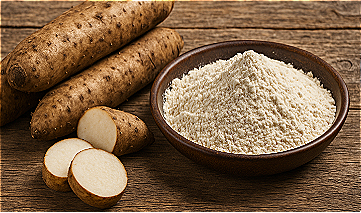
Yam flour is obtained by dehydrating and milling the tubers of Dioscorea spp., plants belonging to the family Dioscoreaceae.
The final product may appear as a fine flour, coarser meal or powdered flakes, usually off-white to light cream in colour.
It is traditionally used in West Africa, the Caribbean, parts of Asia and South America in dishes such as fufu, amala and other thick pastes, and is increasingly used in modern gluten-free formulations.
Technologically, yam flour provides good thickening and gelling capacity, neutral-to-earthy flavour, and contributes body and texture to a wide range of foods.
Indicative nutritional values (per 100 g yam flour, dry)
(Typical ranges for commercial dried yam flour; may vary with species, process and particle size.)
Energy: ≈ 310–370 kcal
Water: ≈ 5–12 g
Protein: ≈ 3–7 g
Total fat: ≈ 0.2–0.7 g
first occurrence: SFA/MUFA/PUFA = saturated / monounsaturated / polyunsaturated fatty acids; total fat is very low and the fatty-acid profile has no major nutritional concern at normal use levels.
Total carbohydrates: ≈ 80–88 g
of which sugars: ≈ 0.5–2 g
Dietary fibre: ≈ 4–10 g (mainly insoluble)
Sodium: very low, unless salt is added during processing
Potassium: ≈ 600–1,000 mg (indicative)
Vitamins: small amounts of B1, B6, residual vitamin C and phenolic compounds
Minerals: manganese, magnesium, iron and trace elements in variable amounts
Key constituents
Starch
High content of complex starch, responsible for thickening and gel formation.
Dietary fibre
Mainly insoluble fibre, with a smaller soluble fraction; contributes to stool bulk and satiety.
Vegetable proteins
Moderate protein content with an incomplete amino-acid profile, useful as a complementary source but not as a sole protein source.
Micronutrients and bioactive compounds
Potassium as the main mineral, plus magnesium, manganese and iron;
Phenolic compounds and other antioxidants in small amounts, depending on the yam variety and processing.
Lipids
Very low overall fat content, with a predominance of unsaturated fatty acids over saturated ones; nutritionally not critical at typical intakes.
Production process
Harvest and selection of sound Dioscorea tubers.
Washing to remove soil and physical impurities.
Peeling (manual or mechanical) to remove the outer skin.
Cutting/slicing into chips or cubes to facilitate uniform drying.
Optional blanching or mild heat treatment to inactivate browning enzymes and reduce microbial load.
Drying (sun/solar dryers or hot-air/industrial dryers) to a low and safe moisture content.
Milling in hammer, stone or roller mills to achieve the desired granulation.
Sieving to obtain homogeneous particle-size fractions.
Packaging in moisture-barrier bags or sacks to maintain dryness and microbiological stability.
Physical properties
Colour: off-white to cream; excessive browning indicates oxidation or poor processing.
Appearance: fine powder or coarse meal depending on target application.
pH: typically slightly acidic to neutral (≈ 5.5–6.5).
Bulk density: medium–low, depending on grind and compaction.
Water absorption capacity: high, with significant swelling and viscosity increase.
Gelatinisation: yam starch gelatinises at moderate temperatures, forming cohesive, elastic pastes.
Sensory and technological properties
Flavour: neutral to mildly earthy and slightly sweet.
Aroma: faint, reminiscent of dried tuber; off-odours (musty, rancid) are a quality defect.
Texture contribution: provides body, smoothness or elasticity depending on water ratio and cooking conditions.
Technological functions:
Thickener in soups, sauces and baby foods.
Bulk ingredient in bakery and snack formulations.
Structure builder in gluten-free doughs and batters.
Stabiliser in purees, mashed products and filled items.
Food applications
Household and foodservice
Preparation of traditional pastes such as fufu, amala and stiff porridges.
Thickening of soups, stews, sauces and vegetable purees.
Partial replacement of wheat flour in pancakes, flatbreads, fritters and dumplings, particularly in gluten-free cooking.
Food industry
Component in gluten-free bakery mixes (breads, cakes, biscuits, crackers).
Ingredient in instant porridges, extruded snacks and cereal bars.
Natural thickener in soups, sauces, baby foods and ready meals.
Base for ethnic and convenience products focused on African and Caribbean cuisines.
Nutrition & health
Yam flour is a source of complex carbohydrates, providing sustained energy when consumed as part of mixed meals.
The dietary fibre fraction supports intestinal transit, satiety and may help modulate postprandial glycaemia when combined with other foods.
Total fat is very low, and the balance between saturated and unsaturated fatty acids is generally favourable, given the small absolute amount.
Its natural gluten-free nature makes yam flour attractive for people needing to avoid gluten, provided cross-contamination is controlled.
The glycaemic impact depends on yam species, degree of processing, particle size and cooking/cooling conditions; combining yam flour with protein, fat and fibre-rich foods may help smooth post-meal glycaemic response.
Potassium and other minerals support electrolyte balance and basic physiological functions, but yam flour should not be considered a concentrated mineral supplement.
Portion note:
As a thickener or minor ingredient (soups, sauces, bakery): typically 20–40 g yam flour per serving portion of the final dish.
As a main carbohydrate base (fufu, amala, stiff porridge): 50–80 g flour (dry weight) per person per meal, depending on overall energy needs and accompanying foods.
Allergens and intolerances
Yam flour is naturally gluten-free and does not belong to the major regulated allergen groups.
Rare individual sensitivities to tropical tubers may occur, though they are uncommon.
The fibre and resistant-starch fraction can cause bloating or gastrointestinal discomfort in sensitive individuals, especially at high intakes or when introduced rapidly.
Cross-contamination can occur in facilities handling gluten-containing cereals, soy, nuts or other allergens; allergen statements and “may contain” warnings should be checked on the label.
Quality & specification (typical parameters)
Moisture: low, typically below thresholds ensuring microbial stability.
Particle size: defined according to the target application (fine flour vs coarse meal).
Colour and odour: uniform, without visible mold growth or strong off-odours.
Microbiological criteria: low total counts; absence of pathogens such as Salmonella and Listeria in specified test volumes.
Chemical safety: compliance with regulatory limits for pesticide residues, heavy metals and mycotoxins.
Nutritional specs: declared ranges for starch, fibre, protein and energy as required by customers and legislation.
Storage & shelf-life
Store in a cool, dry place, away from direct light and strong odours.
Use moisture-barrier packaging (multi-layer bags, lined sacks) and keep tightly sealed after opening to prevent clumping and microbial growth.
Typical shelf-life: 12–24 months for sealed commercial products, depending on drying level and packaging; after opening, quality is best if the product is used within a few weeks or months and protected from humidity.
Safety & regulatory
Yam flour is regulated as a plant-based food ingredient and is generally considered safe when produced from edible yam species and processed under hygienic conditions.
Production plants should apply GMP/HACCP (first occurrence: good manufacturing practices / hazard analysis and critical control points) to control:
raw yam quality (absence of decay, foreign matter),
washing, peeling and slicing hygiene,
drying temperatures and times,
microbiological status and absence of foreign bodies in the final flour.
In some jurisdictions, species or varieties of Dioscorea with problematic toxic constituents are not permitted for human consumption or must be processed in specific ways; food-grade yam flour should always be sourced from compliant edible varieties.
Labelling
Typical ingredient declaration: “yam flour” (often alongside the Latin name Dioscorea spp. in technical documentation).
Labels should include:
ingredient name, net weight and nutritional information;
country of origin and/or origin of the yam tubers where required;
batch/lot number, best-before date and storage instructions;
allergen information related to cross-contamination risks (e.g. cereals containing gluten, nuts, soy) as applicable.
Troubleshooting
Lumping and caking
Cause: moisture uptake during storage.
Action: improve packaging, include desiccant where appropriate, store in dry conditions and break up lumps before use if still safe.
Darkening or grey/brown colour
Cause: enzymatic oxidation or non-enzymatic browning due to delayed drying, high drying temperature or poor raw material.
Action: optimise peeling and pre-treatment, accelerate drying after cutting, control process temperatures.
Weak thickening or poor gel formation
Cause: excessive heat damage to starch, unsuitable yam variety, overly coarse grind.
Action: adjust drying conditions, select appropriate yam varieties, refine milling or blend with other starches.
Off-flavours (musty, rancid)
Cause: microbial spoilage, oxidation, or contamination from storage environment.
Action: reject affected batches; review hygiene, moisture control and storage practices.
Sustainability & supply chain
Yams are high-yield root crops adapted to tropical and subtropical climates, forming a key component of food security in several regions.
Sustainability issues include:
soil and water management,
responsible use of fertilisers and plant-protection products,
energy consumption for drying and milling.
Peels and trimming residues can be valorised as animal feed, compost or feedstock for bioenergy, helping reduce waste.
Processing facilities should manage wastewater with high organic load using appropriate treatment; monitoring BOD/COD (first occurrence: biochemical oxygen demand / chemical oxygen demand) is important for environmental compliance.
Main INCI functions (cosmetics)
Cosmetic ingredients derived from yam may appear under names such as Dioscorea Villosa Root Extract or similar, typically derived from wild yam species.
Main cosmetic roles:
skin-conditioning and mild moisturising agent in creams and lotions,
component in formulations marketed for dry or mature skin, often combined with other plant extracts.
These uses are regulated under cosmetic law and require specific purity and safety assessments distinct from food regulations.
Conclusion
Yam flour is a versatile, naturally gluten-free flour obtained from dried Dioscorea tubers, rich in complex carbohydrates and dietary fibre and very low in fat. Its thickening and gelling properties make it suitable for both traditional staples (fufu, amala) and modern gluten-free bakery and convenience foods. When produced from safe yam species under robust GMP/HACCP conditions, correctly dried, packaged and stored, yam flour offers a stable, functionally useful and nutritionally interesting ingredient that can help diversify carbohydrate sources and support product development for different cultural markets and dietary needs.
Mini-glossary
SFA/MUFA/PUFA – saturated / monounsaturated / polyunsaturated fatty acids; structural categories of fatty acids. In yam flour the total fat content is very low, so the fatty-acid profile has limited impact on overall dietary fat quality at typical use levels.
GMP/HACCP – good manufacturing practices / hazard analysis and critical control points; management systems that define hygienic procedures and identify critical steps where hazards must be controlled to ensure safe, consistent flour production.
BOD/COD – biochemical oxygen demand / chemical oxygen demand; measures of the organic and oxidisable load in processing wastewater, important indicators for designing and monitoring effluent treatment from washing and cleaning steps in yam-flour plants.

