



Calcium disodium EDTA
(synthetic chelating/sequestering agent; food additive E385)
Description
Calcium–disodium salt of EDTA (ethylenediaminetetraacetic acid), a polyamino-carboxylic chelating agent able to bind multivalent metal ions.
Appears as a white crystalline powder, practically odourless, with a slightly salty–metallic taste.
In foods it is used as a metal chelator/sequestrant, with an indirect antioxidant effect, stabilising colour, flavour and, to some extent, texture in various packaged products.
Key constituents
The active substance is calcium disodium EDTA itself:
four carboxylate groups and two chelating nitrogen atoms → strong affinity for metal ions such as Fe³⁺, Cu²⁺, Zn²⁺, Ca²⁺, Mg²⁺ and others;
forms very stable complexes, reducing the availability of these metals for oxidation reactions and for some unwanted enzymatic reactions.
Trace levels of other EDTA salts and synthesis by-products may be present within defined purity limits.
Production process
Industrial synthesis of EDTA from ethylenediamine, formaldehyde and cyanide-derived intermediates, forming sodium salts as intermediates.
Conversion to free EDTA acid and subsequent neutralisation with sodium and calcium bases to obtain the calcium–disodium salt at controlled stoichiometric ratio.
Final steps: crystallisation, filtration, drying, milling, and packing into suitable food-grade containers.
Physical properties
Appearance: white crystalline powder.
Odour: practically odourless.
Taste: slightly salty–metallic (perceptible only at high doses).
Solubility: freely soluble in water, insoluble in fats/oils.
Aqueous solution pH: generally slightly acidic to near neutral, depending on concentration.
Thermally stable under typical food processing conditions.
Sensory and technological properties
Metal chelation:
binds iron, copper and other transition metals that catalyse oxidation of lipids, pigments (e.g. carotenoids, chlorophylls) and sensitive vitamins;
reduces rancidity, browning, colour loss and development of oxidised off-flavours.
At normal use levels, impact on taste is minimal; overdosing can produce metallic notes.
Improves colour and flavour stability in products fortified with vitamins or sensitive to trace metals in water or raw materials.
Food applications
As food additive E385 – calcium disodium EDTA, used within legal limits in:
Canned and preserved foods: vegetables, pulses, fish (e.g. tuna) to stabilise colour and flavour and limit darkening.
Sauces and dressings: mayonnaise, creamy dressings, oil-rich sauces where it helps prevent oxidation of fats and pigments and supports emulsion stability.
Soft drinks and juices: helps preserve colour and flavour and can reduce haze linked to metals and colloidal instability.
Other products: margarines and spreads, ready salads, certain preserves, when allowed by regulation.
(It is also used in medicines and non-food sectors)
Nutrition & health
Poor oral absorption: most ingested calcium disodium EDTA is not absorbed and is excreted in faeces; the small absorbed fraction is excreted in urine as metal complexes.
Major food-safety authorities consider calcium disodium EDTA safe at authorised food-use levels, with an ADI (acceptable daily intake) set in the low mg/kg body weight/day range.
At doses far above food-use levels (pharmacological or experimental exposures) effects on mineral metabolism have been reported; ADI limits are therefore set conservatively.
It does not provide fats (SFA, MUFA, PUFA) or other nutrients of interest: its role is purely technological, not nutritional.
Serving note: at typical concentrations (tens to a few hundred mg/kg, depending on category), normal dietary exposure generally remains below the ADI for most consumers when legal limits are respected.
Allergens and intolerances
Calcium disodium EDTA is not a major allergen and contains no proteins related to the 14 mandatory EU allergens.
Hypersensitivity reactions are considered rare, but may occur in particularly sensitive individuals to chelating agents or specific formulations.
In foods, the main allergens almost always originate from other ingredients (milk, gluten, soy, egg, etc.), not from E385 itself.
Quality and specifications (typical contract parameters)
Identity and purity:
assay for calcium disodium EDTA within defined range;
limits for heavy metals (lead, mercury, cadmium, arsenic);
checks on pH of standard solutions and identification tests.
Appearance: white powder, free from hard lumps and foreign odours.
Microbiology: as a dry salt it has very low water activity; microbiological requirements mainly concern the finished foods into which it is incorporated.
Storage and shelf-life
Store in a cool, dry, well-ventilated place, protected from moisture and contamination.
Keep containers tightly closed; avoid prolonged contact with bare reactive metals.
Typical raw-material shelf-life: 2–5 years depending on manufacturer’s specification and storage conditions.
Safety and regulatory
In Europe it is authorised as additive E385 in specific food categories, with maximum permitted levels expressed in mg/kg of finished product.
Production must follow GMP and HACCP, with batch traceability and control of raw materials and impurities.
International agencies have evaluated its toxicological profile and defined ADI and authorised food categories and levels.
Labeling
In ingredient lists it may appear as:
“E385” with its technological function (e.g. “sequestrant”, “antioxidant”, “preservative”, according to local classification), or
“calcium disodium EDTA” in full text.
For non-EU markets, local labelling rules apply (e.g. specific FDA naming).
Troubleshooting (technological use)
Metallic or off-taste
Possible cause: excessive dosage or interaction with other salts/ingredients.
Action: reduce use level, rebalance the formula or combine with other antioxidant systems.
Insufficient protection against oxidation (rancidity/browning still evident)
Possible causes: dose too low relative to metal load, poor water quality, non-optimal pH, highly sensitive product.
Action: check metal levels, consider combining with primary antioxidants (e.g. ascorbates, tocopherols), optimise pH and overall antioxidant system.
Analytical interference in metal determination
EDTA complexes can mask metals and affect analytical quantification.
Action: use digestion/analytical conditions that release metals from complexes.
Sustainability and supply chain
EDTA is a chelating agent with limited biodegradability, so it is of environmental interest particularly in wastewater, detergents and industrial uses.
In food applications the quantitative contribution is relatively small, but it is still important to manage industrial effluents with appropriate treatment and to optimise water and energy use.
In some non-food uses, more easily biodegradable alternative chelators are being explored; in foods, authorised uses and limits must be followed.
Main INCI functions (cosmetics)
Related INCI names: Calcium Disodium EDTA, Disodium EDTA, Tetrasodium EDTA, etc.
Functions: chelating agent, formulation stabiliser (helps maintain preservative, colour and fragrance performance in the presence of metals).
Cosmetic use is also limited to low concentrations, with environmental and safety aspects taken into account.
Conclusion
Calcium disodium EDTA (E385) is a synthetic chelating/sequestering agent used in foods to bind metal ions, improving oxidative stability, maintaining colour and flavour, and supporting shelf-life of canned products, sauces, beverages and other metal-sensitive foods. At authorised levels, its nutritional impact is essentially zero while its technological benefit can be significant. Proper use requires respect of legal limits, integration into the HACCP plan, and responsible management of effluents to keep consumer and environmental risk under control.
Mini-glossary
Chelating/sequestering agent – Molecule able to bind metal ions in stable complexes, removing them from unwanted reactions (oxidation, catalysis).
EDTA – Ethylenediaminetetraacetic acid, synthetic chelating agent forming the basis of several salts (disodium, calcium–disodium, etc.).
E385 – European code for the additive “calcium disodium EDTA”.
ADI (acceptable daily intake) – Daily intake level (mg/kg body weight) considered safe for chronic exposure.
GMP/HACCP – Good Manufacturing Practices / Hazard Analysis and Critical Control Points; core systems to ensure hygiene, traceability and risk control.
BOD/COD – Biochemical/Chemical Oxygen Demand; indicators of organic load and oxygen demand in wastewater, relevant for environmental management.
Studies
In chemistry, it is a six-atom complexation agent that regulates the equilibrium between ligand and metal ions, often added to lysate with magnesium and calcium complex ions to stabilise nucleic acid and degrade nuclease activity. It controls the polymerisation rate. It also functions as a chelating agent, i.e. an agent that binds to another to promote elimination or harmful reactions caused by metal ions and to form a stable water-soluble complex. These studies explain the mechanism (1). It can chelate with a large majority of different metal ions other than alkali metals such as calcium, magnesium, iron, copper and other polyvalent ions.
It also works as a descaler (2) and as an antioxidant method also called the Fenton method (3).
Widely used to prevent oxidation caused by metals.
Food
Labelled with the number E385 in the list of European food additives, Disodium EDTA is a chemical compound that is added to food as a preservative and chelating agent to prevent spoilage of the product in which it is included and to counteract other ingredients.
It is found in carbonated drinks, jellies, canned beans, mayonnaise and others.
To check for its presence in food, a convenient HPLC method was developed for the quantitative determination of EDTA in food. EDTA in food samples was easily extracted with water using ultrasound. After conversion to Fe (III) complex in the presence of Fe (III) ions, EDTA was separated on a reversed-phase C30 column and detected by ultraviolet detection (260 nm). Citrate and malate, which are present in many foods, also formed Fe (III) complexes but did not interfere with the chromatographic detection of EDTA. The method allowed the determination of EDTA in food at concentrations down to 0.01 mmol/kg. Good recoveries (95.2-101%) were obtained with the standard addition method on four samples with high repeatability (RSD, 0.8-3.4%). The method was successfully applied to the analysis of EDTA in carbonated drinks, jellies, canned beans, canned maize and food supplements (4).
Disodium EDTA is a known enhancer of iron absorption, yet the results of this study suggest that in the presence of EDTA, iron absorption occurs mainly from the paracellular rather than the regulated cellular mode, which could potentially increase its toxicity (5).
There is a maximum ADI (Acceptable Daily Intake) or GDA (Acceptable Daily Allowance) of 2.5 grams per kg body weight for this food additive (6).
Cosmetics
It acts as a chelating agent and pH adjuster in cosmetic formulations. Chelating agents are known to be cytotoxic and weakly genotoxic, but not carcinogenic as confirmed by the final report of the Expert Panel for the Review of Cosmetic Ingredients (7).
Chelating agent. It has the function of preventing unstable reactions and improving the bioavailability of chemical components within a product, and removes calcium and magnesium cations that can cause cloudiness in clear liquids.
Viscosity control agent. It controls and adapts viscosity to the required level for optimal chemical and physical stability of the product and dosage in gels, suspensions, emulsions, solutions.
Medical
Disodium EDTA is used in the form of intravenous administration in chelation therapy for lead and heavy metal poisoning, in the treatment of calcified tendonitis, as an anticoagulant and bactericide due to its low cost.
Other uses
- additive, bleaching and fixing agent for processing colour-sensitive materials
- water purifier and cleaner
- agricultural chemicals
- plant growth inhibitor
- chemical plating, cyanide-free electroplating
For more information:
Typical commercial product characteristics Ethylenediaminetetraacetic acid disodium salt
| Appearance | White powder |
| pH | 4.0-5.0 |
| Boiling Point | >100°C 614.2°C at 760 mmHg |
| Melting Point | 248°C |
| Flash Point | 325.2ºC |
| Density | 1.01 g/mL at 25°C |
| Vapor Pressure | 1.15E-16mmHg at 25°C |
| Chlorides | 0.01% Max |
| Sulphates | 0.1% Max |
| Iron | 0.001% Max |
| Heavy metal | 0.001% Max |
| Chelating value | 221 |
| NTA | 0.2% |
| Water insoluble matter | ≤0.005% |
| Loss on drying | 8.7- 11.4% |
| Aminotriacetic acid | ≤10 ppm |
| Storage | 2-8°C |
| Chemical Risk | 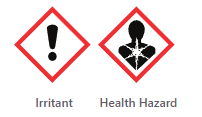 |
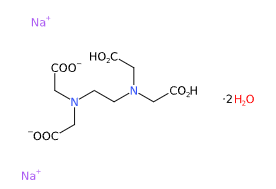 | 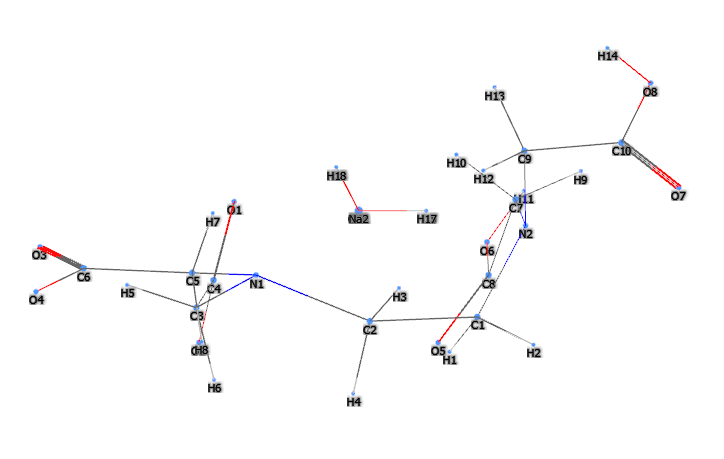 |
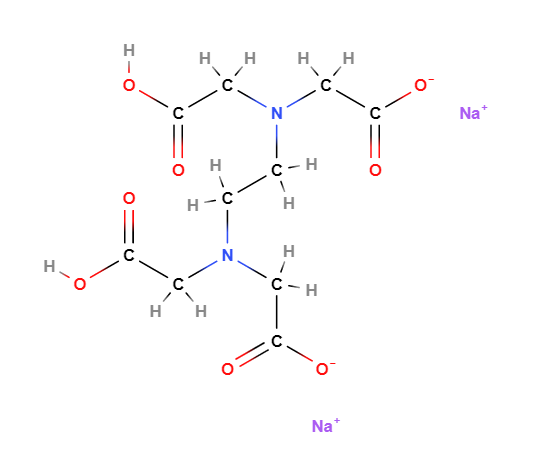 |  |
- Molecular Formula C10H18N2Na2O10 C10H14N2O8Na2.2H2O
- Linear Formula [-CH2N(CH2CO2Na)CH2CO2H]2
- Molecular Weight 336.21
- Exact Mass 336.054565
- CAS 139-33-3 6831-92-6 (Ethylenediaminetetraacetic acid disodium salt dihydrate)
- UNII
- EC Number 205-358-3
- DSSTox Substance ID DTXSID9027073
- IUPAC disodium;2-[2-[carboxylatomethyl(carboxymethyl)amino]ethyl-(carboxymethyl)amino]acetate
- InChl=1S/C10H16N2O8.2Na/c13-7(14)3-11(4-8(15)16)1-2-12(5-9(17)18)6-10(19)20;;/h1-6H2,(H,13,14)(H,15,16)(H,17,18)(H,19,20);;/q;2*+1/p-2
- InChl Key ZGTMUACCHSMWAC-UHFFFAOYSA-L
- SMILES C(CN(CC(=O)O)CC(=O)[O-])N(CC(=O)O)CC(=O)[O-].[Na+].[Na+]
- MDL number MFCD00070672
- PubChem Substance ID 329747771
- RTECS AH4410000
- NCI C65508
- FEMA 4520
- HS Code 2922499990
- Beilstein 3822669
- eCl@ss 39030907
- NACRES NA.25
Synonyms :
Ethylenediaminetetraacetic acid, Disodium salt, Disodic EDTA, Disodic edetate, Acid Edetic

