



Lipolyzed cream
(enzymatically modified cream / enzyme-modified dairy fat, liquid, paste, or spray-dried)
Description
• Dairy ingredient obtained by enzymatic lipolysis of cream (typically 30–60% milk fat) using food-grade lipases to release free fatty acids (FFA) and partial glycerides, intensifying buttery/cheesy notes and improving emulsification.
• Available as liquid/paste (refrigerated or frozen) or spray-dried powder; flavor profile depends on enzyme type (sn-1/3 vs sn-2 specificity), lipolysis degree, temperature, and time.
• Used in flavor systems (butter/cheese/meat snacks), sauces, bakery seasonings, processed cheese, and ready meals.
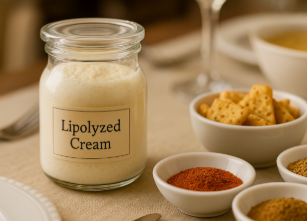
Indicative nutritional values (per 100 g; typical ranges by format)
• Energy: 520–740 kcal (lower end powders with carriers; higher end fat-rich pastes)
• Fat: 55–85 g — first mention lipids: SFA/MUFA/PUFA (saturated/mono-/polyunsaturated; limit SFA, while MUFA/PUFA generally more favorable)
• Protein: 2–12 g (higher in powders retaining milk solids)
• Carbohydrates: 0–25 g (0–5 g in fat pastes; up to 25 g when carriers like maltodextrin are used)
• Sodium: 20–150 mg (intrinsic; higher if salted)
• Moisture: 1–40% (powders 1–5%; pastes/emulsions higher)
Key constituents
• Free fatty acids (FFA): short- and medium-chain acids (notably butyric, caproic, caprylic, capric) that deliver strong buttery/cheesy notes.
• Mono-/diacylglycerols (natural emulsifiers), residual triacylglycerols.
• Milk fat minor lipids (sterols, tocopherols; traces of MFGM phospholipids if not removed).
• Optional carriers/anti-caking agents in powders (e.g., maltodextrin, silicon dioxide), salt, natural flavors.
Production process
• Standardized cream → pasteurization → enzymatic lipolysis (selected microbial lipase, controlled pH/temperature/time) → monitoring to target FFA/acid value → enzyme inactivation (heat) → phase adjustment (emulsification/standardization) → spray drying (if powder) → packaging under oxygen-barrier conditions (often nitrogen-flushed).
• Typical lipolysis endpoints: acid value (AV) ~ 10–80 mg KOH/g fat (application-dependent).
Physical properties
• Appearance: pale cream to light yellow liquid/paste or free-flowing powder.
• Aroma/flavor: from clean buttery to pungent cheesy as lipolysis increases.
• Oxidation sensitivity: elevated due to FFA; requires low PV (peroxide value) and oxygen control.
Sensory and technological properties
• Strong flavor potentiation (buttery, cooked milk, cheesy, savory).
• FFA and partial glycerides improve emulsification, wetting, and flavor release.
• Enhances Maillard and browning in dry applications when powders contain lactose/carriers.
• High impact at low dose; excessive lipolysis can produce harsh/rancid notes.
Food applications
• Flavors & seasonings: butter/cheese notes for snacks, instant pasta/rice, bouillons.
• Sauces & soups: creamy mouthfeel and top-notes in white/cheese sauces and gravies.
• Bakery: laminated doughs, crackers, biscuit fillings, fillings/toppings.
• Processed cheese & analogs: boosts cheese intensity, allows fat reduction or cost optimization.
• Ready meals & meats: rubs, glazes, and savory systems.
Nutrition and health
• Supplies dairy fat and minor bioactives from milk fat; usage levels are small (typically flavor-level).
• Consider saturated fat contribution in nutrition labeling when used at higher inclusion.
• Not suitable for vegetarian diets (dairy-derived); suitable for ovo-lacto vegetarians if permitted by preference.
Serving note (inclusion guidance)
• Flavor systems/seasonings: ~0.05–0.5% as-is in finished food.
• Sauces/processed cheese/bakery: typically 0.2–1.5% (higher for mild products).
• Titrate to sensory target; combine with diacetyl/cheese flavors as needed.
Allergens and intolerances
• Contains milk (major allergen; labeling required).
• Lactose: negligible in fat pastes; may be present in powders with milk solids/carriers.
• Enzymes are inactivated; the source organism (e.g., microbial lipase) may be declared per local rules when carried over.
Quality and specifications (typical)
• Acid value (AV): 10–80 mg KOH/g fat (target by application).
• Peroxide value (PV): ≤ 1–2 meq O₂/kg fat at packing; p-AnV low.
• FFA (% of fat): 5–25%.
• Moisture: powders ≤ 5%; pastes as specified.
• Microbiology (powders): Salmonella absent/25 g; coliforms low; total count within dairy-powder norms.
• Sensory: clean buttery/cheesy without soapy, oxidized, or sulphury off-notes.
Storage and shelf-life
• Powders: cool, dry, dark (≤ 20–25 °C; RH < 65%); oxygen-barrier packs; 12–18 months unopened.
• Pastes/liquids: refrigerated (≤ 4 °C) for short term (weeks) or frozen (−18 °C) for long term (6–12 months).
• Minimize oxygen and light; consider antioxidants (tocopherols/ascorbyl palmitate) where permitted.
Safety and regulatory
• Produced under GMP/HACCP; lipases must be food-grade and approved.
• In many jurisdictions, marketed as enzyme-modified dairy ingredient (EMDI) or enzyme-modified butterfat (EMBF); may be declared as “flavoring”, “enzymatically modified cream”, or “lipolyzed cream” per local labeling rules.
• Allergen “milk” mandatory; declare added flavors, carriers, and antioxidants where used.
Labeling
• Name examples: “Lipolyzed Cream”, “Enzyme-Modified Cream”, “Enzyme-Modified Dairy Fat”, or “Flavoring” (jurisdiction-dependent).
• Indicate milk allergen, ingredient list (including carriers/additives), net weight, lot/date, origin, storage.
• Optional claims: “natural flavor” only if compliant with local flavor regulations.
Troubleshooting
• Harsh/rancid or soapy notes → over-lipolysis or long storage → select lower AV, add antioxidants, tighten oxygen control.
• Oxidized flavor → high PV/oxygen exposure → improve barrier packaging, nitrogen flush, colder storage.
• Poor dispersion (powder) → fine particles or low instantization → select agglomerated grade; disperse into warm phase with shear.
• Phase separation (paste in sauce) → insufficient emulsifiers/shear → increase shear or add complementary emulsifier/starch.
Sustainability and supply chain
• Enables flavor intensity at low dose, reducing overall dairy fat usage in finished foods.
• Can valorize dairy side streams; implement heat recovery on evaporators/dryers and wastewater treatment with BOD/COD reduction.
• Prefer recyclable/mono-material barrier packaging; rotate stock (FIFO) to reduce waste.
Conclusion
Lipolyzed cream delivers high-impact buttery/cheesy flavor and functional emulsification at low inclusion. Control of enzyme specificity, lipolysis endpoint, and oxidation is critical to achieving a clean, stable profile across sauces, seasonings, bakery, processed cheese, and ready meals.
Mini-glossary
• SFA/MUFA/PUFA — Saturated / monounsaturated / polyunsaturated fatty acids; limit SFA, while MUFA/PUFA generally support a more favorable lipid profile.
• FFA — Free fatty acids; released by lipase action, driving buttery/cheesy flavor but increasing oxidation risk.
• MFGM — Milk fat globule membrane; phospholipid/protein membrane fragments that aid emulsification.
• AV (acid value) — mg KOH needed to neutralize FFA per g fat; a measure of lipolysis degree.
• PV (peroxide value) — Primary lipid-oxidation index (meq O₂/kg fat); lower is fresher.
• GMP/HACCP — Good manufacturing practices / hazard analysis and critical control points; hygiene and safety systems.
• BOD/COD — Biochemical / chemical oxygen demand; indicators of organic load in effluents.

