Triphosphates (E451) — stabilizers/sequestrants
(sodium and/or potassium salts of triphosphoric acid; e.g., sodium tripolyphosphate—STPP, potassium tripolyphosphate—KTPP)
Description
• Inorganic food ingredients used as stabilizers, sequestrants, pH adjusters, and water-binding aids. They chelate Ca²⁺/Mg²⁺, moderately raise pH, and increase ionic strength, improving water-holding capacity (WHC), juiciness, sliceability, and emulsion/protein stability.
• Typical in meat and seafood (brines/injection), processed cheese (as co-emulsifiers with other phosphates/citrates), sauces, fillings, surimi, and plant-based analogues.
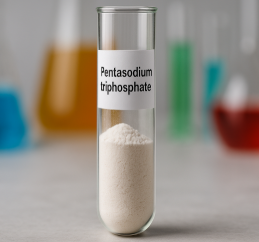
Indicative nutrition values (powder, per 100 g; use levels in foods are low)
• Energy: ~0 kcal
• Protein/Fat/Available carbs: 0 g
• Phosphorus: ~25–30 g as P (≈ 56–60 g as P₂O₅)
• Sodium (sodium salts): can exceed 25–30 g/100 g; Potassium high in K salts
• Note: at typical in-recipe levels (fractions of a percent) energy is nil, but sodium and phosphorus contributions can be relevant.
Key constituents
• Triphosphates of sodium/potassium (STPP/KTPP) with minor ortho-/pyrophosphates from hydrolysis.
• Trace ash/impurities within spec; controlled moisture.
Production process
• Neutralize phosphoric acid with Na/K carbonates or hydroxides → dry and controlled polycondensation to triphosphate → milling/granulation → standardization (pH, P₂O₅) and barrier packing under GMP/HACCP.
Physical properties
• Appearance: white powder or granules.
• Solubility: high in water; clear solutions.
• pH (1% solution): ~9–10 (alkaline).
• Chelation: strong affinity for Ca²⁺/Mg²⁺ (softens water, prevents precipitates).
• Stability: prone to hydrolysis to di-/orthophosphates at low pH/high T or prolonged holding.
Sensory & technological properties
• Yield/juiciness: reduce purge and cook loss; improve tenderness/texture in meat/seafood and plant analogues.
• Emulsions: stabilize fat–water systems (frankfurters, mortadella, processed cheese) synergistically with proteins and other emulsifying salts.
• Color: slightly higher pH keeps myoglobin more reduced (brighter raw appearance).
• Compatibility: effective in brines/pastes; manage total sodium and label targets.
Food applications
• Processed meats/poultry: injected roasts, cooked sausages (0.2–0.5% finished product; often blended with other phosphates).
• Seafood (shrimp, cephalopods, surimi, fillets): dips/brines or injection (0.1–0.3%).
• Processed cheese/cheese sauces: part of emulsifying-salt systems (total salts 1.5–3.0%; triphosphate share per formula).
• Sauces/dressings/fillings: water phase stabilization, viscosity control (0.05–0.30%).
(Ranges are indicative; optimize via pilot runs and category specs.)
Nutrition & health
Triphosphates add no energy, but may increase phosphorus intake and, with sodium grades, sodium intake. Individuals with CKD, hyperphosphatemia, or on low-sodium diets should consider cumulative phosphate/sodium from all sources. For the general population, use at compliant technological doses has a limited nutritional impact, though it is good practice to moderate total added phosphates (E338–E452) and sodium across the diet.
From a safety standpoint, triphosphates are long-used approved additives; adhering to purity specs and the minimum effective dose helps avoid off-notes (alkaline/“soapy” taste) and keeps pH within target.
Portion note: typical in-product levels 0.1–0.5% (1–5 g/kg, sometimes expressed as P₂O₅); in brines 0.2–0.8% of the liquid. Align with the product standard and category limits.
Quality & specifications (typical topics)
• Assay: % P₂O₅ / % P; pH (1% solution); total Na/K; moisture; particle size.
• Purity: limits for metals (Pb, Cd, As, Hg), fluorides, insolubles; ortho/pyro fraction within range.
• Functional: Ca/Mg sequestration capacity, WHC in model systems, solution stability (hydrolysis).
• Microbiology: not applicable to dry salts; pathogens absent/25 g for finished foods.
Storage & shelf-life
• Store dry, tightly closed, away from humidity/CO₂ (avoid caking and assay drift).
• Barrier sacks/liners, cool and dark place; typical shelf-life 24–36 months sealed.
Safety & regulatory
• Additives E451 (i–ii) authorized in many food categories with conditions/limits (often expressed as P₂O₅ and cumulative with other phosphates E338–E452 per category).
• Manufacture/use under GMP/HACCP and purity specifications; maintain technical dossier (origin, traceability, contaminant compliance).
Labeling
• Ingredient list: “stabilizer: triphosphates (E451)” or specific names (“sodium tripolyphosphate,” “potassium tripolyphosphate”).
• Declare allergens only if present from other materials; reflect sodium in the nutrition table when relevant.
Troubleshooting
• Alkaline/metallic taste or “soapy” texture → overdose or excessive pH → reduce %, switch to blends with citrates/diphosphates; add mild acid buffers.
• Post-cook purge in meats → suboptimal hydration/ion exchange → reformulate salt/phosphates and tumbling times; verify temperature control.
• White precipitates in hard water → insufficient sequestration → slightly increase dose or pre-treat water; use a more soluble grade.
• Low yield in processed cheese → unbalanced emulsifying-salt system → re-balance phosphates/citrates and pH.
• Hydrolysis in hot/acid solutions → loss of performance → make fresh solutions; keep preparation pH ≥6 if compatible.
Sustainability & supply chain
• Sourced from phosphate rock—prioritize responsible procurement and tight control of impurities (metals/fluorides).
• In-plant: minimum effective dosing, reduce phosphorus effluent (prevent eutrophication), recover CIP waters, and use recyclable packaging.
INCI functions (cosmetics)
• Sodium Tripolyphosphate (Pentasodium Triphosphate), Pentapotassium Triphosphate: chelating/sequestering, buffering, and viscosity-controlling roles in personal/home care; use per cosmetic regulations and tolerability profiles.
Conclusion
Triphosphates (E451) are highly effective stabilizers/sequestrants for water retention, texture, and emulsions. Grade selection, dosage, and pH management drive performance and sensory acceptance, while compliance with limits and good practice ensures safety and regulatory conformity.
Mini-glossary (acronyms used)
• E451 (i–ii) — EU additive code for triphosphates (Na/K salts of triphosphoric acid).
• E338–E452 — EU codes for phosphoric acid and phosphates (ortho-, pyro-, polyphosphates).
• STPP — Sodium Tripolyphosphate (pentasodium triphosphate).
• KTPP — Pentapotassium Triphosphate (potassium tripolyphosphate).
• WHC — Water-Holding Capacity (matrix ability to retain water).
• P₂O₅ — Phosphorus pentoxide equivalent; standard way to express phosphate assay.
• GMP — Good Manufacturing Practice.
• HACCP — Hazard Analysis and Critical Control Points.
• QS — Quantum satis (use “as needed” to achieve technological effect under good practice).
• CKD — Chronic Kidney Disease.
• CIP — Clean-in-Place (in-line cleaning/sanitation of equipment).
• pH — Measure of solution acidity/alkalinity (0–14 scale).
References__________________________________________________________________________
Capita, R., Alonso-Calleja, C., García-Fernández, M. D. C., & Moreno, B. (2002). Trisodium phosphate (TSP) treatment for decontamination of poultry. Food Science and Technology International, 8(1), 11-24.
Abstract. Use of trisodium phosphate (TSP) treatment for reducing levels of bacteria in poultry is discussed with reference to: health and economic consequences of poultry contamination, causes or routes of contamination, possibilities for reduction of microbial loads, mechanisms of action of TSP, sensory properties and quality of TSP-treated poultry, antimicrobial effectiveness, influences on shelf-life, and worldwide authorization of this process, with special reference to the situation in the European Union. A summary of the main results of microbial reductions on poultry following TSP treatment is shown for Salmonella, coliforms/Escherichia coli, Enterobacteriaceae, Campylobacter, Pseudomonas, total counts, Listeria, Staphylococcus aureus and Lactobacillus. The main results on microbial reductions assessed in foodstuffs other than poultry (beef, fruit, fish and shellfish) are also shown.
Liu D, Cheng J, Zhao C, Guo M. Effect of sodium triphosphate on particle size of heat-induced whey protein concentrate aggregates. Food Sci Nutr. 2018 Sep 7;6(7):1940-1949. doi: 10.1002/fsn3.665.
Abstract. Thermal treatment has been utilized to improve the functional properties of proteins for many years. In this study, we aimed to investigate the effect of sodium triphosphate (Na5P3O10) on particle size and size distribution of heat-induced whey protein concentrate (WPC) aggregates under different processing conditions. The results showed that high Na5P3O10 level (>0.5%, w/w), long heating time (>15 min), and alkaline condition (pH 8-8.5) facilitated formation of large particles (>10 μm). The WPC aggregates with small-to-medium particle size (1-3 μm) that are suitable to be applied as a fat replacer were obtained by heating the WPC solution (8%, w/v) containing 0.4% (w/w) Na5P3O10 at 85°C for 5 min. We conclude that thermal treatment of whey protein concentrate added with Na5P3O10 can obtain whey protein products with different particle sizes for certain applications.
Lampila, L. E. (2013). Applications and functions of food‐grade phosphates. Annals of the New York academy of sciences, 1301(1), 37-44.
Abstract. Food-grade phosphates are used in the production of foods to function as buffers, sequestrants, acidulants, bases, flavors, cryoprotectants, gel accelerants, dispersants, nutrients, precipitants, and as free-flow (anticaking) or ion-exchange agents. The actions of phosphates affect the chemical leavening of cakes, cookies, pancakes, muffins, and doughnuts; the even melt of processed cheese; the structure of a frankfurter; the bind and hydration of delicatessen meats; the fluidity of evaporated milk; the distinctive flavor of cola beverages; the free flow of spice blends; the mineral content of isotonic beverages; and the light color of par-fried potato strips. In the United States, food-grade phosphates are generally recognized as safe, but use levels have been defined for some foods by the Code of Federal Regulations, specifically Titles 9 and 21 for foods regulated by the U.S. Department of Agriculture (USDA) and the U.S. Food and Drug Administration (FDA), respectively. Standards for food purity are defined nationally and internationally in sources such as the Food Chemicals Codex and the Joint Food and Agriculture Organization and World Health Organization (FAO/WHO) Expert Committee on Food Additives.
Xue, S., Zou, Y., Chen, X., Yang, H., Xing, T., Xu, X., & Zhou, G. (2016). Effects of sodium tripolyphosphate on functional properties of low-salt single-step high-pressure processed chicken breast sausage. International Journal of Food Science and Technology, 51(9), 2106-2113.
Abstract. Influences of sodium tripolyphosphate (STPP) contents (0.1, 0.2, 0.3 and 0.4%) on water holding capacity (WHC) and texture properties of low-salt (1.2% NaCl) single-step high-pressure processed chicken breast sausages (LSSS-HPP sausages) were evaluated. Results showed that WHC was improved (4–5%) by the addition of STPP. However, the STPP contents customarily used for cooked sausages (0.3–0.5%) were excessive for LSSS-HPP sausages, causing a soft and tacky texture. Sausages containing 0.1% of STPP had the best taste according to the sensory evaluations. Chemical interactions plus Raman spectroscopic analysis revealed that STPP addition partly changed native structures of myofibrillar proteins. Furthermore, higher STPP contents in the meat batter prevented those proteins from high pressure denaturing and aggregating in the subsequent single-step HPP procedure. Increased hydrogen bonds and decreased hydrophobic interactions explained the better WHC and softer texture. Therefore, 0.1% of STPP is the optimal content in the processing of new-type LSSS-HPP sausages.
Bilska A, Danyluk B, Kowalski R. The effect of an addition of sodium chloride and sodium triphosphate on fat oxidation products in cold stored beef. Acta Sci Pol Technol Aliment. 2012 Jan-Mar;11(1):27-36.
Abstract. Introduction: Meat and processed meats, depending on the animal species and anatomical element from which they were obtained, exhibit a varied fat content (most typically from 10% to 80% dry matter). Fats are relatively unstable food components. The aim of this study was to determine the effect of an addition of model brines on lipid oxidation rate in the selected beef element stored under aerobic conditions and in vacuum at a temperature of 5°C. Material and methods: Material for analyses comprised beef: rump cut (R) and the heel of round (L). Meat was cured (at 20% in relation to raw material weight) with brine A, containing 1% NaCl in total weight and brine B, containing 1% NaCl and 0.3% sodium tripolyphosphate E 451i (including 56% P2O5 ). Meat after being massaged was stored under aerobic conditions (T) and in vacuum (P) at a temperature of 5°C for 15 days. During storage of samples changes were determined in peroxide value (PV), contents of secondary fat decomposition products using the TBARS test as well as changes in pH value. Results: It was observed that with an extension of sample storage time peroxide value was growing gradually, but the dynamics of this growth varied. Samples coming from the rump cut muscle, stored in the atmosphere with unlimited access of oxygen, were characterised by slightly, but statistically significantly higher peroxide values in comparison to the other tested samples. The highest increase in the TBARS test value was observed in samples stored under aerobic conditions and coming from the heel of round muscle, irrespective of the type of applied brine. Conducted analyses showed that vacuum packaging of meat, in comparison to the storage of samples at unlimited access of oxygen, effectively slowed down the increase in the content of secondary oxidation products determined by the TBARS test. The greatest effect of vacuum packaging was observed for the heel of round in brine A. Conclusions: Vacuum packaging, in comparison to storage of experimental samples under aerobic conditions, delayed the increase in peroxide value and effectively slowed down the increase in contents of secondary lipid oxidation products. Statistically significant changes in pH values were observed in the heel of round, irrespective of the type of applied brine, stored under aerobic conditions.
Durage, T. T. D. (2025). Replacing Sodium Tripolyphosphate in Frozen Shrimp Preservation: Soaking Treatments, Nonthermal Technologies, and Their Limitations. Journal of Food Science, 90(7), e70365.
Abstract. Shrimp's nutrient-rich composition and high water activity make it highly perishable, necessitating effective preservation methods like freezing. However, freezing induces undesirable changes, including protein denaturation, lipid oxidation, and reductions in water-holding capacity (WHC), yield, and textural quality. Sodium tripolyphosphate (STPP) is traditionally used to mitigate these effects due to its ability to stabilize proteins, enhance pH and ionic strength, and inhibit oxidation. Yet, STPP presents significant health, environmental, and regulatory challenges, prompting growing interest in sustainable alternatives. This review critically evaluates the effectiveness of STPP and its substitutes, including alkali metal compounds, polysaccharides, proteins, and their combinations. Each class exhibits distinct mechanisms such as ionic strength modulation, hydrogen bonding, and antioxidative activity to preserve shrimp muscle integrity. In addition, nonthermal technologies like ultrasound, vacuum tumbling, high-pressure processing, pulsed electric field, and cold plasma show promise in improving soaking efficiency, structural retention, and oxidative stability. These technologies can enhance or complement the effects of soaking agents through physical, chemical, and enzymatic pathways. Despite promising results, challenges remain regarding the scalability, cost, sodium content, soaking durations, and limited shrimp-specific validation of many treatments. Current findings highlight the need for optimized, clean-label cryoprotective strategies that align with health regulations, environmental goals, and consumer preferences. Future efforts should focus on integrating effective compound combinations with advanced technologies to develop robust, industry-ready solutions that ensure both product quality and sustainability in frozen shrimp processing.




