Trifosfati (E451) — stabilizzanti/sequestranti
(sali di sodio e/o potassio dell’acido trifosforico; es. pentasodio tripolifosfato – STPP, pentapotassio tripolifosfato – KTPP)
Descrizione
• Ingredienti minerali usati come stabilizzanti, sequestranti, correttori di pH e coadiuvanti di ritenzione idrica. Chelano Ca²⁺/Mg²⁺, alzano moderatamente il pH e aumentano la forza ionica, migliorando WHC (water holding), succosità, affettabilità e stabilità di emulsioni/proteine.
• Impiego tipico in carni e prodotti ittici (salamoie/iniezioni), formaggi fusi (come co-emulsionanti con altri fosfati/citrati), salse, ripieni, surimi e prodotti vegetali analoghi carne.
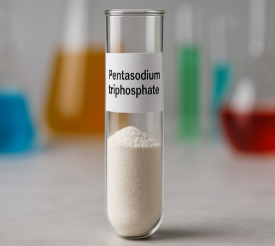
Valori nutrizionali indicativi (polvere, per 100 g; l’uso a ricetta è a basse dosi)
• Energia: ~0 kcal
• Proteine/Grassi/Carboidrati: 0 g
• Fosforo: tipicamente ~25–30 g/100 g come P (≈ 56–60 g/100 g come P₂O₅)
• Sodio (nei sali di sodio): molto elevato (può superare 25–30 g/100 g); Potassio elevato nei sali di K
• Nota: alle concentrazioni d’uso (decimi di punto percentuale) l’apporto calorico è nullo ma può incidere su sodio e fosforo della dieta.
Principali sostanze contenute
• Trifosfati di sodio/potassio (STPP/KTPP) con eventuali quote minori di orto-/pirofosfati per idrolisi.
• Ceneri/impurezze in tracce secondo specifica; umidità controllata.
Processo di produzione
• Neutralizzazione di acido fosforico con carbonati/idrossidi di Na/K → essiccamento e policondensazione controllata fino al triposfato → macinazione/granulazione → standardizzazione (pH, contenuto in P₂O₅) e confezionamento in pack barriera, in regime GMP/HACCP.
Proprietà fisiche
• Aspetto: polvere o granuli bianchi.
• Solubilità: elevata in acqua; soluzioni limpide.
• pH (1%): ~9–10 (alcalino).
• Chelazione: alta affinità per Ca²⁺/Mg²⁺ → ammorbidimento acqua e prevenzione di precipitati.
• Stabilità: suscettibili a idrolisi (→ di-/orto-fosfati) con pH basso/T alta o lunga permanenza in soluzione.
Proprietà sensoriali e tecnologiche
• Ritenzione idrica/resa: riducono purge e calo peso in cottura; migliorano succosità e texture in carni/ittico e analoghi vegetali.
• Emulsioni: stabilizzano sistemi grasso-acqua (hot-dog, mortadella, formaggi fusi) in sinergia con proteine e sali emulsionanti.
• Colore: pH leggermente più alto mantiene mioglobina in forma più riducente (aspetto più vivo da crudo).
• Compatibilità: efficaci in salamoie e paste; attenzione al bilancio di sale e all’indice di sodio del prodotto finito.
Impieghi alimentari
• Carni rosse/bianche lavorate: salami cotti, wurstel, arrosti iniettati, 0,2–0,5% sul prodotto finito (spesso come mix fosfati).
• Prodotti ittici (gamberi, seppie, surimi, filetti): bagni/salamoie o iniezione 0,1–0,3%.
• Formaggi fusi/creme: parte delle miste di sali emulsionanti (dosaggio totale sali 1,5–3,0%, quota trifosfati secondo ricetta).
• Salse/condimenti e ripieni: stabilizzazione fase acquosa, controllo viscosità 0,05–0,30%.
(i range sono indicativi; ottimizzare con prove pilota e specifiche di categoria)
Nutrizione e salute
I trifosfati non apportano energia, ma possono incrementare l’assunzione di fosforo e (per i gradi sodici) di sodio. In soggetti con CKD/insufficienza renale, iperfosfatemia o in regimi a basso sodio, l’uso va valutato nel quadro dietetico complessivo. Per la popolazione generale, il loro impiego tecnologico in dosi conformi non modifica in modo sostanziale l’equilibrio nutrizionale, ma è buona prassi contenere la somma delle fonti di fosfati aggiunti (E338–E452) e di sodio.
Sul piano della sicurezza, i trifosfati sono additivi ammessi e impiegati da decenni; la conformità a limiti di purezza e dose tecnologica minima efficace riduce rischi e off-flavour (sapidità alcalina/“saponosa” in caso di overdose).
Nota porzione: in prodotti finiti lavorati, livelli tipici 0,1–0,5% (1–5 g/kg, spesso espressi come P₂O₅ quando richiesto); per salamoie 0,2–0,8% sul liquido. Adeguare al capitolato e alla categoria d’uso.
Qualità e specifiche (temi tipici)
• Titolo: % P₂O₅ / % P; pH soluzione 1%; sodio/potassio totali; umidità; granulometria.
• Purezza: limiti su metalli (Pb, Cd, As, Hg), fluoruri, insolubili; frazione di orto-/pirofosfati entro range.
• Funzionali: capacità sequestrante Ca/Mg, WHC in sistema modello, stabilità in soluzione (idròlisi).
• Microbiologia: non applicabile (sali anidri); patogeni assenti/25 g per standard alimenti.
Conservazione e shelf-life
• Conservare asciutto, ben chiuso, al riparo da umidità/CO₂ (evitare caking e perdita di titolo).
• Pack barriera (sacchi multistrato/liner) in luogo fresco e buio; shelf-life tipica 24–36 mesi sigillato.
Sicurezza e regolatorio
• Additivi E451 (i–ii) ammessi in varie categorie alimentari con condizioni/limiti specifici (spesso espressi come P₂O₅ e cumulabili con altri fosfati E338–E452 entro limiti di categoria).
• Produrre e utilizzare secondo GMP/HACCP e specifiche di purezza; mantenere dossier tecnico (origine, tracciabilità, conformità contaminanti).
Etichettatura
• In lista ingredienti: “stabilizzante: trifosfati (E451)” o la denominazione specifica (“pentasodio tripolifosfato”, “pentapotassio tripolifosfato”).
• Evidenziare allergeni solo se presenti da altre materie prime; considerare dichiarazione sodio in tabella nutrizionale ove rilevante.
Troubleshooting
• Sapore alcalino/metallico o texture “saponosa” → overdose o pH troppo alto → ridurre % o passare a blend con citrati/difosfati; aggiungere acidi/tamponi.
• Sanguinamento/essudato post-cottura in carni → idratazione/scambio ionico non ottimale → riformulare sale/fosfati e tempi di tumbling; verificare temperatura.
• Precipitazioni (velo bianco) in acque dure → insufficiente sequestrazione → aumentare leggermente dose o pre-trattare acqua; usare grado più solubile.
• Resa bassa in formaggi fusi → rapporto sali emulsionanti non idoneo → riequilibrare fosfati/citrati/polifosfati e pH.
• Idrolisi in soluzioni calde/acide → perdita di efficacia → preparare soluzioni fresche, usare pH ≥6 in preparazione se compatibile.
Sostenibilità e filierae338
• Origine legata a rocce fosfatiche: attenzione a approvvigionamento responsabile e controllo impurità (metalli/fluoruri).
• In stabilimento: dosaggio minimo efficace, riduzione scarichi di fosforo (prevenzione eutrofizzazione), recupero acque CIP e packaging riciclabile.
Principali funzioni INCI (cosmesi)
• Sodium Tripolyphosphate / Pentasodium Triphosphate, Pentapotassium Triphosphate: chelante/sequestrante, buffering, viscosity-controlling in detergenti personali e household; uso secondo normativa cosmetica e profili di tollerabilità.
Conclusione
I trifosfati (E451) sono stabilizzanti/sequestranti molto efficaci per ritenzione idrica, texture ed emulsioni. La scelta del grado, il dosaggio e la gestione del pH determinano prestazioni e accettabilità sensoriale, mentre il rispetto di limiti e buone pratiche assicura sicurezza e conformità.
Mini-glossario)
E451 (i–ii) — Codice additivo UE per i trifosfati (sali di sodio/potassio dell’acido trifosforico).
E338–E452 — Serie di codici UE per acido fosforico e fosfati (orto-, piro-, polifosfati), usati come correttori di pH/stabilizzanti.
STPP — Sodium Tripolyphosphate (pentasodio tripolifosfato).
KTPP — Pentapotassium Triphosphate (pentapotassio tripolifosfato).
WHC — Water Holding Capacity: capacità di ritenzione idrica della matrice.
P₂O₅ — “Anidride fosforica”: modo standard per esprimere il titolo in fosfati/fosforo.
GMP — Good Manufacturing Practice: buone pratiche di fabbricazione.
HACCP — Hazard Analysis and Critical Control Points: sistema di analisi dei rischi e punti critici di controllo.
QS — Quantum satis: “quanto basta” a ottenere l’effetto tecnologico, nel rispetto delle buone pratiche.
CKD — Chronic Kidney Disease: insufficienza renale cronica.
CIP — Clean-in-Place: lavaggi/igienizzazione in linea degli impianti.
IR — Indice di rifrazione (qui usato come parametro fisico dei condensati/soluzioni).
pH — Misura dell’acidità/alcalinità di una soluzione (scala 0–14).
Bibliografia__________________________________________________________________________
Capita, R., Alonso-Calleja, C., García-Fernández, M. D. C., & Moreno, B. (2002). Trisodium phosphate (TSP) treatment for decontamination of poultry. Food Science and Technology International, 8(1), 11-24.
Abstract. Use of trisodium phosphate (TSP) treatment for reducing levels of bacteria in poultry is discussed with reference to: health and economic consequences of poultry contamination, causes or routes of contamination, possibilities for reduction of microbial loads, mechanisms of action of TSP, sensory properties and quality of TSP-treated poultry, antimicrobial effectiveness, influences on shelf-life, and worldwide authorization of this process, with special reference to the situation in the European Union. A summary of the main results of microbial reductions on poultry following TSP treatment is shown for Salmonella, coliforms/Escherichia coli, Enterobacteriaceae, Campylobacter, Pseudomonas, total counts, Listeria, Staphylococcus aureus and Lactobacillus. The main results on microbial reductions assessed in foodstuffs other than poultry (beef, fruit, fish and shellfish) are also shown.
Liu D, Cheng J, Zhao C, Guo M. Effect of sodium triphosphate on particle size of heat-induced whey protein concentrate aggregates. Food Sci Nutr. 2018 Sep 7;6(7):1940-1949. doi: 10.1002/fsn3.665.
Abstract. Thermal treatment has been utilized to improve the functional properties of proteins for many years. In this study, we aimed to investigate the effect of sodium triphosphate (Na5P3O10) on particle size and size distribution of heat-induced whey protein concentrate (WPC) aggregates under different processing conditions. The results showed that high Na5P3O10 level (>0.5%, w/w), long heating time (>15 min), and alkaline condition (pH 8-8.5) facilitated formation of large particles (>10 μm). The WPC aggregates with small-to-medium particle size (1-3 μm) that are suitable to be applied as a fat replacer were obtained by heating the WPC solution (8%, w/v) containing 0.4% (w/w) Na5P3O10 at 85°C for 5 min. We conclude that thermal treatment of whey protein concentrate added with Na5P3O10 can obtain whey protein products with different particle sizes for certain applications.
Lampila, L. E. (2013). Applications and functions of food‐grade phosphates. Annals of the New York academy of sciences, 1301(1), 37-44.
Abstract. Food-grade phosphates are used in the production of foods to function as buffers, sequestrants, acidulants, bases, flavors, cryoprotectants, gel accelerants, dispersants, nutrients, precipitants, and as free-flow (anticaking) or ion-exchange agents. The actions of phosphates affect the chemical leavening of cakes, cookies, pancakes, muffins, and doughnuts; the even melt of processed cheese; the structure of a frankfurter; the bind and hydration of delicatessen meats; the fluidity of evaporated milk; the distinctive flavor of cola beverages; the free flow of spice blends; the mineral content of isotonic beverages; and the light color of par-fried potato strips. In the United States, food-grade phosphates are generally recognized as safe, but use levels have been defined for some foods by the Code of Federal Regulations, specifically Titles 9 and 21 for foods regulated by the U.S. Department of Agriculture (USDA) and the U.S. Food and Drug Administration (FDA), respectively. Standards for food purity are defined nationally and internationally in sources such as the Food Chemicals Codex and the Joint Food and Agriculture Organization and World Health Organization (FAO/WHO) Expert Committee on Food Additives.
Xue, S., Zou, Y., Chen, X., Yang, H., Xing, T., Xu, X., & Zhou, G. (2016). Effects of sodium tripolyphosphate on functional properties of low-salt single-step high-pressure processed chicken breast sausage. International Journal of Food Science and Technology, 51(9), 2106-2113.
Abstract. Influences of sodium tripolyphosphate (STPP) contents (0.1, 0.2, 0.3 and 0.4%) on water holding capacity (WHC) and texture properties of low-salt (1.2% NaCl) single-step high-pressure processed chicken breast sausages (LSSS-HPP sausages) were evaluated. Results showed that WHC was improved (4–5%) by the addition of STPP. However, the STPP contents customarily used for cooked sausages (0.3–0.5%) were excessive for LSSS-HPP sausages, causing a soft and tacky texture. Sausages containing 0.1% of STPP had the best taste according to the sensory evaluations. Chemical interactions plus Raman spectroscopic analysis revealed that STPP addition partly changed native structures of myofibrillar proteins. Furthermore, higher STPP contents in the meat batter prevented those proteins from high pressure denaturing and aggregating in the subsequent single-step HPP procedure. Increased hydrogen bonds and decreased hydrophobic interactions explained the better WHC and softer texture. Therefore, 0.1% of STPP is the optimal content in the processing of new-type LSSS-HPP sausages.
Bilska A, Danyluk B, Kowalski R. The effect of an addition of sodium chloride and sodium triphosphate on fat oxidation products in cold stored beef. Acta Sci Pol Technol Aliment. 2012 Jan-Mar;11(1):27-36.
Abstract. Introduction: Meat and processed meats, depending on the animal species and anatomical element from which they were obtained, exhibit a varied fat content (most typically from 10% to 80% dry matter). Fats are relatively unstable food components. The aim of this study was to determine the effect of an addition of model brines on lipid oxidation rate in the selected beef element stored under aerobic conditions and in vacuum at a temperature of 5°C. Material and methods: Material for analyses comprised beef: rump cut (R) and the heel of round (L). Meat was cured (at 20% in relation to raw material weight) with brine A, containing 1% NaCl in total weight and brine B, containing 1% NaCl and 0.3% sodium tripolyphosphate E 451i (including 56% P2O5 ). Meat after being massaged was stored under aerobic conditions (T) and in vacuum (P) at a temperature of 5°C for 15 days. During storage of samples changes were determined in peroxide value (PV), contents of secondary fat decomposition products using the TBARS test as well as changes in pH value. Results: It was observed that with an extension of sample storage time peroxide value was growing gradually, but the dynamics of this growth varied. Samples coming from the rump cut muscle, stored in the atmosphere with unlimited access of oxygen, were characterised by slightly, but statistically significantly higher peroxide values in comparison to the other tested samples. The highest increase in the TBARS test value was observed in samples stored under aerobic conditions and coming from the heel of round muscle, irrespective of the type of applied brine. Conducted analyses showed that vacuum packaging of meat, in comparison to the storage of samples at unlimited access of oxygen, effectively slowed down the increase in the content of secondary oxidation products determined by the TBARS test. The greatest effect of vacuum packaging was observed for the heel of round in brine A. Conclusions: Vacuum packaging, in comparison to storage of experimental samples under aerobic conditions, delayed the increase in peroxide value and effectively slowed down the increase in contents of secondary lipid oxidation products. Statistically significant changes in pH values were observed in the heel of round, irrespective of the type of applied brine, stored under aerobic conditions.
Durage, T. T. D. (2025). Replacing Sodium Tripolyphosphate in Frozen Shrimp Preservation: Soaking Treatments, Nonthermal Technologies, and Their Limitations. Journal of Food Science, 90(7), e70365.
Abstract. Shrimp's nutrient-rich composition and high water activity make it highly perishable, necessitating effective preservation methods like freezing. However, freezing induces undesirable changes, including protein denaturation, lipid oxidation, and reductions in water-holding capacity (WHC), yield, and textural quality. Sodium tripolyphosphate (STPP) is traditionally used to mitigate these effects due to its ability to stabilize proteins, enhance pH and ionic strength, and inhibit oxidation. Yet, STPP presents significant health, environmental, and regulatory challenges, prompting growing interest in sustainable alternatives. This review critically evaluates the effectiveness of STPP and its substitutes, including alkali metal compounds, polysaccharides, proteins, and their combinations. Each class exhibits distinct mechanisms such as ionic strength modulation, hydrogen bonding, and antioxidative activity to preserve shrimp muscle integrity. In addition, nonthermal technologies like ultrasound, vacuum tumbling, high-pressure processing, pulsed electric field, and cold plasma show promise in improving soaking efficiency, structural retention, and oxidative stability. These technologies can enhance or complement the effects of soaking agents through physical, chemical, and enzymatic pathways. Despite promising results, challenges remain regarding the scalability, cost, sodium content, soaking durations, and limited shrimp-specific validation of many treatments. Current findings highlight the need for optimized, clean-label cryoprotective strategies that align with health regulations, environmental goals, and consumer preferences. Future efforts should focus on integrating effective compound combinations with advanced technologies to develop robust, industry-ready solutions that ensure both product quality and sustainability in frozen shrimp processing.




