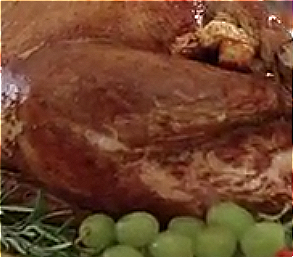
Cooked turkey thigh
(from Meleagris gallopavo; dark meat, oven/seared/sous-vide, skin-on or skinless)*
Description
• Flavorful, juicier cut than breast due to higher myoglobin and collagen; supplied whole, sliced, or pulled, in plain, marinated, or smoked formats.
• Commonly produced as RTE/RTC items, vacuum- or MAP-packed; slow or sous-vide cooking is used to tenderize connective tissue.
Indicative nutrition values (per 100 g, skinless; plain cooked, no brine — typical ranges)
• Energy: 170–200 kcal
• Protein: 24–28 g
• Fat: 6–10 g — SFA (saturated fatty acids) 2–3 g; MUFA 2–4 g; PUFA 1–3 g
• Carbohydrate: 0 g
• Sodium: 60–120 mg (can rise to 200–500 mg with brines/marinades)
• Micronutrients: higher heme iron and zinc than breast; also selenium, phosphorus, vitamins B3/B6
Key constituents
• Myofibrillar proteins (actin/myosin) plus collagen (more than breast; gelatinizes with slow cooking).
• Lipids at moderate levels, with mono- and polyunsaturates predominating over saturates.
• Heme pigments (myo/hemoglobin) giving darker color; minerals (Fe, Zn, Se).
Production process
• Cut selection (skin-on/off, bone-in/boneless) → optional brine/marinade (salt, sugars, spices; sometimes phosphates/citrates where allowed) → cooking (roast, steam, smoke, sous-vide).
• Rapid chilling to ≤4 °C, portioning, and vacuum/MAP packing → cold-chain distribution.
• GMP/HACCP controls: validated core temperature, cook yield, microbiology, and pack integrity.
Physical properties
• Post-cook pH ~5.9–6.2; high aw.
• Color: browned surface; interior from light to slightly pink (pH/redox effects; color alone is not a safety indicator).
• Texture: from tender to pull-apart with slow/low-temperature cooking via collagen gelatinization.
Sensory and technological properties
• High juiciness when temperature is controlled; sous-vide extends shelf-life via low purge and O₂ protection.
• Flavor versatility: herbs, spices, citrus, smoke; performs well cold for slicing/salads.
• Risk of warmed-over flavor on reheating → mitigate with culinary antioxidants (herbs/spices) and oxygen-barrier packs.
Food applications
• Cooked deli slices and gastronomy roasts; pulled turkey for sandwiches and ready meals.
• Entrees and protein salads, bowls, stuffings; strips/cubes for sauces and RTM dishes.
• High-protein snacks and baby foods (reduced-salt formulations).
Nutrition & health
Cooked turkey thigh provides complete protein with moderate fat and a restrained saturated fraction; overall lipid impact depends on skin and cooking method (skin raises calories and saturates). It is a good source of heme iron and zinc compared with breast. Sodium is naturally moderate but can increase markedly with brines and seasonings—check labels for low-sodium needs.
For safety, product is ready-to-eat only if pasteurized; when reheating at home, heat to ≥74–75 °C core, and keep foods out of the 4–60 °C danger zone. Refrigerate to ≤4 °C within 2 hours of service; consume leftovers within 48–72 hours.
Portion note: A cooked serving of 120–160 g (≈ 180–220 g raw, skinless) provides about 28–40 g protein and 8–14 g fat, varying with skin/seasonings.
Quality and specifications (typical topics)
• Protein, fat, moisture on as-sold basis; cook yield and drip/purge.
• pH, Lab* color, texture (shear force).
• Microbiology: pathogens absent on sample units; for RTE, Listeria control.
• Sodium total (if brined), allergens per recipe; foreign-matter controls.
• Packaging: vacuum/MAP (O₂/CO₂/N₂) to spec; seal integrity.
Storage and shelf-life
• Chilled: 0–4 °C; typically 10–21 days under vacuum/MAP (spec-dependent).
• Frozen: ≤ −18 °C; thaw under refrigeration or vacuum in cold water; do not refreeze thawed product.
• Avoid temperature abuse; protect from light/oxygen to limit oxidation.
Safety and regulatory
• Production under GMP/HACCP and poultry-cook hygiene rules.
• Label as “cooked turkey thigh” with ingredient list (brines/additives if used), nutrition table, lot/origin (where required), storage and reheat/use instructions.
• Manage allergens (e.g., milk/gluten/egg in coatings or marinades) and declare % added water where applicable.
Labeling
• Indicate skin-on/skinless, smoked, sous-vide if applicable; state salt per 100 g and per serving.
• Verify legal thresholds before using low-sodium/low-fat claims on finished products.
Troubleshooting
• Dry/fibrous → overcooking or slow cooling → use controlled-temperature cook (low-temp/sous-vide), rapid chill; consider 1–2% brine.
• Pink hue despite full cook → pinking from myoglobin chemistry → verify core temperature rather than color.
• Warmed-over flavor → lipid oxidation → reduce O₂, use herbs/antioxidants, favor short reheats.
• High purge in pack → suboptimal pH/yield or temperature swings → stabilize process, improve vacuum and cold chain.
Sustainability and supply chain
• Poultry has favorable FCR and a lower GHG footprint than ruminants; priorities include animal welfare, prudent antibiotic use, and wastewater to BOD/COD targets.
• Prefer recyclable/lightweight packaging and suppliers with end-to-farm traceability.
Conclusion
Cooked turkey thigh is a savory, juicy, versatile protein for gastronomy and industry, offering high-quality protein with moderate fat. Performance hinges on cook design, collagen management, sodium in recipe, and packaging that preserves quality and safety.
Mini-glossary
• SFA: Saturated fatty acids — Excess intake may raise LDL-cholesterol; levels here depend on skin and cooking.
• MUFA: Monounsaturated fatty acids — Generally favorable when replacing saturates.
• PUFA: Polyunsaturated fatty acids — n-6/n-3 families; beneficial when balanced and protected from oxidation.
• MAP: Modified atmosphere packaging — Protective gas mix extending shelf-life.
• GMP/HACCP: Good manufacturing practice / hazard analysis and critical control points — Preventive hygiene/process-control systems.
• BOD/COD: Biochemical/chemical oxygen demand — Wastewater impact metrics guiding treatment.
• RTE/RTC: Ready-to-eat / ready-to-cook — Consumption status of the product.
References__________________________________________________________________________
Soglia F, Baldi G, Laghi L, Mudalal S, Cavani C, Petracci M. Effect of white striping on turkey breast meat quality. Animal. 2018 Oct;12(10):2198-2204. doi: 10.1017/S1751731117003469.
Abstract. In the past decades, the intense selection practices carried out in order to develop fast growing and high breast-yield turkey hybrids profoundly modified the muscle physiology leading to the development of growth-related alterations and muscular abnormalities. White striations of variable thickness have been particularly observed on the ventral surface of Pectoralis major muscle belonging from heavy male turkeys since several years. However, although the effects of white striping (WS) have been extensively studied on broilers, this condition was not considered as a main quality issue by both turkey producers and meat industry. Thus, this study aimed at evaluating whether the occurrence of WS in heavy male turkeys affects the quality traits and technological properties of meat to the same extent previously observed for broilers. In two replications, 72 Pectoralis major muscles were classified as: normal (NORM), moderate WS (MOD) and severe WS (SEV) cases. The whole muscle was weighed and cut in order to assess colour, ultimate pH, water holding (drip and cooking losses) and binding (marinade uptake) capacities, NMR relaxation properties, shear force as well as proximate composition of meat. The Pectoralis major muscles affected by WS (both moderate and severe cases) exhibited a one-fifth increased weight in comparison with their NORM counterpart. However, the occurrence of WS only partially affected the proximate composition of the meat. In detail, although moisture, collagen and protein contents did not differ among the groups, if compared with NORM, higher lipid levels were found in SEV muscles, whereas MOD had intermediate values. On the other hand, both MOD and SEV exhibited lower ash content. Despite these variations in proximate composition, both water holding and binding capacities of turkey breast meat were not affected by WS. Indeed, quality traits of raw (pH, colour, cooking losses and shear force) and marinated (uptake, cooking losses and shear force) meat as well as water distribution within the muscle tissue did not differ between NORM and WS cases. Overall, if compared with broilers, WS only marginally affected quality traits of turkey breast meat. It might thus be hypothesised a diverse specie-specific physiological response to the pressure in muscle tissue induced by the selection in turkeys that, although analogously led to the occurrence of WS, results in limited effects on meat quality.
Kilic B, Cassens RG, Borchert LL. Influence of turkey meat on residual nitrite in cured meat products. J Food Prot. 2001 Feb;64(2):235-9. doi: 10.4315/0362-028x-64.2.235.
Abstract. A response surface experimental design was employed to estimate residual nitrite level at various initial nitrite concentrations, percent turkey meat in the formula, and heat quantity (F) values using a typical wiener as the test system. Pork and mechanically separated turkey were used as the meat ingredients. Residual nitrite and pH were measured at day 1, 7 days, 14 days, and 49 days after processing. Protein, fat, salt, moisture, and CIE (L*a*b*) color values were also determined. Results showed that the effect of turkey meat on residual nitrite level was significant (P < 0.01). An increased amount of turkey meat in the formula resulted in lower residual nitrite levels at a fixed pH. The residual nitrite level was initially proportional to initial nitrite concentration, but it became a nonsignificant factor during longer storage time. Differences in heat quantity had a significant effect (P < 0.05) on residual nitrite level initially. Greater heat quantity decreased residual nitrite level in finished cured meat products at a fixed pH. However, this effect became nonsignificant during longer storage. Reduction of residual nitrite in wieners because of turkey meat addition at a fixed pH was due to characteristics of the turkey tissue, but the mechanism of action remains unknown. It was also established that commercial wieners had a higher pH if poultry meat was included in the formulation.
Gálvez F, Domínguez R, Pateiro M, Carballo J, Tomasevic I, Lorenzo JM. Effect of gender on breast and thigh turkey meat quality. Br Poult Sci. 2018 Aug;59(4):408-415. doi: 10.1080/00071668.2018.1465177.
Abstract. 1. The influence of gender on chemical composition, physicochemical parameters, fatty acid profile, amino acid and mineral composition of turkey breast and thigh meat was studied in order to assess nutrient requirements. 2. Chemical composition showed that only intramuscular fat in breast meat was significantly affected by gender (p < 0.05). The results showed a higher percentage of intramuscular fat in male samples, almost double the amount found in females (0.73% vs. 0.38%). 3.For meat colour parameters, only a* showed different results between sexes, with male samples (breast: p < 0.01; thigh: p < 0.001) having the highest values. 4. Fatty acid profiles showed that medium chain unsaturated fatty acids were the most abundant. The significant differences (p < 0.05) found in both breast and thigh muscle could be linked to a difference in metabolism between males and females. 5.There were higher levels of C16:1n-7 in females (breast: p < 0.001; thigh: p < 0.01) compared with male muscle sample (5.05 vs. 2.67 g/100 g in breast and 4.95 vs. 3.27 g/100 g in thigh). Nutritional indices (n-6/n-3 and thrombogenic index) were more favourable in female samples demonstrating that female turkeys had better fatty acid profile than the others. 6. Turkey meat is an important source of dietary amino acids, and female samples had the highest contents both of essential and non-essential amino acids. Furthermore, gender had a numeric effect (p > 0.05) on amino acid composition. 7. Mineral composition showed that Na, Zn and Fe were the minerals most affected by turkey gender.
Mielche MM. Development of warmed-over flavour in ground turkey, chicken and pork meat during chill storage. A model of the effects of heating temperature and storage time. Z Lebensm Unters Forsch. 1995 Mar;200(3):186-9. doi: 10.1007/BF01190491.
Abstract. The susceptibility towards development of warmed-over flavour (WOF) was investigated in meat from turkey and chicken breast and thigh, and from pork longissiums dorsi muscle. Ground meat samples from these five sources were heated for 30 min in a water bath at 60, 70 or 80C, and the samples were stored at 5C for 0-4 days. During storage, WOF was quantified by measurement of thiobarbituric-acid reactive substances (TBARS) and by sensory evaluations. The increase in TBARS was modelled for each type of meat at the different heating temperatures by a first-order reaction, and it was shown that a common rate constant could be used for all types of meat. The estimated maximum levels of TBARS in meat samples decreased in the following order: turkey thigh > chicken thigh > turkey breast > chicken breast > port. For each type of meat, the estimated maximum level of TBARS rose when the heating temperature increased in the range 60-80C. This temperature effect was particularly obvious for the chicken samples. Thus thigh and breast meat from chicken heated to 60C was almost stable against oxidation during storage. Results obtained by measurement of TBARS were in good agreement with the sensory evaluations.
Al Masri S, Kattanek M, Richardson KC, Hafez HM, Plendl J, Hünigen H. Comparative Quantitative Studies on the Microvasculature of the Heart of a Highly Selected Meat-Type and a Wild-Type Turkey Line. PLoS One. 2017 Jan 24;12(1):e0170858. doi: 10.1371/journal.pone.0170858.
Abstract. In this study the macroscopic and microscopic structure of the heart of a fast growing, meat-type turkey line (British United turkeys BUT Big 6) and a wild-type turkey line (Canadian Wild turkey) were compared. At 8 and 16 weeks of age, 10 birds of each genotype and sex were sampled. The body mass and heart mass of the meat-type turkey both increased at a faster rate than those of the wild-type turkey. However in both turkey lines, the relative heart mass decreased slightly with age, the decrease was statistically significant only in the male turkeys. Furthermore meat-type turkeys had a significantly (p < 0.01) lower relative heart mass and relative thickness of the left ventricle compared to the wild-type turkeys of the same age. The wild-type turkeys showed no significant change in the size of cardiomyocytes (cross sectional area and diameter) from 8 weeks to 16 weeks. In contrast, the size of cardiomyocytes increased significantly (p < 0.001) with age in the meat-type turkeys. The number of capillaries in the left ventricular wall increased significantly (p < 0.001) in wild-type turkeys from 2351 per mm2 at the age of 8 weeks to 2843 per mm2 at 16 weeks. However, in the meat-type turkeys there were no significant changes, capillary numbers being 2989 per mm2 at age 8 weeks and 2915 per mm2 at age 16 weeks. Correspondingly the area occupied by capillaries in the myocardium increased in wild-type turkeys from 8.59% at the age of 8 weeks to 9.15% at 16 weeks, whereas in meat-type turkeys this area decreased from 10.4% at 8 weeks to 9.95% at 16 weeks. Our results indicate a mismatch in development between body mass and heart mass and a compromised cardiac capillary density and architecture in the meat-type turkeys in comparison to the wild-type turkeys.
Kurt Ş, Kilinççeker O. Mixture optimization of beef, turkey, and chicken meat for some of the physical, chemical, and sensory properties of meat patties. Poult Sci. 2011 Aug;90(8):1809-16. doi: 10.3382/ps.2010-01306.
Abstract. To determine the optimum meat mixture combination, the effects of different meat sources on physical, chemical, and sensory properties of cooked or stored meat patties were investigated using a response surface methodology mixture design. Meat patties were prepared using chicken, turkey, beef, and beef back fat. They were divided 2 groups, with 1 group cooked and 1 group stored. The first part was cooked with a preheated grill, and the second part was stored at -20°C for 2 mo. The effects of the meat mixtures on pH, proximate composition, cooking yield, dimension reduction, thiobarbituric acid, free fatty acid, proteolysis, and sensory properties of patties were studied. The influence of beef, turkey, and chicken meat on patties was found to be significant (P < 0.01). The interaction effects of beef and chicken meat on the sensory properties of patties were also found to be significant (P < 0.01). Meat mixtures improved physical, chemical, and sensory qualities of patties. The optimum combination of beef, turkey, and chicken was found to be 34.87, 12.23, and 52.89%, respectively.




