



Apple Puree
(from fruits of Malus domestica ; family Rosaceae )
Description
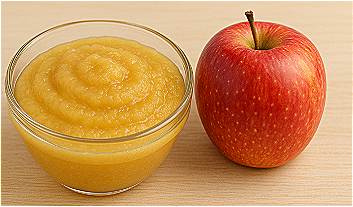
• Preparation obtained by milling/disintegrating sound, ripe apples to a smooth or particulate puree and stabilising by heat.
• Offered NFC (not from concentrate) or from concentrate (reconstituted), in smooth or with particles styles; ascorbic acid may be used as antioxidant.
• Sweet–tart profile with fresh fruity notes or more cooked/caramelised nuances depending on cultivar and heat history.
• Typical single-strength targets: °Brix 10–13, pH ~3.2–3.8, titratable acidity as malic acid 3–8 g/L; viscosity by Bostwick or Brookfield per spec.
Indicative nutrition values (per 100 g, 100% unsweetened puree; typical ranges)
• Energy: 45–60 kcal
• Carbohydrates: 10–14 g (of which sugars 9–12 g)
• Fibre: 1.0–2.0 g (mainly pectins and cell-wall colloids)
• Protein: ~0.2–0.4 g
• Fat: ~0.1 g — SFA (saturated fatty acids; keep low to support LDL control), MUFA and PUFA negligible
• Sodium: <5 mg
• Potassium: 100–180 mg
• Vitamin C: 0–15 mg (higher when ascorbic acid is added and declared)
Key constituents
• Sugars: fructose, glucose, sucrose (range depends on cultivar/maturity).
• Organic acids: malic (dominant), minor citric.
• Pectins and cell-wall colloids: contribute body and viscosity.
• Polyphenols: chlorogenic acid, catechins, procyanidins, quercetin glycosides (levels reduced by oxidation/processing).
• Volatiles: fruity esters (e.g., ethyl-2-methylbutyrate), aldehydes and alcohols.
• Undesirables to control: patulin, 5-HMF from excessive heating, pesticide residues within legal limits.
Production process
• Raw fruit selection: exclude mouldy/decayed apples; manage maturity.
• Washing & preparation: brushing, rinsing, sorting; cutting/milling.
• Browning control: deaeration, ascorbate/citrate where permitted; tight oxygen/time management to limit PPO activity.
• Cooking/refining: gentle heating; sieving/finishing to target particle size; optional °Brix standardisation.
• Stabilisation: HTST pasteurisation with aseptic fill or retort/sterilisation for jars; concentrates by vacuum evaporation.
• Packaging: glass, doypack, cans, aseptic bag-in-box/IBC; reduced headspace (nitrogen) and light/oxygen protection.
Sensory and technological properties
• Colour: golden to amber; Lab* shifts with cultivar and heat load.
• Texture/viscosity: driven by pectins and particle size; control syneresis via pH/Ca²⁺ and thermal curve.
• Stability: sensitive to enzymatic/non-enzymatic oxidation; light and O₂ speed browning.
• Functionality: sweet–acid base for fruit preps (yoghurt/desserts), bakery fillings, thick beverages; adds body and natural colour.
Food applications
• Infant foods, spoonable desserts, yoghurt fruit preparations, smoothies/thick shots.
• Bakery fillings for pies/tarts, toppings, bars, ice creams and sorbets.
• Sauces, glazes and reductions; blending with other purees/juices for tailored profiles.
Nutrition & health
Apple puree retains more fibre than clear juice because part of the fruit matrix (notably pectins) remains. This supports satiety, increases gastric viscosity, and typically moderates glycaemic rise versus juice, though it still elicits a faster response than a whole apple—especially in finely sieved, very smooth styles.
Polyphenols contribute antioxidant activity but are oxygen/heat sensitive; gentle processing, deaeration, and barrier packaging help preserve them. Vitamin C is variable due to process losses; when ascorbic acid is added (and labelled), “source of vitamin C” claims may be achievable subject to thresholds. Among minerals, potassium is notable.
Fat is negligible: SFA are minimal, and mono-/polyunsaturates are trivial, so the impact on dietary fat quality is neutral—useful when limiting saturates.
For children and oral health, prefer unsweetened puree, serve with meals (not sipped over long periods), and be mindful of free sugars exposure and caries risk. In FODMAP-sensitive individuals, natural sorbitol and fermentable sugars can cause discomfort—portioning and personal tolerance testing are prudent.
Portion note: 100–150 g works well as a snack or dessert portion; for infants, follow paediatric guidance and local recommendations.
Quality and specifications (typical topics)
• Identity/composition: °Brix, pH, acidity (as malic), Brix/acid ratio, viscosity (Bostwick/Brookfield), particle-size/percent particulates.
• Appearance: colour (CIELAB), absence of separation/syneresis, fresh aroma without oxidised or overly “cooked” notes.
• Chemistry: low 5-HMF; patulin below limits; heavy metals within spec.
• Residues: pesticides ≤ MRL; sulphites labelled at ≥10 mg/kg (seldom used).
• Microbiology: pathogens absent/25 g; total counts/yeasts/moulds in spec; no spontaneous fermentation.
• Functional tests: light/O₂ stability, accelerated shelf-life, application trials (e.g., syneresis in yoghurt, bake-stability in bakery).
Storage and shelf-life
• Aseptic/retorted packs: ambient storage away from light/heat.
• After opening: refrigerate 0–4 °C; use within 3–5 days.
• Frozen industrial packs: ≤ −18 °C; thaw cold; avoid refreezing.
• Typical shelf-life: 9–12 months depending on process/pack/logistics; main risks are browning, aroma loss, and syneresis.
Safety and regulatory
• Names: “apple puree” / “apple puree from concentrate” (or “applesauce” where customary), per local standards.
• Added sugars: not permitted in 100%/“no added sugar” products (must state “contains naturally occurring sugars”).
• Contaminants: limits for patulin and 5-HMF; pesticide/metal compliance; operations under GMP/HACCP.
• Allergens: not a priority allergen; sulphites declared at ≥10 mg/kg if used.
• Nutrition/health claims: only when thresholds are met (e.g., “source of vitamin C” if content qualifies).
Labeling
• Name of the food and ingredients list: “apple puree” (and “from concentrate” if applicable), ascorbic acid if used, returned flavours where applicable.
• Claims: “no added sugar” when compliant; “100% apple”; origin as required; lot and date marking.
• Directions: storage after opening; intended use (e.g., “fruit preparation for yoghurt”).
Troubleshooting
• Premature browning: excess O₂/active PPO → deaerate, add ascorbate/citrate, avoid copper/iron contact.
• Out-of-spec viscosity: pectin degradation or wrong screen → retune thermal/pH profile, adjust sieving, manage Ca²⁺.
• Syneresis/separation: inadequate pectin or sub-optimal pH/ions → adjust pectin/matrix, correct pH, optimise process.
• Over-cooked notes/loss of freshness: excessive heat/time → optimise HTST, recover/return flavours, shorten residence time.
• Crystals/sediment: pectin/tartrate precipitation → cold stabilisation and polishing filtration.
Sustainability and supply chain
• Raw material: valorise off-grade sizes; reduce post-harvest losses.
• By-products: pomace to pectin/fibre, feed, or bioenergy.
• Plant: heat recovery, CIP water reuse, wastewater management toward BOD/COD targets; recyclable/lightweight packs.
• Systems: robust traceability and safety under GMP/HACCP, supplier audits.
Conclusion
Apple puree is a versatile, natural base that brings flavour, colour, and body via pectins, with an approachable nutrition profile. Product success depends on fruit quality, careful oxygen/heat control, particle-size management, and protective packaging, prioritising 100% no-added-sugar styles and sensible portions.
INCI functions (cosmetics)
• Pyrus Malus (Apple) Fruit Extract / Juice / Pectin: skin-conditioning, humectant, antioxidant; pectin as gelling/thickening agent in water-based cosmetics (claims and use subject to local regulations).
Mini-glossary
• °Brix: Measure of soluble solids (mostly sugars); correlates with sweetness/body.
• Bostwick/Brookfield: Bench tools to gauge viscosity/flow of purees.
• Pectin: Soluble fibre providing gel/viscosity; interacts with pH, sugars, and Ca²⁺.
• PPO: Polyphenol oxidase; enzyme driving browning; controlled by heat, ascorbate, and deaeration.
• Patulin: Mycotoxin from mouldy apples; must remain below legal limits.
• 5-HMF: Marker of excessive heat/sugar degradation; lower values indicate gentle processing.
• Free sugars: Sugars not enclosed in the fruit cell matrix; advisable to moderate.
• SFA: Saturated fatty acids — excessive intake can raise LDL-cholesterol; keep low overall.
• MUFA: Monounsaturated fatty acids — generally favourable when replacing saturates.
• PUFA: Polyunsaturated fatty acids — include n-6/n-3 families; beneficial when balanced and protected from oxidation.
• ALA: Alpha-linolenic acid (essential n-3); not meaningful in apple products.
• EPA/DHA: Long-chain n-3 fatty acids typical of fish/algae; absent in apple products.
• MCT: Medium-chain triglycerides; not relevant in apple products.
• GMP/HACCP: Good manufacturing practice / hazard analysis and critical control points — preventive hygiene systems with validated CCPs.
• BOD/COD: Biochemical/chemical oxygen demand — wastewater impact metrics guiding treatment.
Studies
Apple has antioxidant properties (1) especially on the fats of the cell membrane and therefore helps to combat vascular diseases such as atherosclerosis and other forms of cardiovascular problems.
Another important function is to regulate the balance of blood sugar, stimulating the cells of the pancreas to produce the right dose of insulin (2).
Other studies have shown the effectiveness of apples in reducing the risks of asthma and aging.
Raw or cooked apples are also an excellent digestive aid.
Phlorizin , a glucoside compound found in the bark of apples, in quantities of 100ug/ml has demonstrated a protective antioxidant effect on DNA damage and cellular apoptosis (3).
Among the polyphenols present, cyanidin-3-galactoside, catechin, epicatechin and proanthocyanidin in an apple extract reduced free radicals by inducing apoptosis of cancer cells. Among the apples varieties, red apples were most effective against BGC-803 cancer cells (4).
Phldz (phloretin 2′-O-glucose), a phenylpropanoid found only in apples, and Phlor, a direct derivative thereof, exert an anti-inflammatory function in the intestine, improving the symptoms of intestinal inflammation (5).
In a crossover study involving 30 participants, a high intake of apples improved endothelial function, blood pressure and arterial rigidity both acutely and chronically (6). The cardioprotective role of the apple can therefore be confirmed.

