Riso di konjac (glucomannano)
Descrizione
Preparazione alimentare a base di farina di konjac (ricca di glucomannano) e acqua, gelificata con ioni calcio in granelli che imitano il riso.
Profilo sensoriale: sapore neutro (dopo risciacquo), colore bianco–panna, texture elastica e mordente; assorbe bene salse e condimenti.
Posizionamento: sostituto del riso low-calorie, senza glutine, adatto a diete low-carb/cheto e formulazioni plant-based.
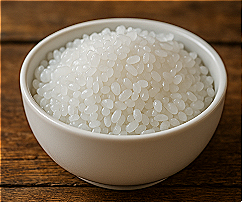
Valore calorico (per 100 g di prodotto sgocciolato)
~5–20 kcal; carboidrati digeribili <1–3 g, fibre solubili (glucomannano) ~2–4 g, proteine <0,5 g, grassi <0,5 g, sodio basso; calcio variabile (da agente indurente).
Principali sostanze contenute
Glucomannano (copolimero β-1,4 glucosio–mannosio) come fibra solubile funzionale.
Acqua (frazione predominante nel prodotto finito).
Idrossido di calcio/lattato di calcio come agente di gelificazione/indurente (residuo tecnologico controllato).
Processo di produzione
Preparazione miscela: farina di konjac + acqua sotto alto shear.
Gelificazione/indurimento: aggiunta controllata di alcali/ioni Ca²⁺ → formazione di gel termostabile.
Formatura: estrusione/taglio in granelli tipo riso → sbiancatura e raffreddamento.
Confezionamento: in acqua/soluzione leggermente alcalina, pastorizzazione o sterilizzazione; imballi barriera (buste, vaschette).
Controlli: peso sgocciolato, pH, tenore di fibra, fermezza e carica microbica.
Proprietà sensoriali e tecnologiche
Assorbimento aromi: eccellente; il gusto è veicolo delle salse.
Stabilità in cottura: mantiene granulo e elasticità; non rilascia amido (niente “cremosità” tipica del riso).
Gestione acqua: può risultare acquoso se non asciugato in padella dopo il risciacquo.
Odore iniziale caratteristico: dovuto alla soluzione alcalina; si riduce con risciacqui e breve sbollentatura.
Impieghi alimentari
Saltati e bowl: base per stir-fry, rice bowl, poké-style (dopo asciugatura in padella).
Piatti “tipo risotto”: richiede salse/leganti (es. formulazioni con panna/crema vegetale, riduzioni) perché non lega l’amido.
Insalate fredde: buon tenore di mordente; sgocciolare e tamponare prima del condimento.
Diete ipocaloriche/low-carb: sostituzione parziale o totale del riso per ridurre kcal e carboidrati.
Nutrizione e salute
Fibra solubile (glucomannano): può favorire sazietà, modulazione glicemica e colesterolemia a dosi adeguate di assunzione giornaliera (rispettare le condizioni d’uso in etichetta).
Possibili disturbi gastrointestinali (gonfiore) se si aumenta bruscamente l’apporto di fibra: introdurre gradualmente e bere acqua.
FODMAP bassi; senza glutine per natura.
Profilo dei grassi
Grassi trascurabili; contributi **PUFA**, **MUFA**, **SFA**, **TFA**, **MCT** irrilevanti in questo ingrediente.
Qualità e specifiche (temi tipici)
Peso netto sgocciolato conforme; pH leggermente alcalino; tenore di fibra dichiarato.
Texture/fermezza uniforme; assenza di odori anomali dopo risciacquo.
Microbiologia: sterilità commerciale o pastorizzazione conforme; patogeni assenti/25 g.
Contaminanti: metalli/pesticidi entro limiti; corpi estranei assenti; residui Ca(OH)₂ sotto specifica.
Conservazione e shelf-life
Ambiente (se confezionato asettico/retort) in luogo fresco e buio; refrigerare dopo l’apertura e consumare entro 2–3 giorni.
Evitare congelamento della confezione in acqua (possibile sinèresi/texture gommasa).
Allergeni e sicurezza
Non è tra gli allergeni maggiori; senza glutine.
Sicurezza d’uso: consumare sempre idratato; masticare adeguatamente; per soggetti sensibili o bambini evitare forme gel troppo compatte.
Etichettare correttamente eventuali claim salutistici relativi al glucomannano.
Uso pratico (consigli di preparazione)
Risciacquare 2–3 volte sotto acqua corrente.
Sbollentare 1–2 minuti (opzionale, con poche gocce di limone/aceto).
Asciugare in padella antiaderente a secco 2–3 minuti per eliminare l’acqua in eccesso.
Condire con salse/proteine/verdure e un filo d’olio per migliorare palatabilità e adesione.
Funzioni INCI in cosmesi (ove applicabile)
Troubleshooting
Odore persistente dopo apertura: risciacqui ripetuti + breve sbollentatura con acido lieve (limone/aceto).
Prodotto acquoso in padella: asciugare a secco prima di aggiungere salse; alzare leggermente temperatura e mescolare.
Salsa non aderente: aggiungere grassi emulsionati (es. olio + lecitina o panna vegetale), ridurre acqua del condimento.
Texture troppo gommosa: ridurre tempi di cottura e l’esposizione a alcali; finire la cottura in salsa.
Sostenibilità e filiera
Konjac richiede bassi input agricoli e offre rese elevate del tubero; il prodotto finito trasporta acqua (valutare imballi leggeri e logistica).
In stabilimento: recupero acqua nei lavaggi, gestione reflui verso target **BOD/COD**, pack riciclabili, sistemi **GMP/HACCP** e tracciabilità robuste.
Etichettatura
Denominazioni: “riso di konjac”, “shirataki di konjac (formato riso)”.
Elenco ingredienti tipico: acqua, farina di konjac (glucomannano), agente di indurimento (idrossido/lattato di calcio).
Dichiarare peso sgocciolato, valori nutrizionali, senza glutine, istruzioni d’uso (risciacquo/asciugatura).
Conclusione
Il riso di konjac è un sostituto del riso a bassissime calorie, con alto contenuto di fibra solubile e buona versatilità. Per risultati ottimali: risciacquare, sbollentare e asciugare prima del condimento; usare salse e una quota di grassi per migliorare adesione e soddisfazione sensoriale, mantenendo i benefici nutrizionali del glucomannano.
Mini-glossario
Glucomannano: fibra solubile (copolimero glucosio–mannosio) responsabile di viscosità e gel dei prodotti a base konjac.
Sinèresi: rilascio di acqua da un gel; si limita con asciugatura o salse più corpose.
FODMAP: carboidrati fermentabili che possono dare gonfiore; il riso di konjac è in genere basso in FODMAP.
**GMP/HACCP**: good manufacturing practice / hazard analysis and critical control points, sistemi igienico–preventivi.
**BOD/COD**: domanda biochimica/chimica di ossigeno, indicatori per la gestione dei reflui di processo.
Bibliografia__________________________________________________________________________
Laignier F, Akutsu RCA, Lima BR, Zandonadi RP, Raposo A, Saraiva A, Botelho RBA. Amorphophallus konjac: Sensory Profile of This Novel Alternative Flour on Gluten-Free Bread. Foods. 2022 May 10;11(10):1379. doi: 10.3390/foods11101379.
Abstract. This study aimed to evaluate the sensory profile of gluten-free bread with Amorphophallus konjac (AK) flour in different concentrations. This experimental study is divided into three steps: preparation of the gluten-free bread formulations, sensory analysis, and statistical analysis. The addition of Konjac flour in a gluten-free bread formulation was tested in different proportions, 12.5%, 25%, 37.5%, and 50% of the flour content. The checking all-that-apply (CATA) was conducted with 110 panelists; among these, 43 were consumers of gluten-free bread. Sensory analysis was conducted using a 9-point hedonic scale for color, aroma, texture, flavor, appearance, and overall acceptability. The AK flour influenced the sensory characteristics of gluten-free bread. Bread with characteristics closer to those found in bread with gluten was the one with 12.5% of konjac flour for both the acceptability analysis as the attributes raised through a detailed CATA map. The control sample is located next to features like dry appearance, dry texture and grainy, dark color, and salty. Therefore, 12.5% AK gluten-free bread is closer to the characteristics of the control sample, such as light crust color, light crumb color, soft and moist texture, cohesion, and brightness. The bread with the highest percentage of overall consumer acceptance was 12.5% konjac with 93% and 96% acceptance among consumers and non-consumers of gluten-free bread, respectively.
Drugs and Lactation Database (LactMed®) [Internet]. Bethesda (MD): National Institute of Child Health and Human Development; 2006–. Glucomannan. 2024 Dec 15.
Abstract. Glucomannan is a soluble, highly viscous fiber commonly derived from Amorphophallus konjac root. Glucomannan has no specific lactation-related uses. It is most often used to lower cholesterol, to treat constipation and diabetes, and is contained in products to promote weight loss. No data exist on the safety and efficacy of glucomannan in nursing mothers or infants. However, because glucomannan is not absorbable, it will not reach the breastmilk and is very unlikely to affect the nursing infant. Dietary supplements do not require extensive pre-marketing approval from the U.S. Food and Drug Administration. Manufacturers are responsible to ensure the safety, but do not need to prove the safety and effectiveness of dietary supplements before they are marketed. Dietary supplements may contain multiple ingredients, and differences are often found between labeled and actual ingredients or their amounts. A manufacturer may contract with an independent organization to verify the quality of a product or its ingredients, but that does not certify the safety or effectiveness of a product. Because of the above issues, clinical testing results on one product may not be applicable to other products. More detailed information about dietary supplements is available elsewhere on the LactMed Web site.
Laignier F, Akutsu RCCA, Maldonade IR, Bertoldo Pacheco MT, Silva VSN, Mendonça MA, Zandonadi RP, Raposo A, Botelho RBA. Amorphophallus konjac: A Novel Alternative Flour on Gluten-Free Bread. Foods. 2021 May 27;10(6):1206. doi: 10.3390/foods10061206.
Abstract. The demand for gluten-free products is rising, but their production with similar quality as their gluten counterparts is challenging. This study aimed to develop gluten-free bread samples using different concentrations of Amorphophallus konjac flour (0%, 12.5%, 25%, 37.5%, and 50% of the total flour content) and to evaluate their nutritional and physicochemical properties. Proteins, lipids, carbohydrates, moisture, ash content, fibers, resistant starch, firmness, specific volume, and color were evaluated using official methods. Protein varied from 2.95% to 4.94%, the energy value from 347.93 to 133.55 kcal/100 g, dietary fiber from 8.19 to 17.90%, and resistant starch from 0.67% to 0.75% on wet basis. The addition of konjac flour positively influenced the specific volume. Higher concentrations of konjac flour in the formulations led to lower calories of the bread due to the significant addition of water to the dough. The bread samples with konjac showed high fiber content due to the composition of the flour. They had lower levels of carbohydrates, which can positively influence the glycemic index. Konjac flour provided dough mold, growth, and better texture for gluten-free bread. The best formulations were prepared in concentrations up to 37.5% konjac. The 50% konjac bread showed slightly reduced specific volume and pale color.
Islam F, Labib RK, Zehravi M, Lami MS, Das R, Singh LP, Mandhadi JR, Balan P, Khan J, Khan SL, Nainu F, Nafady MH, Rab SO, Emran TB, Wilairatana P. Genus Amorphophallus: A Comprehensive Overview on Phytochemistry, Ethnomedicinal Uses, and Pharmacological Activities. Plants (Basel). 2023 Nov 23;12(23):3945. doi: 10.3390/plants12233945.
Abstract. The genus Amorphophallus belongs to the family Araceae. Plants belonging to this genus are available worldwide and have been used in traditional medicines since ancient times, mainly in Ayurveda and Unani medical practices. Amorphophallus species are an abundant source of polyphenolic compounds; these are accountable for their pharmacological properties, such as their analgesic, neuroprotective, hepatoprotective, anti-inflammatory, anticonvulsant, antibacterial, antioxidant, anticancer, antiobesity, and immunomodulatory effects, as well as their ability to prevent gastrointestinal disturbance and reduce blood glucose. Moreover, Amorphophallus species contain numerous other classes of chemical compounds, such as alkaloids, steroids, fats and fixed oils, tannins, proteins, and carbohydrates, each of which contributes to the pharmacological effects for the treatment of acute rheumatism, tumors, lung swelling, asthma, vomiting, abdominal pain, and so on. Additionally, Amorphophallus species have been employed in numerous herbal formulations and pharmaceutical applications. There has been no extensive review conducted on the Amorphophallus genus as of yet, despite the fact that several experimental studies are being published regularly discussing these plants' pharmacological properties. So, this review discusses in detail the pharmacological properties of Amorphophallus species. We also discuss phytochemical constituents in the Amorphophallus species and their ethnomedicinal uses and toxicological profiles.
Jiang M, Li H, Shi JS, Xu ZH. Depolymerized konjac glucomannan: preparation and application in health care. J Zhejiang Univ Sci B. 2018 Jul;19(7):505-514. doi: 10.1631/jzus.B1700310.
Abstract. Konjac glucomannan (KGM) is a water-soluble polysaccharide obtained from the roots and tubers of konjac plants. Recently, a degraded product of KGM, depolymerized KGM (DKGM), has attracted attention because of its low viscosity, improved hydrophily, and favorable physiological functions. In this review, we describe the preparation of DKGM and its prebiotic effects. Other health benefits of DKGM, covering antioxidant and immune activity, are also discussed, as well as its safety. DKGM could be a candidate for use as a tool for the treatment of various diseases, including intestinal flora imbalance, and oxidative- and immune-related disorders.




