Pea starch
Description
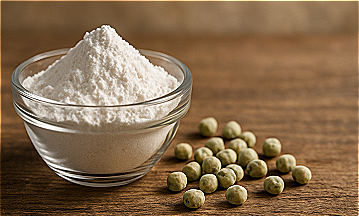
Native starch extracted from yellow/green field peas (Pisum sativum), composed primarily of amylose and amylopectin.
Sensory profile: neutral taste, white to off-white color; forms opaque, firm gels due to high amylose (typically ~30–45% in conventional peas; waxy peas ≈ ~0–5%).
Positioning: clean-label thickener/gelling agent, naturally gluten-free, suitable for allergen-aware and plant-based formulations.
Caloric value (per 100 g, powder)
~350–370 kcal; carbohydrates ~85–90 g (mostly starch), protein ~0.3–1.0 g, fat ~0.1–0.8 g, fiber ~0.5–1.5 g, sodium low.
Key constituents
Starch polymers: amylose (linear) and amylopectin (branched); amylose level drives gel strength, retrogradation, and film-forming ability.
Granule morphology: typically 5–45 µm granules, smooth and lenticular/spherical; low phosphorus vs potato starch → lower swelling, higher gel firmness.
Minor components: lipids/proteins bound to granules (trace), ash low; resistant starch (RS3) increases after cooling/retrogradation.
Production process
Fractionation: peas cleaned → dehulled → milled; wet separation splits starch, protein, and fiber (hydrocyclones/centrifugation).
Purification & drying: repeated washing, dewatering, flash/spray drying, sieving to spec; optional pregelatinization for instant use.
Co-products: pea protein (concentrate/isolate) and fiber; water circuits closed with recovery/filtration.
Sensory and technological properties
Gelatinization: onset typically ~60–67 °C, peak ~68–75 °C (matrix-dependent); yields firm, cuttable gels.
Viscosity & shear: moderate swelling; native paste shear/acid stability is limited—cross-linked grades resist shear/acid/heat better.
Freeze–thaw: native gels can synerese on cycling; acetylated/stabilized grades improve freeze–thaw performance.
Clarity/opacification: gels are opaque (high amylose); for high clarity, blend with waxy maize/tapioca.
Film forming/coating: amylose-rich systems form brittle films with good oil barrier; plasticizers (e.g., glycerol) increase flexibility.
Extrusion/puffing: suitable for snack expansion and noodle texture (elastic, resilient bite).
Food applications
Gluten-free bakery & pasta: improves structure, crumb moisture, and mordant bite; supports sheeting/noodle systems.
Batters & coatings: enhances adhesion/crispness; balances pick-up and oil uptake.
Meat & plant-based analogs: binder and water/fat stabilizer; adds firmness and sliceability to emulsion gels.
Soups, sauces, baby foods: clean-label thickening; pregelatinized pea starch gives instant viscosity.
Confectionery & gummies: starch-set gels (opaque, firm) or moulding starch in jelly production.
Noodles & glass-style alternatives: contributes elasticity and bite; blends can emulate mung-bean textures.
Nutrition and health
Digestible carbohydrate source with potential RS3 increase after cook–cool (may modestly lower GI in finished foods).
Protein/fat contributions are minimal; naturally gluten-free.
Allergenicity: peas are legumes but pea starch contains very low protein; manage cross-contact with pea protein in shared facilities.
Fat profile
Total fat negligible; any lipids are trace and nutritionally insignificant here (therefore **PUFA**, **MUFA**, **SFA**, **TFA**, **MCT** are not relevant for pea starch).
Quality and specifications (typical topics)
Composition: starch ≥85–88% (db), moisture ≤12–14%, protein ≤1%, fat ≤1%, ash ≤0.5%.
Functional metrics: gelatinization onset/peak (DSC), RVA pasting profile, gel strength, swelling power/solubility, blue value (iodine binding ↔ amylose).
Particle size/whiteness: mesh per application; L* target for color-critical uses.
Microbiology: pathogens absent/25 g; low TPC/yeasts/moulds; Salmonella negative.
Contaminants: mycotoxins/metals/pesticides within limits; foreign matter absent.
Storage and shelf life
Store cool, dry, dark, in airtight moisture-barrier packaging; protect from humidity (caking) and odors.
Shelf life: typically 24–36 months unopened; after opening, use within weeks and reseal.
Allergens and safety
Gluten-free by nature; pea/legume allergies exist but risk is reduced due to low protein in starch.
Suitable for vegan/vegetarian products; confirm cleaning validation to prevent protein carryover.
GMO status: peas are generally non-GMO; verify claims with identity-preserved documentation.
INCI functions in cosmetics (where applicable)
INCI: Pisum Sativum (Pea) Starch / Pea Starch.
Roles: absorbent, bulking, skin feel modifier in powders, dry shampoos, lotions.
Troubleshooting
Syneresis after freeze–thaw: switch to acetylated/cross-linked pea starch or blend with tapioca/waxy starch; increase solids/sugars.
Lumping on cold make-up: use pregelatinized/agglomerated starch; improve shear/wetting; disperse into oil before water.
Paste thinning under shear/acid: choose cross-linked grade; adjust pH/ionic strength; reduce cook time.
Too opaque/firm gels: reduce pea starch ratio, add waxy starch/hydrocolloid (e.g., guar, xanthan) for softer, clearer systems.
Weak expansion in snacks: raise moisture at die, optimize barrel temperature profile, or blend with tapioca/corn.
Sustainability and supply chain
Peas are nitrogen-fixing, lowering synthetic fertilizer needs and aiding crop rotations; often grown in EU/Canada with short supply chains.
In-plant: optimize water/energy in wet milling; manage effluents toward **BOD/COD** targets; use recyclable packaging; maintain **GMP/HACCP** and robust traceability.
Labelling
Ingredient name: “pea starch” (or “Pisum sativum starch”); specify native/pregelatinized/modified as applicable.
For modified starches, use the appropriate designation (e.g., acetylated, cross-linked) per jurisdiction; gluten-free/vegan claims when compliant.
Conclusion
Pea starch is a clean-label, gluten-free thickener and firm gelling agent with neutral flavor, good process tolerance, and strong texture contribution—especially where firm, opaque gels, crisp coatings, or resilient noodles/snacks are desired. Optimizing grade (native vs modified vs pregel), cook profile, and blends ensures the target viscosity, freeze–thaw stability, and sensory quality.
Mini-glossary
Amylose/amylopectin: Linear/branched starch polymers; amylose increases gel firmness and retrogradation.
Retrogradation / RS3: Reassociation of gelatinized starch on cooling; forms resistant starch (RS3) with potential GI reduction.
Gelatinization: Heat-induced melting of starch crystallites, allowing swelling and viscosification.
RVA (Rapid Visco Analyzer): Instrument that records pasting curves to predict processing behavior.
DSC (Differential Scanning Calorimetry): Measures gelatinization onset/peak/enthalpy.
Degree of substitution (DS): Average substituent groups per anhydroglucose unit in modified starch; affects stability/texture.
**GMP/HACCP** — good manufacturing practice / hazard analysis and critical control points: Preventive food-safety systems with validated CCPs.
**BOD/COD** — biochemical/chemical oxygen demand: Wastewater metrics guiding treatment and environmental compliance.
GI — glycaemic index: Post-prandial glucose impact; may decrease when RS3 content increases.
References__________________________________________________________________________
Perreau C, Desailly F, Grard S, Thondre PS, Ahlstrom L, Tammam J, Wils D. Slow Digestible Starch in Native Pea Starch (Pisum sativum L.) Lowers Glycemic Response with No Adverse Effects on Gastrointestinal Symptoms in Healthy Adults. J Med Food. 2024 Jan;27(1):95. doi: 10.1089/jmf.2023.0085.
Abstract. Diabetes prevalence achieved 470B in 2021. Diabetics are looking for foods that allow them to better manage the postprandial glycemia. Owing to its large amylose fraction, pea starch may contribute to formulate recipes with a lower glycemic index (GI). This study measured the rapidly, slowly digested and resistant fractions in pea starch and in a powder mix recipe. Starch fractions were determined according to the Englyst methodology. A nonblind repeat measure crossover design trial in healthy humans was used to study the GI of pea starch and maltodextrin powder mix recipes against glucose. Gastrointestinal symptoms were measured. Thirteen healthy volunteers aged 18-60 years with body mass index <30 kg/m2 and fasting blood glucose <6.1 mmol/L participated in the study. They consumed 25 g available carbohydrate portions of the test products. Blood glucose was measured at -5 and 0 min before consumption till 180 min after starting to eat. The slow digestible starch (SDS) content of native pea starch was 30% of the total starch content. The pea-based powder mix recipe contained 25% SDS in comparison with 9% for the maltodextrin-based recipe. The glucose response after pea starch was significantly lower compared with maltodextrin. The glucose response after pea starch recipe was significantly lower compared with maltodextrin recipe. There was no significant difference in mean scores for well-being and gastrointestinal symptoms after consumption of pea starch and maltodextrin or between the two recipes. In conclusion, this study has demonstrated the presence of high SDS content in pea starch, which reduced postprandial glycemic response compared with maltodextrin. The pea starch recipe did not induce any negative gastrointestinal symptoms. Pea starch may, therefore, prove to be a beneficial ingredient in developing food products for improving glycemic control without undesirable side effects.
Qin N, Meng Y, Ma Z, Li Z, Hu Z, Zhang C, Chen L. Pea Starch-Lauric Acid Complex Alleviates Dextran Sulfate Sodium-Induced Colitis in C57BL/6J Mice. Nutr Cancer. 2023;75(8):1673-1686. doi: 10.1080/01635581.2023.2223789.
Abstract. The previous documentation has shown the role of resistant starch in promoting intestinal health, while the effect of starch-lipid complex (RS5) on colitis remains unclear. This study aimed to investigate the effect and potential mechanism of RS5 in colitis. We prepared RS5 complexes by combining pea starch with lauric acid. Mice with dextran sulfate sodium-induced colitis were treated with either RS5 (3.25 g/kg) or normal saline (10 mL/kg) for seven days, and the effects of pea starch-lauric acid complex on mice were observed. The RS5 treatment significantly attenuated weight loss, splenomegaly, colon shortening, and pathological damage in mice with colitis. Compare with the DSS group, cytokines levels, such as tumor necrosis factor-α and interleukin-6 in both serum and colon tissue was significantly decreased in RS5 treatment group, while the gene expression of interleukin-10 and the expression of mucin 2, zonula occludens-1, Occludin, and claudin-1 in the colon was significantly upregulated in RS5 treatment group. In addition, RS5 treatment altered the gut microbiota structure of colitis mice by increasing the abundance of Bacteroides and decreasing Turicibacter, Oscillospira, Odoribacter, and Akkermansia. The dietary composition could be exploited to manage colitis by attenuating inflammation, restoring the intestinal barrier, and regulating gut microbiota.
Zhou J, Wang L, Yang G, Yang L, Zeng X, Qiao S. Pea starch increases the dry matter flow at the distal ileum and reduces the amino acids digestibility in ileal digesta collected after 4 hours postprandial of pigs fed low-protein diets. Anim Biosci. 2022 Jul;35(7):1021-1029. doi: 10.5713/ab.21.0354.
Abstract. Objective: The study was aimed to investigate the rules of postprandial changes in intestine digesta dry matter (DM) flow and amino acid digestibility of growing pigs fed low-protein (LP) diets made of different starch. Methods: Eight barrows (28.8±2.1 kg) with a T-cannula at the distal ileum were randomly allotted to an 8×3 Youden square design. Treatments included: waxy corn starch LP (WLP); corn starch LP (CLP) and pea starch LP (PLP). Diets were given at 08:00 and 20:00. Digesta samples were collected in six 2-h stages from 08:00 to 20:00. Results: The Cr concentrations of ileal digesta increased and then decreased in WLP and CLP, while increased continuously in PLP as time passed after postprandial (p<0.05). Higher average Cr concentrations (0.78% and 0.84% vs 0.70%; p<0.05) and lower average DM flow (181.1 g/kg and 166.3 g/kg vs 240.3 g/kg; p<0.001) were observed in WLP and CLP, compared with PLP. The apparent ileal digestibility coefficient of most amino acids in WLP and CLP increased compared with that in PLP. No difference in lysine or methionine digestibility was observed. When digesta were collected in 2-h periods, the apparent ileal digestibility coefficient of amino acids did not change over time. When digesta was collected in 4-h periods from 16:00 to 20:00 and 6-h periods from 14:00 to 20:00 (p<0.05), WLP and CLP showed markedly higher amino acid digestibility than PLP. Conclusion: High-amylose slowly digested starch can increase the DM flow at the distal ileum and reduce the apparent ileal digestibility coefficient of amino acids of pigs fed LP diets. Compared with waxy corn starch and corn starch, pea starch reduced the digestibility of amino acids in digesta collected after 4 h postprandial.
Yu Z, Gong D, Han C, Wei Y, Fu C, Xu X, Lu Y. Preparation and Properties of Pea Starch/ε-Polylysine Composite Films. Materials (Basel). 2022 Mar 21;15(6):2327. doi: 10.3390/ma15062327.
Abstract. The composite films comprising pea starch (St) and ε-polylysine (PL) as the matrix and glycerol and sodium alginate as the plasticizers were investigated. The rheological properties, mechanical properties, Fourier transformed infrared spectroscopy, water vapor permeability (WVP), oil permeability, microstructure, thermogravimetry (TGA), and antimicrobial properties of the composite films were analyzed. The properties of the composite films with different mass ratios of St/PL varied significantly. First, the five film solutions were different pseudoplastic fluids. Additionally, as the mass ratio of PL increased, the tensile strength of the blends decreased from 9.49 to 0.14 MPa, the fracture elongation increased from 38.41 to 174.03%, the WVP increased, and the oil resistance decreased substantially. The films with a broad range of St/PL ratios were highly soluble; however, the solubility of the film with a St/PL ratio of 2:8 was reduced. Lastly, the inhibition of E. coli, B.subtilis, and yeast by the films increased with increasing mass ratios of PL, and the inhibition of B.subtilis was the strongest.
Li G, Ge X, Guo C, Liu B. Effect of Ultrasonic Treatment on Structure and Physicochemical Properties of Pea Starch. Foods. 2023 Jul 6;12(13):2620. doi: 10.3390/foods12132620.
Abstract. The effects of ultrasonic treatment on the structure and physicochemical properties of pea starch were investigated in this study. The results showed that ultrasonic treatment increased the hydrolysis rate and particle size of pea starch. In the process of treatment, there were some depressions and pores on the surface of pea starch granules. Although the crystallization type of starch was retained, its crystallinity decreased. The pasting temperature of pea starch remained stable after ultrasonic treatment, but its peak viscosity, trough viscosity, cold viscosity, breakdown viscosity and setback viscosity all declined significantly. The transparency of starch paste decreased, but proper ultrasonic treatment could improve the strength of starch gel. The obtained results can provide a reference for the physical modification of pea starch.




