Amido di piselli (Pea starch)
Descrizione
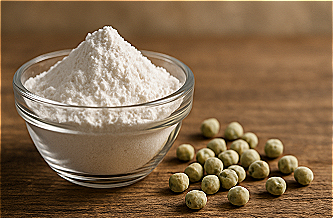
Amido nativo estratto da piselli da campo gialli/verdi (Pisum sativum), costituito principalmente da amilosio e amilopectina.
Profilo sensoriale: gusto neutro, colore bianco–panna; forma gel opachi e sodi grazie all’alto amilosio (tipicamente ~30–45%; nei piselli cerosi ≈ ~0–5%).
Posizionamento: addensante/gelificante clean-label, naturalmente senza glutine, adatto a formulazioni plant-based e allergen-aware.
Valore calorico (per 100 g, polvere)
~350–370 kcal; carboidrati ~85–90 g (prevalentemente amido), proteine ~0,3–1,0 g, grassi ~0,1–0,8 g, fibre ~0,5–1,5 g, sodio basso.
Principali sostanze contenute
Polimeri dell’amido: amilosio (lineare) e amilopectina (ramificata); il tenore di amilosio guida forza del gel, retrogradazione e formazione di film.
Morfologia dei granuli: 5–45 µm, lisci, lenticolari/sferici; fosforo basso vs amido di patata → minor rigonfiamento, gel più sodi.
Componenti minori: lipidi/proteine legati ai granuli (traccia), ceneri basse; lo **RS3** aumenta dopo raffreddamento/retrogradazione.
Processo di produzione
Frazionamento umido: piselli puliti → decorticati → macinati; separazione amido/proteine/fibre (idrocicloni/centrifughe).
Purificazione & asciugatura: lavaggi ripetuti, disidratazione, flash/spray-drying, setacciatura; opzionale pregelatinizzazione per uso istantaneo.
Co-prodotti: proteine di pisello (concentrati/isolati) e fibre; circuiti d’acqua chiusi con recupero/filtrazione.
Proprietà sensoriali e tecnologiche
Gelatinizzazione: inizio ~60–67 °C, picco ~68–75 °C (dipende dalla matrice) → gel sodi e tagliabili.
Viscosità & taglio: rigonfiamento moderato; la stabilità a taglio/acido del nativo è limitata — i gradi reticolati resistono meglio a taglio/acido/calore.
Congelamento/scongelamento: i gel nativi possono sinere; i gradi acetilati/stabilizzati migliorano la freeze–thaw.
Chiarezza: gel opachi (alto amilosio); per elevata trasparenza, miscelare con tapioca/mais ceroso.
Film/coating: sistemi ricchi in amilosio formano film fragili con buona barriera all’olio; glicerolo come plastificante aumenta la flessibilità.
Estrusione/espansione: adatto a snack espansi e noodles con mordente elastico.
Impieghi alimentari
Bakery & pasta senza glutine: migliora struttura, umidità dell’alveolo e bite; supporta laminazione/noodle.
Pastelle & panature: aumenta adesione/croccantezza; bilancia pick-up e assorbimento d’olio.
Carni & analoghi plant-based: legante e stabilizzante acqua/grassi; dona sodezza e affettabilità a gel d’emulsione.
Zuppe, salse, baby food: addensante clean-label; l’amido pregel fornisce viscosità istantanea.
Confetteria & gelatine: gel da amido (opachi, sodi) o moulding starch.
Noodles & alternative “glass-style”: contribuisce a elasticità e mordente; i blend possono emulare la testura del fagiolo mungo.
Nutrizione e salute
Fonte di carboidrati digeribili; lo **RS3** post cottura-raffreddamento può ridurre moderatamente l’**GI** del prodotto finito.
Proteine/grassi minimali; naturalmente senza glutine.
Allergenicità: i piselli sono leguminose, ma l’amido ha proteine molto basse; gestire il cross-contact con proteine di pisello in impianto.
Profilo dei grassi
Grassi totali trascurabili; i lipidi sono in traccia e nutrizionalmente irrilevanti (quindi **PUFA**, **MUFA**, **SFA**, **TFA**, **MCT** non rilevanti in questo ingrediente).
Qualità e specifiche (temi tipici)
Composizione: amido ≥85–88% (s.s.), umidità ≤12–14%, proteine ≤1%, grassi ≤1%, ceneri ≤0,5%.
Funzionalità: onset/picco di gelatinizzazione (DSC), profilo di pastificazione **RVA**, forza del gel, potere di rigonfiamento/solubilità, blue value (legame allo iodio ↔ amilosio).
Dimensione particelle/bianco L* a specifica applicativa.
Microbiologia: patogeni assenti/25 g, carica totale/lieviti/muffe bassa; Salmonella negativa.
Contaminanti: micotossine/metalli/pesticidi nei limiti; assenza di corpi estranei.
Conservazione e shelf-life
Conservare al fresco, asciutto, al buio, in pack barriera all’umidità, ben ermetico; proteggere da umidità (caking) e odori.
Shelf-life: tipicamente 24–36 mesi chiuso; dopo apertura richiudere e consumare entro poche settimane.
Allergeni e sicurezza
Senza glutine per natura; esistono allergie a legumi/pisello, ma il rischio è ridotto dato il basso tenore proteico dell’amido.
Idoneo a prodotti vegani/vegetariani; validare la pulizia per evitare trascinamenti proteici.
**GMO**: i piselli sono in genere non-OGM; verificare claim con documentazione IP.
Funzioni INCI in cosmesi (ove applicabile)
INCI: Pisum Sativum (Pea) Starch / Pea Starch.
Ruoli: assorbente, bulking, skin-feel modifier in polveri, dry shampoo, lozioni.
Troubleshooting
Sinèresi dopo freeze–thaw: usare gradi acetilati/reticolati o blend con tapioca/mais ceroso; aumentare solidi/zuccheri.
Grumi a freddo: impiegare pregel/aglomerato, migliorare bagnabilità/taglio; disperdere in olio prima dell’acqua.
Assottigliamento sotto taglio/acido: scegliere grado reticolato; regolare pH/forza ionica; ridurre tempo di cottura.
Gel troppo opachi/sodi: ridurre dosaggio, aggiungere amidi cerosi/idrocolloidi (guar, xanthan) per testure più morbide/limpide.
Bassa espansione snack: aumentare umidità in testa stampo, ottimizzare profilo termico del cilindro, blend con tapioca/mais.
Sostenibilità e filiera
I piselli fissano azoto, riducono l’uso di fertilizzanti e favoriscono rotazioni; ampia coltivazione in EU/Canada con filiera corta.
In stabilimento: ottimizzare acqua/energia nel wet-milling, gestire i reflui verso target **BOD/COD**; impiegare pack riciclabili; mantenere **GMP/HACCP** e tracciabilità robuste.
Etichettatura
Denominazione: “amido di pisello” (“Pisum sativum starch”); specificare nativo/pregelatinizzato/modificato.
Per amidi modificati, usare la designazione corretta (es. acetilato, reticolato) secondo giurisdizione; claim senza glutine/vegano solo se conformi.
Conclusione
L’amido di piselli è un addensante/gelificante clean-label e senza glutine con sapore neutro, buona tolleranza di processo e forte contributo testurizzante — ideale quando servono gel opachi e sodi, panature croccanti o noodles/snack resilienti. La corretta scelta del grado (nativo vs modificato vs pregel), il profilo di cottura e i blend consentono di centrare viscosità, stabilità freeze–thaw e qualità sensoriale.
Mini-glossario
Amilosio/Amilopectina: Polimeri dell’amido (lineare/ramificato); l’amilosio aumenta forza del gel e retrogradazione.
Retrogradazione — **RS3**: Riorganizzazione dell’amido gelatinizzato al raffreddamento; genera amido resistente (RS3) con possibile riduzione dell’**GI**.
Gelatinizzazione: Fusione termica dei cristalli d’amido con rigonfiamento e viscosificazione.
**RVA** (Rapid Visco Analyzer): Strumento che registra le curve di pastificazione per prevedere il comportamento di processo.
**DSC** (Differential Scanning Calorimetry): Misura onset/picco/entalpia di gelatinizzazione.
**GI** — indice glicemico: Impatto glicemico post-prandiale; può diminuire se aumenta lo **RS3**.
**PUFA** — grassi polinsaturi: Potenzialmente benefici se bilanciati; irrilevanti nell’amido di pisello.
**MUFA** — grassi monoinsaturi: Spesso neutri/favorevoli; irrilevanti qui.
**SFA** — grassi saturi: Da mantenere moderati; trascurabili qui.
**TFA** — acidi grassi trans: Trascurabili negli amidi.
**MCT** — trigliceridi a media catena: Non rilevanti negli amidi.
**GMP/HACCP** — good manufacturing practice / hazard analysis and critical control points: Sistemi igienico-preventivi con CCP convalidati.
**BOD/COD** — domanda biochimica/chimica di ossigeno: Metriche per la gestione dei reflui e la conformità ambientale.
Bibliografia__________________________________________________________________________
Perreau C, Desailly F, Grard S, Thondre PS, Ahlstrom L, Tammam J, Wils D. Slow Digestible Starch in Native Pea Starch (Pisum sativum L.) Lowers Glycemic Response with No Adverse Effects on Gastrointestinal Symptoms in Healthy Adults. J Med Food. 2024 Jan;27(1):95. doi: 10.1089/jmf.2023.0085.
Abstract. Diabetes prevalence achieved 470B in 2021. Diabetics are looking for foods that allow them to better manage the postprandial glycemia. Owing to its large amylose fraction, pea starch may contribute to formulate recipes with a lower glycemic index (GI). This study measured the rapidly, slowly digested and resistant fractions in pea starch and in a powder mix recipe. Starch fractions were determined according to the Englyst methodology. A nonblind repeat measure crossover design trial in healthy humans was used to study the GI of pea starch and maltodextrin powder mix recipes against glucose. Gastrointestinal symptoms were measured. Thirteen healthy volunteers aged 18-60 years with body mass index <30 kg/m2 and fasting blood glucose <6.1 mmol/L participated in the study. They consumed 25 g available carbohydrate portions of the test products. Blood glucose was measured at -5 and 0 min before consumption till 180 min after starting to eat. The slow digestible starch (SDS) content of native pea starch was 30% of the total starch content. The pea-based powder mix recipe contained 25% SDS in comparison with 9% for the maltodextrin-based recipe. The glucose response after pea starch was significantly lower compared with maltodextrin. The glucose response after pea starch recipe was significantly lower compared with maltodextrin recipe. There was no significant difference in mean scores for well-being and gastrointestinal symptoms after consumption of pea starch and maltodextrin or between the two recipes. In conclusion, this study has demonstrated the presence of high SDS content in pea starch, which reduced postprandial glycemic response compared with maltodextrin. The pea starch recipe did not induce any negative gastrointestinal symptoms. Pea starch may, therefore, prove to be a beneficial ingredient in developing food products for improving glycemic control without undesirable side effects.
Qin N, Meng Y, Ma Z, Li Z, Hu Z, Zhang C, Chen L. Pea Starch-Lauric Acid Complex Alleviates Dextran Sulfate Sodium-Induced Colitis in C57BL/6J Mice. Nutr Cancer. 2023;75(8):1673-1686. doi: 10.1080/01635581.2023.2223789.
Abstract. The previous documentation has shown the role of resistant starch in promoting intestinal health, while the effect of starch-lipid complex (RS5) on colitis remains unclear. This study aimed to investigate the effect and potential mechanism of RS5 in colitis. We prepared RS5 complexes by combining pea starch with lauric acid. Mice with dextran sulfate sodium-induced colitis were treated with either RS5 (3.25 g/kg) or normal saline (10 mL/kg) for seven days, and the effects of pea starch-lauric acid complex on mice were observed. The RS5 treatment significantly attenuated weight loss, splenomegaly, colon shortening, and pathological damage in mice with colitis. Compare with the DSS group, cytokines levels, such as tumor necrosis factor-α and interleukin-6 in both serum and colon tissue was significantly decreased in RS5 treatment group, while the gene expression of interleukin-10 and the expression of mucin 2, zonula occludens-1, Occludin, and claudin-1 in the colon was significantly upregulated in RS5 treatment group. In addition, RS5 treatment altered the gut microbiota structure of colitis mice by increasing the abundance of Bacteroides and decreasing Turicibacter, Oscillospira, Odoribacter, and Akkermansia. The dietary composition could be exploited to manage colitis by attenuating inflammation, restoring the intestinal barrier, and regulating gut microbiota.
Zhou J, Wang L, Yang G, Yang L, Zeng X, Qiao S. Pea starch increases the dry matter flow at the distal ileum and reduces the amino acids digestibility in ileal digesta collected after 4 hours postprandial of pigs fed low-protein diets. Anim Biosci. 2022 Jul;35(7):1021-1029. doi: 10.5713/ab.21.0354.
Abstract. Objective: The study was aimed to investigate the rules of postprandial changes in intestine digesta dry matter (DM) flow and amino acid digestibility of growing pigs fed low-protein (LP) diets made of different starch. Methods: Eight barrows (28.8±2.1 kg) with a T-cannula at the distal ileum were randomly allotted to an 8×3 Youden square design. Treatments included: waxy corn starch LP (WLP); corn starch LP (CLP) and pea starch LP (PLP). Diets were given at 08:00 and 20:00. Digesta samples were collected in six 2-h stages from 08:00 to 20:00. Results: The Cr concentrations of ileal digesta increased and then decreased in WLP and CLP, while increased continuously in PLP as time passed after postprandial (p<0.05). Higher average Cr concentrations (0.78% and 0.84% vs 0.70%; p<0.05) and lower average DM flow (181.1 g/kg and 166.3 g/kg vs 240.3 g/kg; p<0.001) were observed in WLP and CLP, compared with PLP. The apparent ileal digestibility coefficient of most amino acids in WLP and CLP increased compared with that in PLP. No difference in lysine or methionine digestibility was observed. When digesta were collected in 2-h periods, the apparent ileal digestibility coefficient of amino acids did not change over time. When digesta was collected in 4-h periods from 16:00 to 20:00 and 6-h periods from 14:00 to 20:00 (p<0.05), WLP and CLP showed markedly higher amino acid digestibility than PLP. Conclusion: High-amylose slowly digested starch can increase the DM flow at the distal ileum and reduce the apparent ileal digestibility coefficient of amino acids of pigs fed LP diets. Compared with waxy corn starch and corn starch, pea starch reduced the digestibility of amino acids in digesta collected after 4 h postprandial.
Yu Z, Gong D, Han C, Wei Y, Fu C, Xu X, Lu Y. Preparation and Properties of Pea Starch/ε-Polylysine Composite Films. Materials (Basel). 2022 Mar 21;15(6):2327. doi: 10.3390/ma15062327.
Abstract. The composite films comprising pea starch (St) and ε-polylysine (PL) as the matrix and glycerol and sodium alginate as the plasticizers were investigated. The rheological properties, mechanical properties, Fourier transformed infrared spectroscopy, water vapor permeability (WVP), oil permeability, microstructure, thermogravimetry (TGA), and antimicrobial properties of the composite films were analyzed. The properties of the composite films with different mass ratios of St/PL varied significantly. First, the five film solutions were different pseudoplastic fluids. Additionally, as the mass ratio of PL increased, the tensile strength of the blends decreased from 9.49 to 0.14 MPa, the fracture elongation increased from 38.41 to 174.03%, the WVP increased, and the oil resistance decreased substantially. The films with a broad range of St/PL ratios were highly soluble; however, the solubility of the film with a St/PL ratio of 2:8 was reduced. Lastly, the inhibition of E. coli, B.subtilis, and yeast by the films increased with increasing mass ratios of PL, and the inhibition of B.subtilis was the strongest.
Li G, Ge X, Guo C, Liu B. Effect of Ultrasonic Treatment on Structure and Physicochemical Properties of Pea Starch. Foods. 2023 Jul 6;12(13):2620. doi: 10.3390/foods12132620.
Abstract. The effects of ultrasonic treatment on the structure and physicochemical properties of pea starch were investigated in this study. The results showed that ultrasonic treatment increased the hydrolysis rate and particle size of pea starch. In the process of treatment, there were some depressions and pores on the surface of pea starch granules. Although the crystallization type of starch was retained, its crystallinity decreased. The pasting temperature of pea starch remained stable after ultrasonic treatment, but its peak viscosity, trough viscosity, cold viscosity, breakdown viscosity and setback viscosity all declined significantly. The transparency of starch paste decreased, but proper ultrasonic treatment could improve the strength of starch gel. The obtained results can provide a reference for the physical modification of pea starch.




