



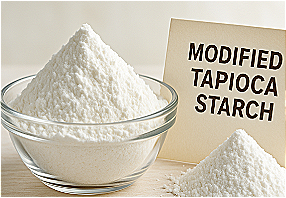
Modified tapioca starch (Manihot esculenta)
Description
- Functional starch derived from tapioca/cassava and modified — physically and/or chemically — to calibrate viscosity, stability, texture, freeze–thaw performance and process tolerance.
- Typical modification families: pregelatinised (instant), cross-linked — e.g. distarch phosphate — stabilised/substituted — e.g. acetylated, hydroxypropylated, octenyl succinate – OSA — acid-thinned/acidolysed, oxidised, and physical treatments such as annealing/HMT (heat–moisture treatment).
Caloric value (per 100 g, powder)
- Approximately 330–360 kcal; carbohydrates 85–90 g — mainly starch — fibre ~1–3 g — ↑ RS3 — resistant starch from retrogradation after cooling — protein ≤0.5 g, fat ≤0.5 g, sodium negligible — may increase slightly in sodium salts, e.g. OSA.
- Use levels: typically 1–6% in soups/sauces/dressings, 6–12% in fillings/dairy or plant-based systems, higher in coatings/batters.
Main substances and types of modification
- Starch polymers — amylopectin/amylose — with functional groups or cross-linking that remodel swelling, pasting and retrogradation.
- Examples and effects — indicative:
- Cross-linked — e.g. distarch phosphate: ↑ shear/acid/heat stability, ↓ breakdown in retort/UHT processes.
- Acetylated (E1420) / acetylated distarch adipate (E1422): improved freeze–thaw performance, storage stability, softer gel.
- Hydroxypropylated (E1440) / hydroxypropylated distarch phosphate (E1442): viscosity at low temperatures, clarity, ↓ retrogradation.
- OSA — starch sodium octenyl succinate (E1450): surface/emulsifying activity for beverage clouds and flavour encapsulation.
- Oxidised (E1404): low viscosity, clean taste, good film formation/crispness.
- Acid-thinned (E1401): low hot viscosity but high cold gel strength — confectionery/jellies.
- Pregelatinised: cold-dispersible for instant thickening.
- Physical modification — annealing/HMT: ↑ granule integrity without introducing new chemical groups.
Production process
- Slurry preparation: suspension of tapioca starch in water; adjustment of pH/temperature.
- Modification step: application of physical treatments — pregelatinisation, annealing/HMT — or chemical treatments under food-grade conditions — e.g. STMP/STPP for cross-linking; acetic anhydride for acetylation; propylene oxide for hydroxypropylation; octenyl succinic anhydride for OSA; sodium hypochlorite for oxidation.
- Neutralisation and washing: removal/neutralisation of residues; dehydration.
- Drying and finishing: flash/drum/spray drying or hot air drying; then milling, sieving, metal detection, barrier packaging.
- Quality controls: moisture/aw, ash, pH, viscosity profiles — RVA/Brookfield/Brabender — gel strength, DS/MS — degree/molar substitution, phosphorus/OSA where relevant, particle size, microbiology — pathogens absent/25 g — residues/metals within limits.
Sensory and technological properties
- Neutral taste and generally clear/bright pastes — tapioca base — with low masking.
- Process tolerance: cross-linked types withstand high shear, acid and temperature — retort, UHT, canning.
- Texture design: from creamy and short — stabilised types — to elastic or crisp — oxidised/acid-thinned types in coatings.
- Freeze–thaw & storage: acetylated/hydroxypropylated types limit syneresis and retrogradation; OSA adds stable emulsification.
- Instant: pregelatinised types provide cold viscosity for RTD products and instant sauces.
Food uses
- Soups, sauces, gravy, retort meals: cross-linked blends stable to shear/acid for hot-fill/retort processes.
- Dairy & plant-based: yogurt, spoonable products, UHT beverages — body/stability; OSA for emulsion stability.
- Bakery & fillings: fruit fillings, glazes, creams — gloss, clarity, freeze–thaw.
- Snacks/coatings: batters/breadings for crispness and ↓ oil pick-up; oxidised types for thin films.
- Beverages and flavours: OSA for beverage clouds, encapsulation and spray-drying.
- Confectionery: acid-thinned types for jellies/gummies — clean bite, defined setting.
Nutrition and health
- Carbohydrate-based, with low fat/protein; at typical dosages, the energy contribution per serving is limited.
- RS3 — resistant starch may increase after cooking–cooling, with a modest reduction in GI — glycaemic index in some matrices.
- Naturally gluten-free; manage cross-contact in mixed facilities.
- Sodium generally low, except for types with sodium salts — still modest per serving.
Fat profile
- Very low total fat; traces contain mainly PUFA — polyunsaturated fatty acids — potentially beneficial if balanced; more oxidisable — MUFA — monounsaturated fatty acids — often neutral/favourable — and minimal SFA — saturated fatty acids — to be moderated in the overall diet. TFA — trans fatty acids negligible; MCT — medium-chain triglycerides not significant.
Quality and specifications — typical issues
- Identity/purity: moisture — often ≤13% — ash, whiteness, absence of foreign bodies.
- Functionality: RVA curves — peak/hold/breakdown — setback, gel strength, clarity, freeze–thaw/syneresis tests.
- Chemistry: DS/MS within specification; phosphorus — phosphate types — OSA level, residues compliant.
- Microbiology: pathogens absent, low yeasts/moulds; mycotoxins/metals/pesticides compliant.
- Regulatory: compliant with food-grade modified starch categories in target markets; possible limits of use for infant foods.
Storage and shelf life
- Store cool, dry, airtight, away from odours/light; protect from moisture — caking.
- Shelf life: typically 24–36 months sealed; after opening, reseal and use promptly.
Allergens and safety
- Naturally gluten-free; intrinsically low allergenic risk.
- Under GMP/HACCP, validate management of cross-contact and reagent residues.
- In acidic, high-shear or prolonged holding processes, select cross-linked/stabilised types to avoid breakdown and separation.
INCI functions in cosmetics — where applicable
- INCI examples: Tapioca Starch, Hydroxypropyl Starch Phosphate, Sodium Starch Octenylsuccinate, Aluminum Starch Octenylsuccinate.
- Roles: absorbent, anti-caking, viscosity increasing, film-forming, emulsifying — OSA types — sensory mattifying agent.
Troubleshooting
- Cold lumps: predisperse in premix/slurry or use a pregelatinised grade.
- Breakdown in kettle/retort: increase cross-linking level or reduce shear/holding; optimise pH; blend with stabilised types.
- Syneresis after freezing/thawing: use acetylated/hydroxypropylated types; increase solids or add hydrocolloids at low dosage.
- Opacity/less clean taste: choose oxidised types — film, neutral taste — or high-clarity grades based on tapioca.
- Creaming in emulsified beverages: switch to OSA with suitable DS; verify emulsifier:oil ratio and homogenisation.
Sustainability and supply chain
- Cassava is a tropical crop with high yield; prioritise traceability, support for smallholders and responsible land use.
- Manage washing/modification effluents towards BOD/COD targets; ensure reagent neutralisation and EHS protection.
- Optimise energy use — e.g. drum/spray-drying — and use recyclable packaging.
Labelling
- Ingredient names: “modified tapioca starch” or the specific names/codes required — e.g. E1422, E1442, E1450.
- Physically modified forms may be declared as “pregelatinised tapioca starch” — depending on jurisdiction.
- Comply with local rules on naming and additive class.
Conclusion
Modified tapioca starch is a toolbox for designing body, stability and texture in retort/UHT, frozen, beverage, snack and bakery systems. Aligning modification chemistry — cross-linking/substitution — and granule state — native vs pregel — with the process/product enables consistent viscosity, clean flavour release, freeze–thaw robustness and cost-efficient performance.
Mini-glossary
- RS3 — resistant starch from retrogradation: less digestible fraction formed during cooling; may moderate GI.
- GI — glycaemic index: post-prandial glycaemic response; it is reduced by fibre/fats and cooling.
- DS/MS — degree/molar substitution: average number of functional groups per glucose unit; guides performance.
- RVA — rapid visco analyser: instrument/profile for pasting/viscosity behaviour.
- OSA — starch sodium octenyl succinate (E1450): emulsifying starch for beverage clouds/encapsulation.
- aw — water activity: key parameter for microbiological stability and caking.
- PUFA — polyunsaturated fatty acids: potentially beneficial if balanced; more susceptible to oxidation — here traces.
- MUFA — monounsaturated fatty acids: often neutral/favourable — traces.
- SFA — saturated fatty acids: to be moderated in the overall diet — minimal.
- TFA — trans fatty acids: negligible in starches.
- MCT — medium-chain triglycerides: not significant in tapioca.
- GMP/HACCP — good manufacturing practice / hazard analysis and critical control points: preventive systems with validated CCP.
- BOD/COD — biochemical/chemical oxygen demand: metrics for effluent impact and water treatment.

