Plant-derived fiber)
Descrizione
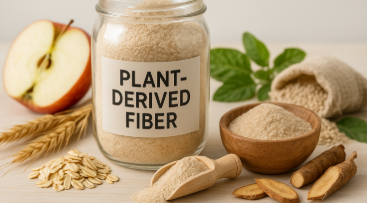
Ingrediente funzionale ottenuto da matrici vegetali (cereali, legumi, frutta, verdura, tuberi e loro sottoprodotti: crusca, bucce, polpe) e costituito da carboidrati non digeribili e lignina: cellulosa, emicellulose, pectine, β-glucani, inulina/FOS, arabinoxilani, galattomannani/psillio, amido resistente (RS).
Classificazione nutrizionale: fibra solubile (SDF) viscosa/fermentabile e fibra insolubile (IDF) non viscosa (più strutturante); il totale è la TDF (total dietary fiber).
Valore calorico (per 100 g di ingrediente)
Energia stimata ~2 kcal/g (≈8 kJ/g) per le frazioni fermentabili → ~200 kcal/100 g; grassi e proteine trascurabili salvo specifiche materie prime.
In uso tipico (2–15% nelle ricette) l’apporto energetico è modesto.
Principali sostanze contenute
Polimeri strutturali: cellulosa, emicellulose, lignina (soprattutto IDF).
Polimeri solubili/viscosi: pectine, β-glucani, arabinoxilani solubili, galattomannani (guar/psillio).
Prebiotici: inulina, FOS, alcune destrine resistenti, RS.
Minerali in tracce; polifenoli legati alla matrice (dipende dalla fonte).
Processo di produzione
Selezione e pulizia della materia prima; macinazione/frazionamento per separare le frazioni ricche in fibra.
Estrazioni: acquosa/alcolica (es. pectine, inulina), precipitazione etanolica, filtrazione/ultrafiltrazione, essiccazione (spray-dry) e micronizzazione.
Modifiche fisiche/enzimatiche (cut-size, solubilizzazione, riduzione FODMAP), agglomerazione per migliorare disperdibilità.
Controlli: titolo TDF/SDF/IDF (AOAC), umidità, ceneri, microbiologia, metalli/pesticidi, glutine quando pertinente.
Proprietà sensoriali e tecnologiche
Ritenzione acqua (WBC) e olio (OBC), aumento di viscosità (SDF), gelificazione (pectine/psillio), bulking a basse calorie.
Migliora texture: più corpo, masticabilità, riduce sinèresi in salse/yogurt/plant-based; può sostituire parte di zuccheri o grassi.
Solubilità/clarità: fibre clear-solution per bevande; le insolubili conferiscono granulosità se dosate in eccesso.
Impieghi alimentari
Bakery/pasta (crusca, RS, inulina): tenuta, fibre claim, indice glicemico più moderato.
Lattiero-caseari e analoghi vegetali: corpo, sinèresi↓, fibra solubile.
Carni/plant-based: legante, resa, succosità (psillio, agrumi, cereali).
Bevande/barrette/smoothie: inulina, destrine resistenti, β-glucani.
Salse/condimenti/zuppe: viscosità e stabilità; in snack estrusi migliora croccantezza e apporto fibra.
Nutrizione e salute
Apporto raccomandato adulti: ~25–30 g/die.
Benefici supportati: regolarità intestinale (IDF/TDF), sazietà e controllo energetico, attenuazione del picco glicemico (SDF viscose), colesterolo↓ con β-glucani da avena/orzo, microbiota favorito (fibre prebiotiche → SCFA: acetato, propionato, butirrato).
Tollerabilità: fibre altamente fermentabili (inulina/FOS) possono dare gonfiore (FODMAP). Introdurre gradualmente e idratare adeguatamente.
Profilo dei grassi
Qualità e specifiche (temi tipici)
TDF/SDF/IDF (AOAC 991.43/2009.01), umidità (≤6–10%), ceneri, granulometria, colore/odore, viscosità (per SDF), WBC/OBC.
Allergeni (es. glutine da frumento, soia), metalli/pesticidi conformi, micotossine se da cereali.
Microbiologia: cariche basse (polveri, aw ridotta); corpi estranei assenti.
Conservazione e shelf-life
Conservare asciutto, al buio, in pack barriera (la fibra è igroscopica); evitare odori estranei.
Shelf-life tipica 18–36 mesi secondo umidità, attività dell’acqua, grado di raffinazione.
Allergeni e sicurezza
Verificare origine botanica: glutine (frumento/segale/orzo), soia, frutta a guscio se co-processata.
Psillio: rari casi di ipersensibilità; assumere con acqua sufficiente.
Per low-FODMAP, preferire destrine resistenti/RS rispetto a inulina/FOS.
Funzioni INCI in cosmesi
Voci INCI: Cellulose, Microcrystalline Cellulose, Inulin, Arabinoxylan, Citrus Fiber.
Ruoli: texturizer, assorbente, stabilizzante, film-forming leggero in gel/creme.
Troubleshooting
Grittiness/sabbiosità: ridurre granulometria, usare SDF o blend.
Torbidezza in bevande: impiegare fibre clear-solution e ottimizzare pH/ioni.
Eccessiva viscosità/gel: abbassare dose, cambiare tipo di SDF, modulare shear e T.
Gonfiore/meteorismo: titolare la dose, preferire RS/destrine per target FODMAP.
Secchezza in bakery: aumentare acqua di impasto, usare SDF con WBC adeguata.
Sostenibilità e filiera
Upcycling di sottoprodotti (crusca, bucce di agrumi, polpa di mela/barbabietola); riduzione sprechi e impronta.
Processi con recupero acqua/energia, gestione reflui verso BOD/COD target, pack riciclabili.
Sistemi GMP/HACCP e tracciabilità per origine e allergeni.
Etichettatura
Denominazioni: “fibra vegetale”, “fibra di [fonte]” (es. fibra di agrumi, fibra di avena, inulina da cicoria).
Claim UE: “fonte di fibra” (≥3 g/100 g) e “ad alto contenuto di fibra” (≥6 g/100 g).
Per bevande, specificare g/porzione e indicazioni d’uso (es. acqua consigliata).
Conclusione
Le fibre di origine vegetale sono multipurpose: migliorano texture, stabilità e profilo nutrizionale, contribuendo a sazietà, regolarità e metabolismo. La scelta del tipo (SDF/IDF/RS), il dosaggio e la matrice determinano performance sensoriali e tollerabilità: una progettazione attenta consente claim credibili e prodotti piacevoli e funzionali.
Mini-glossario
TDF — total dietary fiber: fibra totale (somma di SDF + IDF).
SDF — soluble dietary fiber: fibra solubile (spesso viscosa/fermentabile; aiuta glicemia e colesterolo).
IDF — insoluble dietary fiber: fibra insolubile (aumenta massa fecale e transito).
RS — resistant starch: amido resistente (energia ridotta, effetto prebiotico).
SCFA — short-chain fatty acids: acetato/propionato/butirrato prodotti dal microbiota; benefici per il colon.
FOS — frutto-oligosaccaridi: prebiotici fermentabili, possibili FODMAP.
FODMAP — fermentable oligo-, di-, monosaccharides and polyols: carboidrati che possono dare gonfiore in soggetti sensibili.
WBC/OBC — water/oil binding capacity: capacità di legare acqua/olio utile per resa e texture.
GMP/HACCP — good manufacturing practice / hazard analysis and critical control points: sistemi igienico-preventivi con CCP convalidati.
BOD/COD — domanda biochimica/chimica di ossigeno: indicatori dell’impatto dei reflui.
References__________________________________________________________________________
Dini I, Mancusi A. Weight Loss Supplements. Molecules. 2023 Jul 12;28(14):5357. doi: 10.3390/molecules28145357.
Abstract. Being overweight or obese can predispose people to chronic diseases and metabolic disorders such as cardiovascular illnesses, diabetes, Alzheimer's disease, and cancer, which are costly public health problems and leading causes of mortality worldwide. Many people hope to solve this problem by using food supplements, as they can be self-prescribed, contain molecules of natural origin considered to be incapable of causing damage to health, and the only sacrifice they require is economic. The market offers supplements containing food plant-derived molecules (e.g., primary and secondary metabolites, vitamins, and fibers), microbes (probiotics), and microbial-derived fractions (postbiotics). They can control lipid and carbohydrate metabolism, reduce appetite (interacting with the central nervous system) and adipogenesis, influence intestinal microbiota activity, and increase energy expenditure. Unfortunately, the copious choice of products and different legislation on food supplements worldwide can confuse consumers. This review summarizes the activity and toxicity of dietary supplements for weight control to clarify their potentiality and adverse reactions. A lack of research regarding commercially available supplements has been noted. Supplements containing postbiotic moieties are of particular interest. They are easier to store and transport and are safe even for people with a deficient immune system.
Rome S . Biological properties of plant-derived extracellular vesicles. Food Funct. 2019 Feb 20;10(2):529-538. doi: 10.1039/c8fo02295j.
Abstract. Identification of active constituents of our diet is crucial to understand the impact of food on health, and disease development, and for the formulation of functional food and nutraceuticals. Until now research into the pharmacological properties of the components of our diet has focused on vitamins, sterols, polyphenols, fiber, etc. But very recently, it has been found that plants contain various types of vesicles which are in contact with the intestinal tract throughout our lives. They participate in intestinal tissue renewal processes and modulate gut microbiota in healthy subjects and have important biological functions against inflammatory diseases (e.g.; colitis injury, liver steatosis) or cancers associated with their specific lipid and miRNA content. In addition, recent data have suggested that plant-derived nanovesicles would be excellent candidates for the delivery of therapeutic agents (e.g.; anti-cancerous drugs, siRNAs) or poorly soluble natural compounds (e.g.; curcumin), as they are able to cross mammalian barriers without inducing either an inflammatory response or necrosis, conversely to conventional liposomes. It is thus important to consider these plant-derived vesicles as new components of our food in order to evaluate their potential for health benefit and food-derived technology.
Jia W, Peng J, Zhang Y, Zhu J, Qiang X, Zhang R, Shi L. Amelioration impact of gut-brain communication on obesity control by regulating gut microbiota composition through the ingestion of animal-plant-derived peptides and dietary fiber: can food reward effect as a hidden regulator? Crit Rev Food Sci Nutr. 2024 Nov;64(31):11575-11589. doi: 10.1080/10408398.2023.2241078.
Abstract. Various roles of intestinal flora in the gut-brain axis response pathway have received enormous attention because of their unique position in intestinal flora-derived metabolites regulating hormones, inducing appetite, and modulating energy metabolism. Reward pathways in the brain play a crucial role in gut-brain communications, but the mechanisms have not been methodically understood. This review outlined the mechanisms by which leptin, ghrelin, and insulin are influenced by intestinal flora-derived metabolites to regulate appetite and body weight, focused on the significance of the paraventricular nucleus and ventromedial prefrontal cortex in food reward. The vagus nerve and mitochondria are essential pathways of the intestinal flora involved in the modulation of neurotransmitters, neural signaling, and neurotransmission in gut-brain communications. The dynamic response to nutrient intake and changes in the characteristics of feeding activity requires the participation of the vagus nerve to transmit messages to be completed. SCFAs, Bas, BCAAs, and induced hormones mediate the sensory information and reward signaling of the host in the complex regulatory mechanism of food selection, and the composition of the intestinal flora significantly impacts this process. Food reward in the process of obesity based on gut-brain communications expands new ideas for the prevention and treatment of obesity.
Gauer JS, Ajanel A, Kaselampao LM, Candir I, MacCannell ADV, Roberts LD, Campbell RA, Ariëns RAS. Plant-derived compounds normalize platelet bioenergetics and function in hyperglycemia. Res Pract Thromb Haemost. 2024 Aug 14;8(6):102548. doi: 10.1016/j.rpth.2024.102548.
Abstract. Background: Polyphenols have been shown to decrease oxidative stress and modulate glycemic response. Nevertheless, their effect on platelet bioenergetics and clot structure in diabetes and hyperglycemia is unknown. Objectives: To investigate the effect of polyphenols on human platelet bioenergetics and its subsequent effect on clot structure in normoglycemia vs acute hyperglycemia in vitro. Methods: Four polyphenols (resveratrol, hesperetin, epigallocatechin gallate [EGCG], and quercetin) were selected for initial analysis. Healthy volunteers' isolated platelets/platelet-rich plasma were treated with 5 or 25 mM glucose to represent normoglycemia and acute hyperglycemia, respectively. Platelet-derived reactive oxygen species (ROS), citrate synthase activity (mitochondrial density), mitochondrial calcium flux, and mitochondrial respiration were performed following exposure to polyphenols (20 µM, 1 hour) to determine their effects on platelet bioenergetics. Procoagulant platelets (annexin V) and fibrin fiber density (Alexa Fluor-488 fibrinogen; Invitrogen) were analyzed by laser scanning confocal microscopy, while clot porosity was determined using platelet-rich plasma following exposure to polyphenols (20 µM, 20 minutes). Results: Acute hyperglycemia increased ROS, mitochondrial calcium flux, maximal respiration, and procoagulant platelet number. Resveratrol, quercetin, and EGCG reduced platelet ROS in normoglycemic and acute hyperglycemic conditions. Mitochondrial density was decreased by quercetin and EGCG in normoglycemia. Resveratrol and EGCG reduced mitochondrial calcium flux in acute hyperglycemia. Resveratrol also decreased procoagulant platelet number and attenuated oxygen consumption rate in normoglycemia and acute hyperglycemia. No effect of hyperglycemia or polyphenols was observed on fibrin fiber density or clot pore size. Conclusion: Our results suggest polyphenols attenuate increased platelet activity stemming from hyperglycemia and may benefit thrombosis-preventative strategies in patients with diabetes.




