



Dried ancho chili peppers (dried ripe poblano; Capsicum annuum L., family Solanaceae)
Description
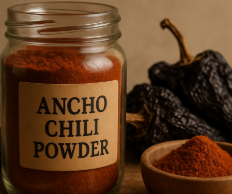
The ancho is the fully ripe, dried poblano chile: large, heart-shaped, wrinkled pod, deep maroon–mahogany color, mild heat (~1,000–2,000 SHU).
Sensory profile: sweet, raisin/prune, hints of cocoa, coffee, tobacco, light earthiness; minimal bitterness if seeds/placenta are removed.
Caloric value (per 100 g)
~250–350 kcal (varies with moisture and seed content). At typical use levels (grams per recipe), energy contribution is modest.
Key constituents
Capsaicinoids at low levels (mainly capsaicin/dihydrocapsaicin).
Carotenoids (capsanthin, capsorubin, β-carotene), sugars (glucose/fructose), organic acids (malic/citric), fiber/pectins, minor polyphenols; vitamin C largely reduced by drying.
Analytical markers: SHU, capsaicinoids by HPLC, color (CIE L*a*b*; red products often report ASTA color), moisture/aw, mesh/particle size, defects/foreign matter.
Production process
Raw material: sound, field-ripened red poblanos.
Preparation: washing → destemming, deseeding (as required) → splitting/cutting.
Drying: sun/solar or hot-air dehydration with controlled time–temperature to targets moisture ≤10–12% and aw ≤0.60–0.65.
Sizing/screening, metal detection, and high-barrier packaging (often nitrogen-flushed).
Managed under GMP/HACCP with CCP on drying profile, foreign bodies, and pack integrity.
Sensory and technological properties
Blooming/toasting (brief, low heat) enhances volatiles; over-toasting yields bitterness.
Rehydration: soak in hot water/stock (∼60–80 °C, 15–30 min); blend to paste; strain to remove tough skins if desired.
Acid (vinegar/tomato) brightens fruit notes; fat (oil/nuts/seeds) rounds bitterness and carries aroma.
Food uses
Core chile in moles (e.g., mole poblano), adobos, enchilada/enchilamole sauces, salsas rojas, stews/chili con carne, dry rubs, sausages, marinades.
Typical dosages: powder 0.2–1.0% in blends; paste 1–5% of sauce weight; whole rehydrated 1–3% of finished product. Validate in pilot trials.
Nutrition and health
Low sodium, low fat at culinary portions; provides carotenoids and fiber (vs fresh).
Capsaicin may irritate in sensitive individuals; avoid unauthorized health claims.
Lipid profile
Very low total fat; traces from seeds/placenta only. Pattern is trace PUFA ≥ MUFA > SFA with no material impact at use levels.
Health note: diets favoring MUFA (monounsaturated fatty acids) and PUFA (polyunsaturated fatty acids) over SFA (saturated fatty acids) are generally favorable/neutral for blood lipids; here the effect is minimal. TFA (industrial trans fatty acids) absent; MCT (medium-chain triglycerides) not characteristic.
Quality and specifications (typical topics)
Moisture ≤10–12%, aw ≤0.60–0.65, uniform color (deep red-brown), low defects/foreign matter, absence of infestation.
Microbiology: APC within spec; yeasts/molds low; Salmonella absent/25 g.
Contaminants: pesticides/metals compliant; monitor mycotoxins (e.g., aflatoxins/ochratoxin A) and lead in imported powders.
Capsaicinoids/HPLC, ASTA color, mesh size for powders.
Storage and shelf-life
Store cool/dry/dark in oxygen/light-barrier packs; 12–24 months sealed.
Reseal after opening; after rehydration, treat as perishable (refrigerate; short hold).
Allergens and safety
Capsicum is not a major EU allergen; rare individual sensitivities exist.
Manage cross-contact on seasoning lines (sesame, celery, mustard, gluten/soy carriers). Use PPE when milling/powder handling.
INCI functions in cosmetics
Listings: Capsicum Annuum Fruit Extract/Powder (non-pungent to mildly pungent).
Roles: fragrance, mild warming/rubefacient; assess irritancy and color stability.
Troubleshooting
Bitter/ashy notes: over-toasting → reduce time/temp; remove seeds/placenta; balance with acid/fat.
Tough skins/gritty sauces: extend soak or lightly simmer, then blend and strain.
Dull color: oxidation/light → use amber/high-barrier packs; add chile late in cooking.
Caking in powders: high RH → add desiccant, improve barrier, consider anticaking.
Weak flavor: toast briefly, increase dose, or blend with guajillo/pasilla for complexity.
Sustainability and supply chain
Favor IPM cultivation and efficient irrigation; use solar drying where feasible.
Optimize dryer heat recovery; use recyclable/mono-material packs; treat plant effluents to BOD/COD targets; full traceability under GMP/HACCP.
Conclusion
Dried ancho delivers mild heat, lush dried-fruit sweetness, and signature color that define many Mexican sauces. Controlled drying/toasting/rehydration, good packaging, and spec standardization ensure safe, stable, and sensory-consistent results across applications.
Mini-glossary
SHU — Scoville heat units: pungency scale (ancho ≈ 1,000–2,000).
HPLC — High-performance liquid chromatography: quantifies capsaicinoids and identity markers.
ASTA (color) — American Spice Trade Association color index for red spice products.
aw — Water activity: low aw (≤0.60–0.65) limits microbial growth in dried goods.
SFA — Saturated fatty acids: excessive intakes may raise LDL; trace here.
MUFA — Monounsaturated fatty acids (e.g., oleic): generally favorable/neutral for blood lipids; trace here.
PUFA — Polyunsaturated fatty acids (e.g., linoleic): beneficial when balanced; trace here.
TFA — Trans fatty acids (industrial): avoid; absent in non-hydrogenated spices.
MCT — Medium-chain triglycerides: characteristic of coconut fat; not present in ancho.
GMP/HACCP — Good Manufacturing Practice / Hazard Analysis and Critical Control Points: hygiene/preventive-safety systems with defined CCP.
CCP — Critical control point: step where a control prevents/reduces a hazard.
BOD/COD — Biochemical/Chemical oxygen demand: indicators of effluent impact from processing.

