

Ciao, Visitatore!


🔍
RECENSIONE

Recensione

Al222
Al222 (25264 pt) 03-Nov-2025 09:58

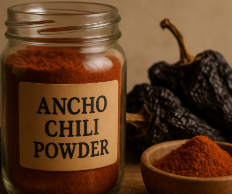
Peperoncini ancho essiccati (poblano maturo essiccato; Capsicum annuum L., fam. Solanaceae)

Descrizione

  • L’ancho è il poblano rosso pienamente maturo, essiccato: baccello grande, a cuore, rugoso, colore mogano–amaranto e pungenza lieve (~1.000–2.000 SHU).

  • Profilo sensoriale: note di uvetta/prugna secca, cenni di cacao/caffè/tabacco, lieve terrosità; l’asportazione di semi/placenta riduce amarezza e piccantezza.
Valore calorico (per 100 g di prodotto)

  • ~250–350 kcal/100 g (in funzione di umidità e semi). Alle porzioni d’uso (grammi) l’apporto energetico è modesto.

Principali sostanze contenute

  • Capsaicinoidi a basso tenore (prevalenti capsaicina/diidrocapsaicina).

  • Carotenoidi (capsantina, capsorubina, β-carotene), zuccheri (glucosio/fruttosio), acidi organici (malico/citrico), fibre/pectine, polifenoli minori; vitamina C fortemente diminuita dall’essiccazione.

  • Marcatori analitici: SHU, capsaicinoidi (HPLC), colore (CIE L*a*b*; talvolta ASTA per i rossi), umidità/aw, granulometria/mesh, difetti/corpi estranei.

Processo di produzione

  • Materia prima: poblano rosso sano e a maturazione di campo.

  • Preparazione: lavaggio → rimozione peduncolo/semiapertura/taglio.

  • Essiccazione: solare o aria calda con profilo tempo–temperatura controllato fino a umidità ≤10–12% e aw ≤0,60–0,65.

  • Classificazione/setaccio, ricerca metalli, confezionamento alta barriera (spesso con azoto).

  • Gestione sotto GMP/HACCP con CCP su profilo di essiccazione, corpi estranei e integrità imballo.

Proprietà sensoriali e tecnologiche

  • Tostatura leggera (brevissima) “apre” i volatili; eccesso produce amaro/affumicato.

  • Reidratazione: ammollo in acqua/brodo caldo (60–80 °C, 15–30 min); frullare in pasta e filtrare se si desidera buccia meno percepibile.

  • Acidità (aceto/pomodoro) vivacizza le note fruttate; grassi (olio, frutta secca/semi) arrotondano e veicolano aroma.

Impieghi alimentari

  • Moles (es. mole poblano), adobo, salse roja/enchilada, stufati/chili, rub a secco, salsicce, marinate.

  • Dosaggi indicativi: polvere 0,2–1,0% nei blend; pasta 1–5% sul peso della salsa; intero reidratato 1–3% sul prodotto finito. Validare con prove pilota.

Nutrizione e salute

  • Sodio basso, grassi bassi alle porzioni d’uso; apporta carotenoidi e fibre rispetto al fresco.

  • La capsaicina può irritare soggetti sensibili; evitare indicazioni salutistiche non autorizzate.

Profilo dei grassi

  • Grassi totali molto bassi; tracce dai semi/placenta. Pattern in tracce: PUFAMUFA > SFA, con impatto nutrizionale non materiale alle dosi d’uso.

  • Nota salute: una maggiore enfasi su MUFA (grassi monoinsaturi) e PUFA (grassi polinsaturi) rispetto a SFA (grassi saturi) è generalmente favorevole/neutralmente associata ai lipidi ematici; TFA (grassi trans industriali) assenti; MCT (trigliceridi a media catena) non caratteristici.

Qualità e specifiche (temi tipici)

  • Umidità ≤10–12%, aw ≤0,60–0,65, colore rosso-bruno uniforme, difetti/infestazioni assenti.

  • Microbiologia: carica aerobica entro specifica; lieviti/muffe basse; Salmonella assente/25 g.

  • Contaminanti: pesticidi/metalli conformi; monitorare micotossine (aflatossine/ocratossina A) e piombo in polveri importate.

  • Per le polveri: capsaicinoidi (HPLC), colore ASTA, mesh.

Conservazione e shelf-life

  • Conservare fresco/asciutto/buio in pack barriera a luce/ossigeno; 12–24 mesi da chiuso.

  • Richiudere dopo l’apertura; dopo reidratazione trattare come deperibile (refrigerare; consumo rapido).

Allergeni e sicurezza

  • Il Capsicum non è allergene maggiore UE; possibili sensibilità individuali.

  • Gestire cross-contact su linee di condimento (sesamo, sedano, senape, carrier con glutine/soia). DPI per macinazione/manipolo polveri.

Funzioni INCI in cosmesi

  • Denominazioni: Capsicum Annuum Fruit Extract/Powder (dolce–lievemente pungente).

  • Ruoli: fragrance, lieve warming/rubefacente; valutare irritazione e stabilità colore.

Troubleshooting

  • Note amare/torrefatte: tostatura eccessiva → ridurre tempo/temperatura; rimuovere semi/placenta; bilanciare con acido/grasso.

  • Buccia coriacea/salse ruvide: prolungare ammollo o sobbollire leggermente, quindi frullare e filtrare.

  • Colore spento: ossidazione/luce → pack ambra/alta barriera, aggiunta del chile tardiva in cottura.

  • Caking nelle polveri: UR elevatadisidratanti, barriera migliore, eventuali antiagglomeranti.

  • Aroma debole: breve tostatura, dose maggiore, o blend con guajillo/pasilla per complessità.

Sostenibilità e filiera

  • Preferire coltivazioni con IPM e irrigazione efficiente; adottare essiccazione solare dove possibile.

  • In stabilimento: recupero calore sugli essiccatoi, pack riciclabili/monomateriale; reflui verso target BOD/COD; tracciabilità GMP/HACCP.

Conclusione
L’ancho essiccato offre pungenza moderata, dolcezza da frutta secca e colore tipico che caratterizzano molte salse messicane. Un controllo accurato di essiccazione/tostatura/reidratazione, packaging e standard di specifica garantisce prodotti sicuri, stabili e sensorialmente coerenti.


Mini-glossario

  • SHUscoville heat units: scala della pungenza (ancho ~1.000–2.000).

  • HPLChigh-performance liquid chromatography: quantifica capsaicinoidi e marker di identità.

  • ASTA (color) — indice colore della american spice trade association per prodotti rossi.

  • awattività dell’acqua: ≤0,60–0,65 nei secchi limita la crescita microbica.

  • SFAgrassi saturi: in eccesso possono aumentare LDL; qui sono tracce.

  • MUFAgrassi monoinsaturi (es. oleico): generalmente favorevoli/neutralmente associati ai lipidi ematici; tracce qui.

  • PUFAgrassi polinsaturi (es. linoleico): benefici se bilanciati; tracce qui.

  • TFAgrassi trans: da evitare se industriali; assenti nei prodotti non idrogenati.

  • MCTtrigliceridi a media catena: tipici del cocco; non presenti nell’ancho.

  • GMP/HACCPgood manufacturing practice / hazard analysis and critical control points: sistemi igienico-preventivi con CCP definiti.

  • CCPcritical control point: fase in cui un controllo previene/riduce un pericolo.

  • BOD/CODdomanda biochimica/chimica di ossigeno: indicatori dell’impatto dei reflui.

  • FIFOfirst in, first out: rotazione scorte che privilegia l’uso dei lotti più vecchi.

Bibliografia__________________________________________________________________________

Hernández, L. J., Montejo, N. C., Rangel, A. S., Torres, V. R., Rico, J. S. G. J. A., & Naveda, A. F. (2024). Agronomic and morphological evaluation of six genotypes and two hybrids of Poblano peppers in field conditions. Agro Productividad.

Abstract. Objective: to evaluate agronomic and morphological traits of six Poblano-type pepper genotypes, compared to a commercial hybrid and an experimental hybrid, in order to select genotypes with potential to continue with a plant breeding program. Design/ Methodology/ Approach: treatments and statistical model were arranged in randomized complete blocks, with eight treatments (six F2 genotypes, and two hybrids Carranza (commercial F1) and F402 (experimental F1). Treatments were analyzed with analysis of variance (p ≤ 0.05); then tested with Multiple Mean Comparison (Tukey, p ≤ 0.05) and Pearson Correlation Analysis. Results: no statistical differences were found in yield per plant (RPP), number of fruits per plant (NFP), average weight per fruit (PPF), plant height (AP), stem thickness (GT), leaf length (AL) and leaf width (AH). Regarding width at the base of the fruit (ABF) the hybrids were superior; in average width of the fruit the genotypes G4, G6 and the hybrids were better; in fruit length G2, G5 and G6 stood out; in calyx depth G1, G3 and G4; in length of the peduncle G4 was different from the others; and in thickness of the mesocarp (GM) the genotypes G2, G4, G6 and hybrids were superior. According to Pearson's correlation, the yield depended on NFP (0.66), MG (0.46), ABF (0.38), as it is shown by their coefficients.

Toledo-Aguilar, R., López-Sánchez, H., López, P. A., Guerrero-Rodríguez, J. D. D., Santacruz-Varela, A., & Huerta-de la Peña, A. (2016). Morphological diversity of native population’s poblano pepper. Revista mexicana de ciencias agrícolas7(5), 1005-1015.

Abstract. The genetic diversity in different types of pepper in Mexico has been little studied. The poblano pepper (Capsicum annuum L.) has great culinary importance as an ingredient in traditional dishes from Puebla; also constitutes a source of income for rural families in the region of the Sierra Nevada de Puebla; however, there is no study to determine the morphological diversity of native populations of this type of pepper found in this ecological niche. The aim of this study was to analyze the morphological diversity of native population’s poblano peppers de la Sierra Nevada de Puebla. By using descriptors were analyzed 41 populations of pepper poblano, four of ancho pepper, two of “Loco” pepper, one of “Miahuateco” and hybrid pepper ancho pepper “Doroteo” (Ahern Seeds®). An experimental design was used in three randomized complete block assessment in two locations. In the combined analysis of variance statistically significant difference in 60% of the variables found. With the selection of 30 morphological was performed variables principal component analysis, where populations of pepper poblano formed a group, away from the rest of populations evaluated and the hybrid. The cluster analysis was also performed, in which four subgroups were defined. The native populations that shaped each subgroup were not related to the geographical location of seed collection, suggesting the exchange of germplasm among farmers. In the native populations of pepper poblano morphological diversity found mainly in fruit variables, plant habit and earliness.

Santiago López, U., Ramírez Meraz, M., & Méndez Aguilar, R. (2018). HAP14F: hybrid of ancho poblano pepper for the Altiplano de México. Revista mexicana de ciencias agrícolas, 9(2), 481-485.

Abstract. In Mexico, the poblano pepper has great gastronomic, economic and social importance because it is a basic ingredient of traditional dishes. Obtaining low yields in the producing areas, mainly in the Altiplano de México, is due to the high use of creole seeds. To mitigate the aforementioned problem, INIFAP developed the HAP14F wide pepper poblano hybrid, which is an early cycle because it presents flowering and ripening at 39 and 118 days after transplantation (DDT), respectively. It produces fruits of intermediate green color in an immature state that turn a dark red color with a strong brilliance in a mature state. In open-pit evaluations, this hybrid had an average yield of 3.7 t ha-1 of dried or dehydrated chili and in green fruit it reached 23.1 t ha-1. For the aforementioned, HAP14F is considered a good alternative for the Altiplano de México.

Hernández Hernández, B. N., Tornero Campante, M. A., Sandoval Castro, E., Rodríguez Mendoza, M. D. L. N., Taboada Gaytán, O. R., & Peña Olvera, B. V. (2021). Growth, yield and quality of poblano chili pepper grown in hydroponics under greenhouse. Revista mexicana de ciencias agrícolas, 12(6), 1043-1056.

Abstract. The poblano chili pepper crop sown in soil in the Alto Atoyac in Puebla has been affected by the presence of diseases caused by fungi, bacteria and nematodes, generating losses in yield and reduction of the sowing area. The production under greenhouse and hydroponics is an alternative solution to this problem, since it allows the development of crops in a controlled environment using inert substrates, ensuring a greater percentage of production. The objective was to evaluate the growth, yield and fruit quality of two local varieties of poblano chili pepper (Tlacotepec and Tlalancaleca) and a commercial variety (San Luis), supplied nutritionally by three concentrations of the Steiner nutrient solution under greenhouse and hydroponics in order to know their agronomic and productive behavior. A 3x3 factorial treatment design in a completely randomized experimental design was considered. The variables evaluated were: plant height, stem thickness, number of leaves, number of bifurcations, number of flowers, yield and fruit quality. The results showed that the San Luis variety reached the highest yield and fruit quality. As for the three concentrations of nutrient solution, there was no significant effect on the yield and the agronomic behavior of creole varieties in the substrate, greenhouse and hydroponics system may be an option for the production of poblano chili pepper in the Alto Atoyac region