Estratto di frutto del monaco (monk fruit extract; Siraitia grosvenorii)
Descrizione
Dolcificante ad alta intensità ottenuto dal frutto di Siraitia grosvenorii mediante estrazione e arricchimento dei mogrosidi (soprattutto mogroside V).
Dolcezza percepita ~150–300× rispetto al saccarosio, con profilo generalmente pulito e persistenza moderata.
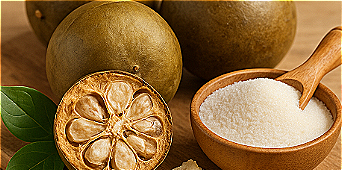
Valore calorico (per 100 g di prodotto)
Estratto ad alta purezza (mogroside V ≥20–50%): ~0–5 kcal/100 g (apporto trascurabile ai dosaggi d’uso).
Frutto fresco: ~30–40 kcal/100 g; frutto essiccato: ~250–320 kcal/100 g.
Miscele da tavola con carrier (eritritolo, destrosio, fibre, ecc.): valore dipendente dal carrier.
Principali sostanze contenute
Mogrosidi (triterpeni glicosidici): mogroside V (marcatore principale), IV, III.
Polisaccaridi/pectine (nel frutto), amminoacidi e acidi organici in tracce.
Vitamina C e minerali minori (spesso ridotti durante il processo).
Marcatori analitici: mogroside V (%) via HPLC, umidità/aw, colore (Lab*), solubilità, ceneri.
Processo di produzione
Materie prime: frutti maturi → essiccazione → frantumazione.
Estrazione acquosa (eventuale quota idroalcolica) → filtrazione/clarifica → adsorbimento su resine e desorbimento → eventuale decolorazione/deionizzazione → concentrazione → spray-drying o standardizzazione liquida.
Controlli qualità: titolo in mogroside V, microbiologia, pesticidi/metalli, eventuali solventi residui; gestione sotto GMP/HACCP.
Proprietà sensoriali e tecnologiche
Stabile a calore e in ampio intervallo di pH; adatto a forno e bevande acide.
Non apporta massa: spesso richiede bulking agents (polioli, fibre, maltodestrine).
Sinergie con eritritolo, allulosio, stevia o piccole quote di zuccheri per modulare onset, corpo e aftertaste.
Impieghi alimentari
Bevande (anche acide), lattiero-caseari e plant-based, bakery a zucchero ridotto, confetteria, sciroppi/salse, integratori.
Dosaggi indicativi (estratto): ~50–400 ppm sul finito (dipende da purezza/target); calibrare con prove pilota.
Etichettatura: “estratto di frutto del monaco”; nelle miscele dichiarare i carrier.
Nutrizione e salute
Indice glicemico/carico ≈ 0 per estratti puri; utile nelle strategie di riduzione zuccheri.
Stato regolatorio: negli USA generalmente GRAS; in altre giurisdizioni (es. UE) l’uso come dolcificante può richiedere autorizzazione specifica o rientrare in altre categorie (es. aromi) → verificare sempre normativa ed etichettatura vigenti.
Evitare claim salutistici non autorizzati.
Profilo dei grassi
Grassi totali trascurabili; SFA, MUFA, PUFA solo in tracce, senza impatto nutrizionale rilevante.
Nota salute: di norma un rapporto più alto MUFA/PUFA rispetto a SFA è considerato favorevole/neutrale per i lipidi ematici; qui l’effetto è non significativo.
Qualità e specifiche (temi tipici)
Mogroside V (%) e mogrosidi totali (HPLC), umidità/aw, solubilità, colore (Lab*), densità apparente (polveri).
Microbiologia (TVC, lieviti/muffe), metalli pesanti, residui di pesticidi entro limiti; solventi secondo normativa.
Sensoriale: profilo pulito (limitate note erbacee/gourd-like) e ripetibilità lotto-lotto.
Conservazione e shelf-life
Conservare al fresco/asciutto, al riparo da luce/odori, in imballi barriera all’umidità; richiudere bene.
Polveri: rischio caking → valutare essiccanti; shelf-life tipica 24–36 mesi se in specifica (FIFO).
Allergeni e sicurezza
Non è allergene maggiore UE; reazioni avverse rare.
In stabilimento: prevenire cross-contamination; CCP su igiene, essiccazione e confezionamento.
Funzioni INCI in cosmesi
Denominazioni: Siraitia Grosvenorii Fruit Extract / Monk Fruit Extract.
Ruoli: fragrance/flavor, antioxidant/skin conditioning in leave-on/rinse-off secondo buone pratiche.
Troubleshooting
Retrogusto erbaceo/persistente: aumentare la purezza in mogroside V; modulare con eritritolo/allulosio/stevia o acidi organici (citrico/lattico).
Dolcezza “vuota”/poca struttura: aggiungere bulking (fibre, polioli) o piccole quote di zuccheri non riducenti.
Torbidità in bevanda: filtrare, scegliere gradi ad alta solubilità, ottimizzare pH e ioni.
Variabilità sensoriale: specifiche strette su mogroside V e validazione con panel.
Sostenibilità e filiera
Conclusione
L’estratto di frutto del monaco è un dolcificante intenso, termicamente stabile e a basso apporto calorico, efficace in molteplici matrici. Purezza in mogroside V, co-dolcificanti adeguati e standardizzazione di processo sono chiavi per un profilo sensoriale pulito e costante.
Mini-glossario
GI — indice glicemico: impatto sulla glicemia; per l’estratto puro è ≈0 (positivo per il controllo degli zuccheri).
ADI — dose giornaliera ammissibile: parametro regolatorio; verificare l’eventuale valore fissato nel Paese di impiego.
GRAS — generally recognized as safe: status USA per ingredienti considerati sicuri alle condizioni d’uso.
SFA — grassi saturi: in eccesso possono aumentare LDL; qui sono in tracce.
MUFA — grassi monoinsaturi (es. oleico): generalmente favorevoli/neutrali; qui tracce.
PUFA — grassi polinsaturi (n-6/n-3): benefici se bilanciati; qui tracce.
TFA — grassi trans: evitare quelli industriali; non rilevanti nell’estratto.
ALA — acido α-linolenico (n-3): precursore di EPA/DHA; tema non rilevante per questo ingrediente.
EPA/DHA — acidi grassi n-3 a lunga catena: positivi per il profilo cardiometabolico; assenti nell’estratto.
MCT — trigliceridi a media catena: non caratteristici dell’estratto.
GMP/HACCP — good manufacturing practice / hazard analysis and critical control points: sistemi igienico–preventivi con CCP definiti.
BOD/COD — domanda biochimica/chimica di ossigeno: indicatori dell’impatto dei reflui di processo.
FIFO — first in, first out: rotazione scorte che usa per primi i lotti più vecchi.
Bibliografia__________________________________________________________________________
Kaim U, Gawlik U, Lisiecka K. Why Does Monk Fruit Extract Remain Only Partially Approved in the EU? Regulatory Barriers and Policy Implications for Food Innovation. Foods. 2025 Aug 13;14(16):2810. doi: 10.3390/foods14162810.
Abstract. Monk fruit extract (Siraitia grosvenorii, MFE) is a natural, non-caloric sweetener known for its intense sweetness, antioxidant properties, and potential metabolic health benefits. While certain aqueous monk fruit decoctions are recognised as non-novel foods in the UK and Ireland due to significant pre-1997 consumption, the European Union (EU) has adopted a more cautious approach under the Novel Food Regulation (EU) 2015/2283. As of October 2024, only one specific aqueous extract of monk fruit has been authorised in the EU under Regulation (EU) 2024/2345, permitting its use in several food categories. However, highly purified mogrosides and non-aqueous extracts remain unapproved due to gaps in toxicological data and the absence of industry-led applications. This review systematically analyses the EU's regulatory barriers, comparing MFE's legal status with other approved non-caloric sweeteners such as steviol glycosides and erythritol, and examining regulatory frameworks in the EU, United States, United Kingdom, and China. Findings indicate that although 18 non-caloric sweeteners are currently authorised in the EU, regulatory constraints continue to hinder the broader approval of MFE, limiting innovation and the availability of natural sweeteners for consumers. Harmonising regulations, leveraging international safety assessments, and promoting industry engagement are recommended to advance MFE's authorisation and support sustainable food innovation in the EU. Addressing these challenges is crucial to ensure that European consumers and industry can benefit from safe, innovative, and health-promoting alternatives to sugar, aligning food policy with broader public health goals and sustainability commitments.
Kaim U, Labus K. Monk Fruit Extract and Sustainable Health: A PRISMA-Guided Systematic Review of Randomized Controlled Trials. Nutrients. 2025 Apr 24;17(9):1433. doi: 10.3390/nu17091433.
Abstract. Sustainable health approaches promote functional food alternatives that support metabolic well-being while reducing reliance on added sugars and artificial sweeteners. Monk fruit extract (MFE), a natural, non-caloric sweetener, is gaining interest for its potential metabolic benefits, but its effects and regulatory status require further evaluation. Objective: This PRISMA-guided systematic review synthesizes findings from randomized controlled trials (RCTs) assessing the impact of MFE on metabolic health, lipid profiles, inflammation, and regulatory considerations. Methods: The literature search was conducted across PubMed, Scopus, Web of Science, and Cochrane Library, covering studies published between 2015 and 2025. Inclusion criteria were human RCTs evaluating MFE's metabolic effects, while animal studies, reviews, and mixed-intervention trials were excluded. Study quality was assessed using the Cochrane risk of bias tool and the Jadad scale. Results: Five randomized controlled trials met the inclusion criteria, demonstrating that monk fruit extract (MFE) reduces postprandial glucose levels by 10-18% and insulin responses by 12-22%. No severe adverse effects were observed. Regulatory analysis indicated that MFE is approved for use in the United States and China, while its status remains under review in the European Union. Conclusions: MFE shows potential as a functional food ingredient for metabolic health. However, long-term clinical trials and a harmonized regulatory framework must confirm its safety and efficacy within sustainable health strategies.
Shivani, Thakur BK, Mallikarjun CP, Mahajan M, Kapoor P, Malhotra J, Dhiman R, Kumar D, Pal PK, Kumar S. Introduction, adaptation and characterization of monk fruit (Siraitia grosvenorii): a non-caloric new natural sweetener. Sci Rep. 2021 Mar 18;11(1):6205. doi: 10.1038/s41598-021-85689-2. PMID: 33737610;
Abstract. Siraitia grosvenorii, an herbaceous perennial plant, native to the southern parts of China, is commonly used as a low-calorie natural sweetener. It contains cucurbitane-type triterpene glycosides known as mogrosides. The extract from monk fruit is about 300 times sweeter than sucrose. In spite of its immense importance and International demand, Siraitia grosvenorii (Swingle) is not commercially cultivated outside China since scientific information for cultivation of this species is lacking. Planting material of monk fruit plant was not available in India. Thus, the seeds of monk fruit were introduced in India from China after following International norms. Then the experiments were conducted on different aspects such as seed germination, morphological and anatomical characterization, phenology, flowering and pollination behaviors, and dynamic of mogroside-V accumulation in fruit. The hydropriming at 40 °C for 24 h was found effective to reduce the germination time and to increase the germination rate (77.33%). The multicellular uniseriate trichomes were observed in both the leaf surfaces, however, higher trichomes density was observed in the ventral surface of males compared to females. The microscopic view revealed that the ovary was trilocular (ovary consists three chambers) having two ovules in each chamber or locule. Most of the fruits were globose or oblong type with 5-7 cm in length and 4-7 cm diameter. Mogroside-V content in fruit at 80 days after pollination was 0.69% on dry weight basis. The rate of increase of mogroside-V accumulation from 50 to 70 days was very slow, whereas a sharp increase was observed from 70 to 80 days. The higher receptivity of stigma was observed with fully open flowers. The floral diagram and formula have also been developed for both male and female flowers. Our results highlighted that monk fruit can be grown in Indian conditions.
Muñoz-Labrador A, Azcarate S, Lebrón-Aguilar R, Quintanilla-López JE, Galindo-Iranzo P, Kolida S, Methven L, Rastall RA, Moreno FJ, Hernandez-Hernandez O. High-Yield Synthesis of Transglycosylated Mogrosides Improves the Flavor Profile of Monk Fruit Extract Sweeteners. J Agric Food Chem. 2021 Jan 27;69(3):1011-1019. doi: 10.1021/acs.jafc.0c07267.
Abstract. Luo Han Guo fruit extract (Siraitia grosvenorii), mainly composed of mogroside V (50%), could be considered a suitable alternative to free sugars; however, its commercial applications are limited by its unpleasant off-notes. In the present work, a central composite design method was employed to optimize the transglycosylation of a mogroside extract using cyclodextrin glucosyltransferases (CGTases) from three different bacteriological sources (Paenibacillus macerans, Geobacillus sp., and Thermoanaerobacter sp.) considering various experimental parameters such as maltodextrin and mogroside concentration, temperature, time of reaction, enzymatic activity, and pH. Product structures were determined by liquid chromatography coupled to a diode-array detector (LC-DAD), liquid chromatography-electrospray ionization-mass spectrometry (LC-ESI-MS), and matrix-assisted laser desorption ionization time-of-flight mass spectrometry (MALDI-TOF MS). Sensory analysis of glucosylated mogrosides showed an improvement in flavor attributes relevant to licorice flavor and aftereffect. Consequently, an optimum methodology was developed to produce new modified mogrosides more suitable when formulating food products as free sugar substitutes.
Ban Q, Cheng J, Sun X, Jiang Y, Guo M. Effect of feeding type 2 diabetes mellitus rats with synbiotic yogurt sweetened with monk fruit extract on serum lipid levels and hepatic AMPK (5' adenosine monophosphate-activated protein kinase) signaling pathway. Food Funct. 2020 Sep 23;11(9):7696-7706. doi: 10.1039/d0fo01860k.
Abstract. Monk fruit extract (MFE) is a natural sweetener that has been used as an ingredient of food and pharmaceutical products. The effects of feeding synbiotic yogurt fortified with MFE to rats with type 2 diabetes induced by high-fat diet and streptozotocin on serum lipid levels and hepatic AMPK signaling pathway were evaluated. Results showed that oral administration of the synbiotic yogurt fortified with MFE could improve serum lipid levels, respiratory exchange rate, and heat level in type 2 diabetic rats. Transcriptome analysis showed that synbiotic yogurt fortified with MFE may affect the expression of genes involved in binding, catalytic activity, and transporter activity. The Kyoto Encyclopedia of Genes and Genomes enrichment analysis revealed that these differentially expressed genes were related to AMPK signaling pathway, linoleic acid metabolism, and α-linolenic acid metabolism. Western blotting confirmed that synbiotic yogurt fortified with MFE could activate AMPK signaling and improve the protein level of the hepatic gluconeogenic enzyme G6Pase in diabetic rats. The results indicated that MFE could be a novel sweetener for functional yogurt and related products.




