Pepe di caienna (cayenne pepper; Capsicum annuum L./C. frutescens, fam. Solanaceae)
Descrizione
• Spezia ottenuta da baccelli rossi essiccati e macinati di cultivar a media–alta piccantezza; di norma polvere pura (non va confuso con le miste “chili powder”).
• Profilo sensoriale: caldo, pungente, con note fruttate e leggermente affumicate; colore rosso vivo.
• Piccantezza tipica: ~30.000–50.000 SHU (può variare per cultivar e lotto).
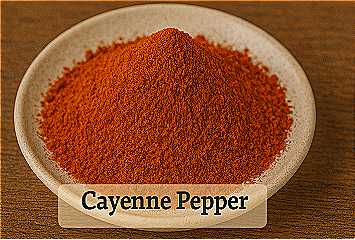
Nome comune: Pepe di Caienna
Pianta di origine: Capsicum annuum L.
Regno: Plantae
Clado: Angiosperme
Clado: Eudicotiledoni
Ordine: Solanales
Famiglia: Solanaceae
Genere: Capsicum
Specie: Capsicum annuum L.
Coltivazione e condizioni di crescita
Clima:
Il pepe di Caienna richiede un clima caldo e stabile, con estati lunghe e prive di gelate. Le piante sono sensibili al freddo e crescono al meglio in ambienti temperati-caldi.
Esposizione:
Preferisce la piena esposizione solare. La luce diretta favorisce fioritura, fruttificazione e contenuto in capsaicinoidi (le sostanze responsabili della piccantezza).
Terreno:
Cresce in suoli ben drenati, di medio impasto, ricchi di sostanza organica e leggermente acidi o neutri (pH 6,0–7,0). I ristagni idrici possono causare marciumi radicali.
Irrigazione:
Necessita di un’umidità moderata e regolare. L’acqua dev’essere abbondante nelle prime fasi e durante la crescita, ma ridotta nella maturazione per intensificare il sapore e prevenire spaccature nei frutti.
Temperatura:
La germinazione avviene al meglio tra 20 e 30 °C. La crescita ottimale si verifica tra 22 e 28 °C. Temperature sotto i 12 °C rallentano lo sviluppo; sopra i 35 °C possono ostacolare l’allegagione.
Concimazione:
Richiede una buona dotazione di potassio, fondamentale per la fruttificazione. Apporti equilibrati di fosforo e azoto migliorano vigoria e produzione. La sostanza organica favorisce la fertilità del suolo.
Cure colturali:
È utile sarchiare il terreno per mantenerlo soffice e privo di infestanti. Le piante possono trarre beneficio dalla pacciamatura per trattenere umidità e limitare le erbe spontanee. Necessario il controllo di afidi, tripidi e acari, comuni su peperoncini.
Raccolta:
La raccolta avviene quando i frutti diventano rosso vivo. A maturazione completa, la polpa concentra capsaicina e aromi. I frutti destinati all’essiccazione si raccolgono completamente maturi per preservare colore e piccantezza.
Moltiplicazione:
Il pepe di Caienna si moltiplica per seme. La semina si effettua in semenzaio a fine inverno, con trapianto in primavera quando la temperatura del suolo supera i 15 °C. La rotazione colturale è consigliata per evitare l’accumulo di parassiti tipici delle Solanaceae.
Valore calorico (per 100 g)
• ~280–360 kcal/100 g (varia con semi/olio residuo).
• Indicativo: carboidrati 50–60 g, fibre 25–35 g, proteine 10–15 g, grassi 10–17 g; sodio naturalmente basso.
Principali sostanze contenute
• Capsaicinoidi: soprattutto capsaicina e diidrocapsaicina (driver della piccantezza; spesso 0,2–1,0 % p/p).
• Carotenoidi: capsantina, capsorubina, zeaxantina, β-carotene (colore e attività antiossidante).
• Composti volatili fruttati/erbacei (terpeni, aldeidi).
• Olio fisso dei semi (triacilgliceroli) con prevalenza di PUFA (linoleico n-6) e quota di MUFA (oleico).
• Marcatori: SHU/capsaicinoidi (HPLC), colore ASTA, umidità e aw.
Processo di produzione
• Raccolta dei baccelli maturi → essiccazione controllata (aria calda/essiccatoi) fino all’umidità target.
• Pulizia e destinatura → eventuale tostatura leggera → macinazione alla granulometria richiesta.
• Sanitizzazione (vapore o equivalenti), setacciatura, confezionamento in imballi barriera sotto GMP/HACCP.
Proprietà sensoriali e tecnologiche
• I grassi estraggono meglio i capsaicinoidi → percezione di calore più piena in matrici lipidiche; breve riscaldamento ne intensifica l’effetto.
• Buona dispersibilità in olio/alcol; in fase acquosa conviene emulsionare.
• Contribuisce a colore, aroma e browning; sinergie con cumino, aglio, cipolla e acidi (aceto, lime).
Impieghi alimentari
• Salse piccanti, rub e marinature per carni/pesci, stufati e legumi, condimenti per snack e salumi, olio al peperoncino.
• Dosaggi tipici: 0,05–0,6 % (validare con prove pilota secondo SHU target).
Nutrizione e salute
• Fonte di fibre e carotenoidi; grassi e sodio bassi alle dosi d’uso.
• La capsaicina può indurre termogenesi lieve e sensazione di calore; può irritare mucose/IG in soggetti sensibili.
• Per reflusso/ulcere o pelle/mucose delicate: preferire dosi minori o varietà più dolci. Evitare claim salutistici non autorizzati.
Profilo dei grassi
• Tenore lipidico totale modesto; pattern tipico: PUFA > MUFA >> SFA (impatto nutrizionale trascurabile alle dosi d’uso).
• Nota salute: una quota relativamente maggiore di MUFA/PUFA rispetto agli SFA è in genere favorevole/neutrale per i lipidi ematici.
Qualità e specifiche (temi tipici)
• Umidità (tipico ≤10–12 %), aw, granulometria, colore ASTA, capsaicinoidi/SHU.
• Microbiologia (TVC, lieviti/muffe), assenza di patogeni; pesticidi/metalli nei limiti; controllo micotossine (es. aflatossine, OTA).
• Autenticità: assenza di coloranti non autorizzati; tenore di semi/steli entro specifica.
Conservazione e shelf-life
• Conservare al fresco, asciutto, al riparo da luce/ossigeno; richiudere bene.
• Sensibile a caking e scolorimento: imballi barriera e, se necessario, sachets essiccanti.
• Shelf-life tipica 12–24 mesi se i parametri restano in specifica (FIFO).
Allergeni e sicurezza
• Il pepe di caienna non è allergene maggiore UE, ma può causare irritazione cutanea/oculare e reazioni in individui sensibili.
• In produzione: DPI contro polveri; evitare cross-contamination; gestione CCP in HACCP.
Funzioni INCI in cosmesi
• Voci tipiche: Capsicum Annuum/Capsicum Frutescens Fruit Extract/Oleoresin.
• Ruoli: rubefacente/riscaldante, stimolante a basse dosi, colorante naturale rosso (oleoresine). Gestire sensibilizzazione e limiti d’uso.
Troubleshooting
• Colore spento/ossidazione: luce/O₂ → migliorare barriera, riempimento a bassa O₂.
• Note rancide/polverose: eccesso di semi o ossidazione → selezione materia prima, macinazione a bassa T°, rotazione FIFO.
• Piccantezza incostante: variabilità varietale/lotto → blend e controllo HPLC/SHU.
• Caking: UR elevata → barriera migliore, antiagglomerante consentito, essiccanti.
Sostenibilità e filiera
• Upcycling di semi/steli per olio/oleoresine; valorizzazione scarti.
• Gestione reflui verso target BOD/COD; imballaggi riciclabili; audit e tracciabilità fornitori in GMP/HACCP.
• Tutela del personale (ventilazione, DPI) contro polveri/capsaicina.
Conclusione
Il pepe di caienna fornisce piccantezza pulita, colore intenso e ampia versatilità. Selezione varietale, controllo di SHU/capsaicinoidi e protezione da luce/umidità assicurano risultati costanti e profilo sensoriale di qualità.
Mini-glossario
• SHU — Scoville heat units: misura della piccantezza, proporzionale ai capsaicinoidi.
• ASTA — Indice standardizzato del colore per le spezie.
• aw — Attività dell’acqua: più è bassa, maggiore è la stabilità microbiologica.
• SFA — Grassi saturi: da moderare; eccessi possono aumentare LDL (qui in tracce).
• MUFA — Grassi monoinsaturi (es. oleico): in genere favorevoli/neutrali per i lipidi ematici (qui bassi).
• PUFA — Grassi polinsaturi (n-6/n-3): utili se bilanciati; impatto minimo alle dosi d’uso.
• GMP/HACCP — Good manufacturing practice / Hazard analysis and critical control points: quadri per igiene e sicurezza preventiva.
• BOD/COD — Domanda biochimica/chimica di ossigeno: indicatori dell’impatto dei reflui.
• CCP — Critical control point: fase in cui un controllo previene/riduce un pericolo.
• FIFO — First in, first out: rotazione scorte che usa per primi i lotti più vecchi.
Bibliografia__________________________________________________________________________
Sarabon N, Löfler S, Cvecka J, Hübl W, Zampieri S. Acute effect of different concentrations of cayenne pepper cataplasm on sensory-motor functions and serum levels of inflammation-related biomarkers in healthy subjects. Eur J Transl Myol. 2018 Mar 1;28(1):7333. doi: 10.4081/ejtm.2018.7333.
Abstract. Physical medicine therapies are often used in treating widespread musculoskeletal disorders, such as neck and low back pain. Herbal cataplasms containing rubefacient substances, such as Cayenne pepper, or galenic preparations like Munari cataplasm are commonly used as natural medications to treat painful areas. In this paper we show the effects of a 20-min application of Cayenne pepper and kaolin powder cataplasm (CPC) on healthy subjects. Treatment effects were evaluated by cold/hot feeling on visual analogue scale, blood pressure, body temperature, skin light touch sensations, two-point discrimination, and pain threshold to a mechanical stimulus, before and immediately after, 15 min after and 30 min after different concentration of Cayenne pepper in CPC preparation on healthy subjects. Maximal voluntary trunk extension force and trunk extension submaximal force matching error were also measured. In addition, the resulting optimal CPC mixture was tested for its safety by measuring changes in circulating levels of inflammatory-related biomarkers after 20-min application. The results indicate that the 5% concentration of Cayenne pepper in the preparation of CPC is the best choice, since no additional effects can be obtained with the 10% concentration, and the effects are higher than those observed at the 2.5% concentration. Importantly, 5% CPC application did not induce a significant increase of inflammatory-related biomarkers, suggesting that 20-min application has no negative side effects at systemic levels. Further studies are needed to investigate the immediate and long-term effects of repeated CPC applications as well as to understand the intersecting underlying mechanisms activated by Capsaicin and other identified factors, in order to be more extensively used in the field of physical medicine therapies.
Knazicka Z, Galik B, Novotna I, Arvay J, Fatrcova-Sramkova K, Kacaniova M, Mlcek J, Kovacikova E, Mixtajova E, Jurikova T, Ivanisova E, Kolesarova A, Duranova H. Enhancing Commercial Gourmet Oil Quality: The Role of Dried Cayenne Pepper Red (Capsicum annuum L.) as a Natural Additive. Molecules. 2025 Feb 17;30(4):927. doi: 10.3390/molecules30040927.
Abstract. This study assessed the potential of dried Cayenne pepper (CP; Capsicum annuum L.) as a natural additive to rice bran oil (RBO), grape seed oil (GSO), and virgin olive oil (OO). Key analyses included peroxide and acid values, oxidative stability (Rancimat method), the composition of fatty acids (FAs) (GC-FID method), antioxidant activity (AA; DPPH method), and antimicrobial properties (disc diffusion method). Capsaicin and the dihydrocapsaicin contents in CP were quantified (HPLC-DAD method) as 1499.37 ± 3.64 and 1449.04 ± 5.14 mg/kg DW, respectively. Oleic acid (C18:1cis n9) dominated in OO (69.70%), OO-CP (69.73%), and RBO-CP (38.97%), while linoleic acid (C18:2cis n6) prevailed in RBO (41.34%), GSO (57.93%), and GSO-CP (58.03%). The addition of CP influenced the FA profile, particularly linoleic acid in OO and RBO, and all FAs in GSO. Peroxide and acid values increased significantly in RBO and GSO upon CP addition, but induction times remained unaffected. The strongest AA (77.00 ± 0.13%) was observed in OO-CP. Cayenne pepper significantly enhanced the antioxidant profiles of all oils compared to the counterparts. However, the antimicrobial activity was weak (≤5.0 mm inhibition zones) against tested microorganisms. These findings support CP as a functional additive for enhancing the nutritional and functional properties of gourmet oils, while highlighting the need for further optimization to improve stability and bioactivity.
Abstract. This study assessed the potential of dried Cayenne pepper (CP; Capsicum annuum L.) as a natural additive to rice bran oil (RBO), grape seed oil (GSO), and virgin olive oil (OO). Key analyses included peroxide and acid values, oxidative stability (Rancimat method), the composition of fatty acids (FAs) (GC-FID method), antioxidant activity (AA; DPPH method), and antimicrobial properties (disc diffusion method). Capsaicin and the dihydrocapsaicin contents in CP were quantified (HPLC-DAD method) as 1499.37 ± 3.64 and 1449.04 ± 5.14 mg/kg DW, respectively. Oleic acid (C18:1cis n9) dominated in OO (69.70%), OO-CP (69.73%), and RBO-CP (38.97%), while linoleic acid (C18:2cis n6) prevailed in RBO (41.34%), GSO (57.93%), and GSO-CP (58.03%). The addition of CP influenced the FA profile, particularly linoleic acid in OO and RBO, and all FAs in GSO. Peroxide and acid values increased significantly in RBO and GSO upon CP addition, but induction times remained unaffected. The strongest AA (77.00 ± 0.13%) was observed in OO-CP. Cayenne pepper significantly enhanced the antioxidant profiles of all oils compared to the counterparts. However, the antimicrobial activity was weak (≤5.0 mm inhibition zones) against tested microorganisms. These findings support CP as a functional additive for enhancing the nutritional and functional properties of gourmet oils, while highlighting the need for further optimization to improve stability and bioactivity.
Abstract. Background: Herbal drug delivery is limited by poor solubility and bioavailability which can be overcome with suitable nanomaterials that will enhance their pharmacokinetics and performance. Objective: This study aimed to analyze the synthesis, characterization, and biological activities of silver nanoparticles (AgNPs) from three spices. Materials and methods: AgNPs were prepared using 0.1 M silver nitrate and aqueous extracts of Allium sativum L. (garlic), Zingiber officinale Rosc. (ginger), and Capsicum frutescens L. (cayenne pepper). The AgNPs were characterized using ultraviolet-visible (UV-Vis) spectroscopy, scanning electron microscopy (SEM), transmission electron microscopy (TEM), energy dispersive X-ray, X-ray diffraction (XRD), and Fourier transform infrared (FTIR) spectroscopy. Results: The AgNPs were formed within an hour of the reaction and showed maximum UV-Vis absorption in the 375-480 nm range. SEM and TEM revealed well-dispersed spherical particles with little agglomeration, average sizes of 3-6 nm, 3-22 nm, and 3-18 nm for garlic, ginger, and cayenne pepper, respectively. FTIR showed that amine, protein, phenolic, aromatic, and alkynes groups contributed to AgNP synthesis and XRD confirmed their crystalline and face-centered cubic nature. Antibacterial action of the AgNPs was in the following order: ginger (minimum inhibitory concentration [MIC] <25 μg/mL) > garlic> cayenne pepper (MIC 125 μg/mL). Antioxidant action showed cayenne pepper > ginger > garlic (inhibitory concentration 50% [IC50]: 40, 240, and 250 μg/mL, respectively) against 2,2-Azino-bis (3-ethylbenzthiazoline-6-sulfonic acid) and garlic > cayenne pepper > ginger (IC50: <31.25, 40, and 120 μg/mL, respectively) against 1,1-diphenyl-2-picrylhydrazyl. Conclusion: Optimization of this green synthesis would support the production of AgNPs with great therapeutic potentials.
Yang L, Sun J, Zhao M, Xi B. Chili pepper intake and all-cause and disease-specific mortality. Int J Vitam Nutr Res. 2023 Aug;93(4):378-384. doi: 10.1024/0300-9831/a000746.
Abstract. Background: Chili pepper has been used for the treatment and prevention of multiple diseases. This may be due to its abundance of bioactive components, such as carotenoids, which are well known for their antioxidant properties. To date, several prospective cohort studies have examined the association between chili pepper intake and mortality, but the results have not been consistent. This study aimed to clarify the association between chili pepper intake and all-cause and disease-specific mortality using a meta-analysis. Methods: PubMed, Embase, and ISI Web of Science databases were searched up to December 20, 2020, and reference lists of included studies were manually reviewed. All prospective cohort studies on the association between chili pepper intake and all-cause, cardiovascular disease (CVD)-specific, and cancer-specific mortality were included in this study. Pooled hazard ratios (HRs) and 95% confidence intervals (CIs) were calculated in the meta-analysis. Between-study heterogeneity was assessed using I2 statistic and Q test. Results: A total of 4 cohort studies (N=564,748; all four studies had adjusted for important potential confounders such as demographic variables, dietary intake, and physical activity) were ultimately included in this meta-analysis. Among them, 31,527 died due to all causes, 10,184 died due to CVD, and 9,868 died due to cancer. Compared to none or rare consumption of chili pepper, consumption of chili pepper (ever or more than once a week) could significantly reduce the risk of all-cause mortality (summary adjusted HR: 0.87, 95% CI: 0.85, 0.90), CVD-specific mortality (summary adjusted HR: 0.89, 95% CI: 0.85, 0.93), and cancer-specific mortality (summary adjusted HR: 0.92, 95% CI: 0.88, 0.97). There was no significant between-study heterogeneity in the analyses (all-cause mortality: I2=0.7%, P=0.389; CVD-specific mortality: I2=21.8%, P=0.280; cancer-specific mortality: I2=0.0%, P=0.918). Conclusions: The present meta-analysis confirmed that chili pepper intake could reduce the risk of all-cause, CVD-specific, and cancer-specific mortality, suggesting that chili pepper may be a beneficial ingredient in the diets in prolonging life.
Luo L, Yan J, Wang X, Sun Z. The correlation between chili pepper consumption and gastric cancer risk: A meta-analysis. Asia Pac J Clin Nutr. 2021;30(1):130-139. doi: 10.6133/apjcn.202103_30(1).0016.
Abstract. Background and objectives: The correlation between chili pepper intake and gastric cancer (GC) risk has been controversial. We conducted a meta-analysis of 16 studies to provide updated evidence for this uncertainty. Methods and study design: Medline, and China National Knowledge Infrastructure (CNKI) databases were searched to obtain all qualified literature related to pepper consumption and GC incidence before June 2020. Random effects models were adopted to integrate the relative risk of individual studies. The Newcastle-Ottawa Scale (NOS) was used to assess the quality of the literature of each included study. Dose response meta-analysis was implemented through the one-stage robust error meta-regression (REMR) approach. Results: 16 studies (8337 cases) were included in quantitative meta-analysis. The pooled odds ratio (OR) of GC for the highest versus the lowest category of chili consumption were 1.51 (95% confidence interval [CI]=1.02-2.00) for all countries, 2.05 (95% CI=1.15-2.95) for Mexican, 2.03 (95% CI =0.71-3.34) for Colombian, 1.92 (95% CI=1.21-2.64) for Asian and 0.48 (95% CI=0.24-0.72) for other countries. Dose-response meta-analysis showed that there was a positive linear correlation between the risk of GC and the daily frequency of chili consumption. Conclusions: Significantly increased consumption of chili pepper or capsaicin has the potential to increase the risk of gastric cancer, however, inconsistencies still exist in subgroup analysis between different regions.
Ao Z, Huang Z, Liu H. Spicy Food and Chili Peppers and Multiple Health Outcomes: Umbrella Review. Mol Nutr Food Res. 2022 Dec;66(23):e2200167. doi: 10.1002/mnfr.202200167. Epub 2022 Oct 19. PMID: 36111960; PMCID: PMC10078540.




