



Greater galangal (Alpinia galanga)
Greater galangal is a rhizome of the Zingiberaceae family with a citrusy–camphoraceous aromatic profile accented by peppery and resinous notes. It is used fresh, dried, or ground throughout Southeast Asian cuisines (e.g., curry pastes and soups such as tom kha), and as a raw material for essential oils and extracts.
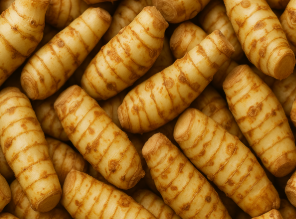
Common name: Greater galangal (large galangal)
Parent plant: Alpinia galanga (L.) Willd.
Kingdom: Plantae
Clade: Angiosperms
Clade: Monocots
Order: Zingiberales
Family: Zingiberaceae
Genus: Alpinia
Species: Alpinia galanga (L.) Willd.
Cultivation and growth conditions
Climate:
Greater galangal is a tropical plant native to Southeast Asia. It requires a warm, humid climate throughout the year, with high temperatures and regular rainfall. It does not tolerate frost and suffers below 10 °C. It grows best in tropical and monsoon-type environments.
Sun exposure:
It prefers bright partial shade, but can also grow in full sun as long as the soil remains constantly moist. In its natural habitat, it typically grows at the edges of tropical forests, where it receives filtered light.
Soil:
Greater galangal needs soil that is rich in organic matter, loose, and very well drained. Ideal soil characteristics:
medium or slightly sandy texture;
good water-holding capacity without waterlogging;
pH between 5.5 and 7.0.
Waterlogged soils quickly promote rhizome rot.
Irrigation:
It has a medium to high water requirement. Soil should be kept consistently moist, especially during the hottest months. In less rainy regions, regular irrigation is essential. Prolonged drought reduces growth and the aromatic quality of the rhizomes.
Temperature:
Optimal growth: 22–30 °C
Sensitive to cold below 10 °C
Performs best in environments with high air humidity (above 60–70%)
Fertilization:
Galangal responds well to fertilization rich in organic matter:
Compost and well-rotted manure enhance vigor and aroma of the rhizomes.
Phosphorus and potassium support healthy rhizome development.
Nitrogen should be supplied in moderate amounts to avoid excessive leafy growth.
Crop care:
Weed control, especially during the early growth stages.
Application of organic mulches to maintain soil moisture and temperature.
Monitoring of soil pests such as beetles and nematodes.
Control of fungal diseases, particularly where drainage is poor or humidity is excessive.
Harvest:
The rhizomes are usually harvested 10–12 months after planting, when the plant has reached full maturity. Rhizomes are washed, cut, and often dried or ground into powder for culinary and medicinal uses.
Propagation:
Greater galangal is propagated almost exclusively by rhizome division.
Each section should include at least one viable bud.
Planting is usually carried out in spring or at the beginning of the rainy season.
Propagation by seed is rare due to low germination and high genetic variability.
Caloric value (100 g)
Fresh rhizome: approximately 60–80 kcal/100 g.
Dried/ground: approximately 300–360 kcal/100 g (moisture dependent; contribution at flavoring doses is modest).
Key constituents
Total essential oil typically 0.4–1.5% in dried rhizome, featuring 1,8-cineole (eucalyptol), bornyl acetate, camphor, eugenol, α-pinene, methyl cinnamate, with traces of citral.
Characteristic phenylpropanoids/diarylheptanoids (notably 1′-acetoxychavicol acetate), plus minor flavonoids.
Nonvolatile matrix of starch, fibers, simple sugars, organic acids, and minerals (K, Mg).
Essential-oil identity and lot consistency are commonly checked by GC–MS.
Average composition (indicative, dried rhizome, per 100 g)
Moisture: ~8–12 g.
Total carbohydrate: ~55–70 g (starch predominant).
Dietary fiber: ~10–20 g.
Protein: ~5–9 g.
Fat: ~1–5 g.
Ash: ~4–6 g.
Typical aw: low in dried material; higher (perishable) when fresh.
Production process
Cultivation and harvest: Perennial stands in tropical climates; rhizomes harvested at ~8–12 months when aroma is developed.
Primary preparation: Washing, optional peeling, and controlled slicing.
Drying: Hot-air or assisted solar drying (≈45–60 °C) to a stable final moisture; managing RH and temperature limits volatile loss.
Milling and standardization: Grinding and sieving to specification; optional steam sterilization; volatile profile verification by GC–MS.
Extraction: Steam distillation for essential oil; hydroalcoholic extraction (EtOH) or SFE with supercritical CO₂ for selective extracts.
Packing: Moisture/oxygen-barrier packaging under GMP/HACCP with defined CCPs for hygiene, moisture, and foreign bodies.
Sensory and technological properties
Aroma and taste: Notes of pine/eucalyptus, citrus, gentle ginger-like warmth, and peppery spice; cleaner and more camphoraceous than ginger.
Functionality: Potent flavor at low dose; mild antioxidant–aromatic support in marinades and soups; good infusion and paste performance.
Stability: Volatiles are sensitive to light/heat/air; whole rhizomes retain aroma better than ground powder.
Food applications
Curry and chili pastes (typically 1–3% of paste mass), soups (tom kha, tom yum), stews and sauces, pickles and condiments, spice blends for meats/fish, and spiced beverages/infusions. For fresh use, bruised slices (~5–10 g/L stock) are simmered and removed before serving.
Nutrition and health
Culinary use levels yield negligible energy impact while delivering aromatic compounds. The essential oil contains eugenol and other bioactives that can be irritant at excess dose; food use should follow good practice without implying health claims.
Quality and specification themes
Verified botanical identity, purity, and moisture in range; free of molds and insects.
Essential-oil content and terpene composition consistent by GC–MS.
Cream–ocher color without undue browning; clean, non-earthy aroma.
Pesticides/metals within limits; compliant microbiology; full traceability under GMP/HACCP.
Storage and shelf life
Store cool, dry, and dark in well-sealed, low-permeability containers; control ambient RH to prevent caking and volatile loss.
Prefer whole rhizome for long storage; mill close to use.
Apply FIFO rotation; for essential oil, use dark glass, minimal headspace, and cool conditions.
Allergens and safety
Greater galangal is not a listed major allergen but may cause individual sensitization; essential oil is irritant to skin/mucosa if undiluted. Plant handling should limit dust, and CCPs should address foreign bodies.
Cosmetic (INCI) functions
Common listings: Alpinia Galanga Root Oil, Alpinia Galanga Root Extract. Reported roles: fragrance, masking, skin conditioning, supportive antioxidant, and mild antimicrobial functions in natural leave-on and rinse-off products.
Troubleshooting
Weak aroma: Over-hot drying or long storage → Reduce drying severity, improve barrier packaging, and grind on demand.
Excess bitter/camphor notes: Overdose or prolonged cooking → Lower inclusion and add nearer to end of cook.
Powder caking: High RH → Use better barrier packs and desiccants; improve logistics.
Darkening of slices: Enzymic/oxidative browning → Peel/slice and start drying promptly; consider mild antioxidant dips.
Sustainability and supply chain
Southeast Asian supply chains often involve smallholders; traceability programs and sustainable agronomy improve the ethical profile. Heat-recovery in drying, recyclable packaging, and effluent control to BOD/COD targets reduce environmental impact.
Conclusion
Greater galangal provides a distinctive, versatile flavor distinct from ginger, delivering camphoraceous citrus freshness across many dishes. Application quality hinges on rhizome maturity, gentle drying, protection of volatiles, and proper standardization of extracts.
Mini-glossary
GC–MS — Gas chromatography–mass spectrometry; used to fingerprint and verify essential-oil composition.
aw — Water activity; low aw in dried spices supports microbial and oxidative stability.
RH — Relative humidity; high RH promotes caking and volatile loss during storage.
EtOH — Ethanol; common hydroalcoholic solvent for food extracts/flavors.
SFE — Supercritical fluid extraction; CO₂-based process yielding selective aromatic extracts.
GMP — Good Manufacturing Practice; hygiene and process controls ensuring consistency and traceability.
HACCP — Hazard Analysis and Critical Control Points; preventive food-safety system with defined CCPs.
CCP — Critical control point; a step where control prevents, eliminates, or reduces a hazard to acceptable levels.
FIFO — First in, first out; inventory rotation principle—use the oldest lots first.
INCI — International Nomenclature of Cosmetic Ingredients; standardized cosmetic ingredient naming/functions.
BOD/COD — Biochemical/Chemical oxygen demand; indicators of organic load in effluents and environmental impact.
PV — Peroxide value; index of primary oxidation in oils and oleoresins.
AV — Anisidine value; index of secondary oxidation (aldehydes) in oils and oleoresins.

