



HA (Hyaluronic acid) is a polysaccharide belonging to the class of glycosaminoglycans, involved in tissue repair processes and in their regeneration. It is a fundamental component of the extracellular matrix, which contributes to an optimal performance of the repair processes by providing the appropriate degree of hydration, which facilitates cell migration (1).
Hyaluronic acid is a natural component present in abundance in load-bearing joints of the human body (2), has the property of retaining skin moisture (3), has anti-inflammatory, antioxidant, and antibacterial effects for the treatment of periodontal diseases ( 4). However, the lubricating effect of hyaluronic acid is generally of short duration and the duration of its biological effects is not predictable (5).
Hyaluronic Acid is a naturally occurring substance in the human body, widely used in various cosmetic and personal care products for its exceptional moisturizing and anti-aging properties. It provides long-lasting hydration, enhances skin elasticity, and improves overall skin texture.
Chemical Composition and Structure
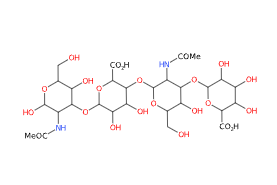
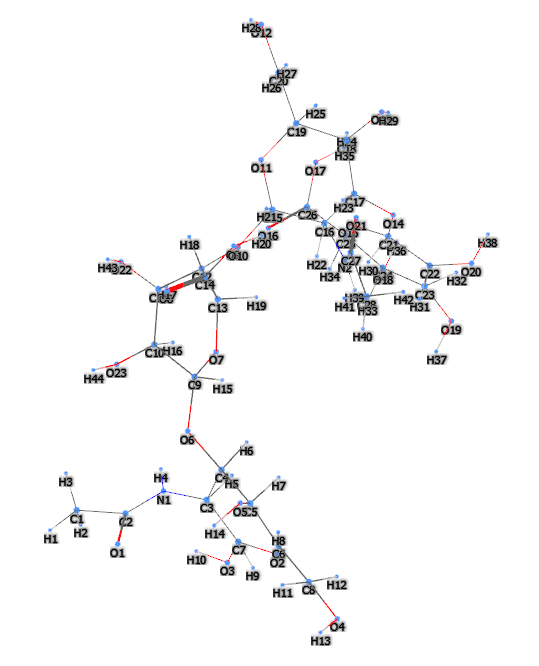
Hyaluronic Acid, chemically known as a glycosaminoglycan, consists of repeating disaccharide units of N-acetylglucosamine and glucuronic acid. Its unique ability to bind and retain water molecules contributes to its remarkable moisturizing properties. The molecular formula for Hyaluronic Acid is (C14H21NO11)n, where "n" represents the number of repeating units.
Physical Properties
Hyaluronic Acid typically appears as a white, odorless powder that is highly soluble in water. When dissolved, it forms a clear, viscous solution that can hold up to 1,000 times its weight in water, making it an excellent hydrating agent. Its viscosity and water-retaining capacity make it a popular ingredient in various cosmetic formulations.
Industrial Production Process
- Preparation of reagents. The main raw materials include natural sources (such as rooster combs) or genetically modified bacteria (Escherichia coli or Streptococcus zooepidemicus) for fermentation.
- Fermentation. If using a fermentation method, the bacteria are cultured in a nutrient-rich growth medium, such as glucose, peptones, and mineral salts, at controlled temperature and pH. The fermentation is maintained for a specified period to produce hyaluronic acid.
- Harvesting. At the end of fermentation, the fermentation broth is centrifuged to separate the bacterial cells from the supernatant containing hyaluronic acid.
- Purification. The supernatant undergoes several purification steps, including filtration, solvent precipitation with ethanol, and chromatography to remove impurities and concentrate the hyaluronic acid.
- Precipitation. The hyaluronic acid is precipitated by adding ethanol or another organic solvent. The precipitate is collected by centrifugation or filtration.
- Washing. The hyaluronic acid precipitate is washed with ethanol or water to remove further impurities.
- Drying. The washed precipitate is dried by lyophilization (freeze-drying) or vacuum drying to obtain a dry product.
- Grinding. The dried product is ground to obtain a fine and uniform powder.
- Classification. The dried powder is classified to ensure a uniform particle size. This step may involve sieving or the use of air classifiers.
- Stabilization. The hyaluronic acid is stabilized to ensure its stability during transportation and storage, preventing aggregation and degradation.
- Quality control. The hyaluronic acid undergoes rigorous quality testing to ensure it meets standards for purity, safety, and functionality. These tests include chemical analysis, spectroscopy, and physical tests to determine particle size and rheological properties.
Industrially it is in the form of a white, water-soluble powder.

Applications
Moisturizers and Creams: Hyaluronic Acid is widely used in moisturizers and creams for its ability to provide intense hydration. It helps maintain the skin's moisture balance, resulting in smoother and more supple skin.
Anti-Aging Products: Due to its strong water-binding capacity, Hyaluronic Acid is a key ingredient in anti-aging products. It helps to plump the skin, reducing the appearance of fine lines and wrinkles, and enhancing skin firmness and elasticity.
Serums and Essences: In serums and essences, Hyaluronic Acid acts as a powerful hydrating agent, improving the penetration and effectiveness of other active ingredients. It provides immediate and long-lasting hydration, making the skin appear more radiant and youthful.
Hair Care Products: Hyaluronic Acid is also used in hair care products such as shampoos, conditioners, and hair masks. It helps to hydrate and condition the hair, improving its texture, softness, and manageability.
Eye Care: The ingredient is ideal for use in eye creams and gels due to its gentle yet effective moisturizing properties. It helps to reduce puffiness, fine lines, and dark circles around the delicate eye area.

Safety
Hyaluronic Acid is generally considered safe for use in cosmetic and personal care products. It is non-irritating, non-sensitizing, and suitable for all skin types, including sensitive skin. As a biodegradable substance, it poses minimal risk to the environment when disposed of properly. However, it is important to use Hyaluronic Acid within the recommended guidelines to ensure safety and efficacy.
For more information:
| Appearance | White powder |
| Boiling Point | 1274.4±65.0°C at 760 mmHg |
| Flash Point | 724.5±34.3°C |
| Density | 1.8±0.1 g/cm3 |
| PSA | 399.71000 |
| LogP | -6.62 |
| Refraction Index | 1.666 |
| Vapor Pressure | 0.0±0.6 mmHg at 25°C |
| Storage | −20°C |
 |  |
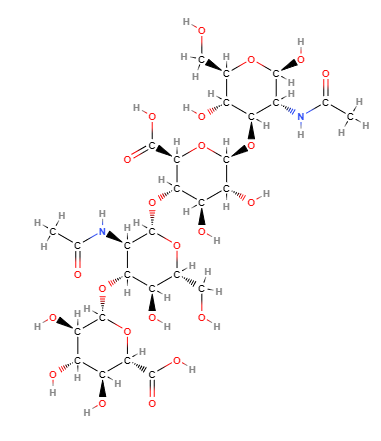 | 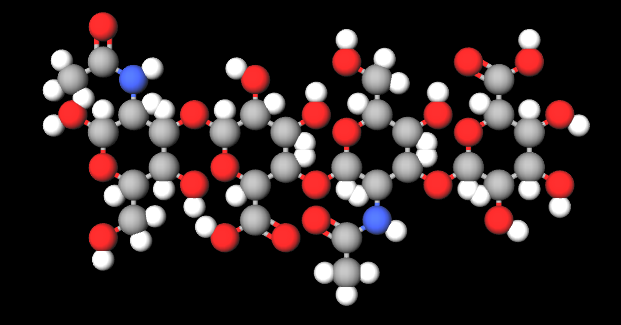 |
FMolecular Formula C28H44N2O23
Molecular Weight 776.6
CAS 9004-61-9
UNII
EC Number
DSSTox Substance ID
IUPAC (2S,3S,4S,5R,6R)-6-[(2S,3R,5S,6R)-3-acetamido-2-[(2S,3S,4R,5R,6R)-6-[(2R,3R,5S,6R)-3-acetamido-2,5-dihydroxy-6-(hydroxymethyl)oxan-4-yl]oxy-2-carboxy-4,5-dihydroxyoxan-3-yl]oxy-5-hydroxy-6-(hydroxymethyl)oxan-4-yl]oxy-3,4,5-trihydroxyoxane-2-carboxylic acid
InChI=1S/C28H44N2O23/c1-5(33)29-9-18(11(35)7(3-31)47-25(9)46)49-28-17(41)15(39)20(22(53-28)24(44)45)51-26-10(30-6(2)34)19(12(36)8(4-32)48-26)50-27-16(40)13(37)14(38)21(52-27)23(42)43/h7-22,25-28,31-32,35-41,46H,3-4H2,1-2H3,(H,29,33)(H,30,34)(H,42,43)(H,44,45)/t7-,8-,9-,10-,11-,12-,13+,14+,15-,16-,17-,18?,19?,20+,21+,22+,25-,26+,27-,28-/m1/s1
InChl Key KIUKXJAPPMFGSW-MNSSHETKSA-N
SMILES CC(=O)NC1C(C(C(OC1O)CO)O)OC2C(C(C(C(O2)C(=O)O)OC3C(C(C(C(O3)CO)O)OC4C(C(C(C(O4)C(=O)O)O)O)O)NC(=O)C)O)O
Synonyms
- (2S,3S,4S,5R,6R)-6-[(2S,3R,5S,6R)-3-acetamido-2-[(2S,3S,4R,5R,6R)-6-[(2R,3R,5S,6R)-3-acetamido-2,5-dihydroxy-6-(hydroxymethyl)oxan-4-yl]oxy-2-carboxy-4,5-dihydroxyoxan-3-yl]oxy-5-hydroxy-6-(hydroxymethyl)oxan-4-yl]oxy-3,4,5-trihydroxyoxane-2-carboxylic acid
- (2S,3S,4S,5R,6R)-6-[(2S,3R,5S,6R)-3-acetamido-2-[(2S,3S,4R,5R,6R)-6-[(2R,3R,5S,6R)-3-acetamido-2,5-dihydroxy-6-(hydroxymethyl)oxan-4-yl]oxy-2-carboxy-4,5-dihydroxyoxan-3-yl]oxy-5-hydroxy-6-(hydroxymethyl)oxan-4-yl]oxy-3,4,5-trihydroxyoxane-2-carboxylic acid
- D-Glucopyranose, O(4ξ)-α-D-xylo-hexopyranuronosyl-(1->3)-O-2-(acetylamino)-2-deoxy-β-D-allopyranosyl-(1->4)-O(5ξ)-β-D-xylo-hexopyranuronosyl-(1->3)-2-(acetylamino)-2-deoxy-

