



Hyundai Kona – Model Year 2025
Country of Manufacture
The Hyundai Kona MY2025 for Europe is produced at the Hyundai plant in Nošovice, Czech Republic.
Brief Description
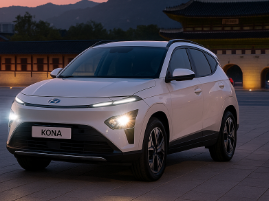
The Hyundai Kona MY2025 is one of the most versatile and technologically advanced compact crossovers in its segment, available with petrol, mild hybrid, full hybrid, and electric powertrains. The design is modern and distinctive, with sculpted lines, horizontal LED light bars, and chrome accents. The completely redesigned interior features high-quality materials, dual digital displays up to 12.3", automatic climate control, heated and ventilated seats, broad connectivity, and surprising roominess for both passengers and luggage. Safety is ensured by a comprehensive ADAS package.
2025 Powertrains
| Version | Power / Torque | Engine / Battery | Drivetrain | Transmission | 0–100 km/h | Avg. Consumption / Range* |
|---|---|---|---|---|---|---|
| 1.0 T-GDi 48V | 120 hp / 200 Nm | 1.0 Turbo 3-cyl Mild Hybrid | FWD | 6-speed manual | 11.7 s | 5.5 l/100 km |
| 1.6 HEV Full Hybrid | 141 hp / 265 Nm | 1.6 GDI + electric 1.32 kWh | FWD | 6-speed DCT | 10.9 s | 4.4 l/100 km |
| Electric 48 kWh | 156 hp / 255 Nm | 48 kWh battery | FWD | Automatic | 8.8 s | 377 km (WLTP) |
| Electric 65 kWh | 218 hp / 255 Nm | 65 kWh battery | FWD | Automatic | 7.8 s | 514 km (WLTP) |
*WLTP combined cycle data.
Charging (Electric versions)
DC fast charging up to 100 kW: 10–80% in about 41 minutes (65 kWh battery).
AC (Wallbox) up to 11 kW: full charge in about 6 hours.
Dimensions and Capacity
| Length | Width | Height | Boot Capacity |
|---|---|---|---|
| 4,350 mm | 1,825 mm | 1,580 mm | 466–1,300 liters |
Main Trims
Kona: 16” steel wheels, dual 12.3" displays, Apple CarPlay/Android Auto, automatic climate control, emergency braking, lane keeping assist, rear parking sensors.
Kona N Line: 18” alloy wheels, sport interior, leather seats and steering wheel, sporty exterior details, rear camera, wireless charger, dual-zone climate.
Kona X Class: 19” alloy wheels, heated and ventilated seats, integrated navigation, power tailgate, advanced ADAS package, premium audio, panoramic sunroof.
PROS
| PRO | Why it stands out |
|---|---|
| Complete engine range | Petrol, mild hybrid, full hybrid, and electric—something for everyone. |
| Advanced onboard technology | Dual digital displays, full infotainment, standard ADAS. |
| Space and comfort | Spacious cabin, generous boot, premium seats and features. |
| Top electric range | EV version up to 514 km WLTP, among the best in class. |
| Safe and relaxing to drive | Comfortable suspension and comprehensive safety package. |
CONS
| CONS | Noted detail |
|---|---|
| Higher than average price | Top trims have a high price tag. |
| Heavy weight in EV versions | Electric models are heavy, affecting maneuverability in city use. |
| Base engines lack punch | The 1.0 turbo is not particularly lively; best for city driving. |
| Limited rear visibility | Thick rear pillars and small rear window hinder visibility. |
| Basic entry-level version | Initial trim can feel sparse compared to competitors. |
Indicative Prices
| Version | List Price* |
|---|---|
| 1.0 T-GDi 48V Kona | €25,900 |
| 1.6 HEV Full Hybrid | €29,900 |
| Electric 48 kWh | €36,900 |
| Electric 65 kWh X Class | €44,400 |
*VAT included; registration tax and delivery fees excluded.
Summary
The Hyundai Kona MY2025 is one of the most versatile and high-tech crossovers on the market, ideal for those looking for a compact yet spacious vehicle with a wide choice of powertrains and top-level features. Highlights include its technology, EV range, and overall versatility. Its limitations are price, rear visibility, and the lack of dynamism in entry-level engines.
Verdict — Hyundai Kona (Model-Year 2025)
Hyundai Kona 1.0 T-GDi 120 hp Mild Hybrid · 1.6 T-GDi 198 hp (HEV) · Electric 115 kW/160 kW (48.4/65.4 kWh) · N Line
The Hyundai Kona is the Korean brand’s compact crossover, designed for those who want distinctive style, cutting-edge technology, and a choice between petrol, hybrid, or fully electric. The bold design features a full-width LED signature, sharp muscular lines, sporty N Line details, contrasting roof, and 17" to 19" wheels. The interior is modern and spacious: dual panoramic 12.3" displays, soft-touch materials, supportive seats, and plenty of room for passengers and luggage.
On the technical side:
1.0 T-GDi Mild Hybrid: 120 hp, manual or DCT, 5.5 l/100 km WLTP, front-wheel drive.
1.6 HEV: 198 hp full hybrid, automatic transmission, 4.6 l/100 km WLTP, lively performance and low costs.
Electric: two power levels (115 or 160 kW), batteries 48.4 or 65.4 kWh, WLTP range up to 514 km, fast DC charging 100 kW (10-80% in 41 min).
Suspension tuned for both comfort and dynamics, precise steering, enjoyable driving both in town and on the open road.
| Aspect | Where it excels | Where it matches | Where it lags |
|---|---|---|---|
| Design & Image | Bold lines, full-width LED signature, N Line details, vivid colors, wheels up to 19". | Two-tone paint, contrasting roof, real SUV stance. | Interior not as “premium” as Audi Q2 or Mini Countryman. |
| Comfort & NVH | Spacious and bright cabin, supportive seats, great sound insulation, dual-zone auto climate. | USB-C ports, wireless charging, soft-touch materials. | Center rear seat is firm, ride a bit stiff with 19" wheels. |
| Real-world Efficiency | Electric version with top-class real range, low consumption on HEV. | Fast DC charging, low running costs, simple maintenance. | 1.6 turbo petrol not available, higher consumption on powerful versions. |
| Dynamics | Smooth and secure driving, stable chassis, responsive steering, good grip on all surfaces. | Precise automatic transmission, good comfort/dynamics balance. | Some body roll with comfort setup, less engaging than Ford Puma. |
| Practicality | 5 doors, 466–1300 L boot (Electric), split rear seats, plenty of small storage. | Electric tailgate, low loading lip, adjustable boot floor. | Smaller boot on HEV, no all-wheel-drive versions available. |
| HMI / Infotainment | Dual 12.3" displays, wireless Apple/Android, navigation, HD rear camera, physical climate controls. | Bluetooth, multiple USBs, voice recognition. | System sometimes less responsive, graphics less modern than German rivals. |
| ADAS & safety | Emergency braking, lane keep assist, adaptive cruise, Blind Spot, parking assist, traffic sign recognition. | Parking sensors, Hill Assist, 360° cameras, eCall. | Level 2 only on high trims, advanced autonomous driving not available. |
| Running Costs | 17–19" tyres (from €90 each), 5-year/unlimited mileage warranty, EV incentives, clear servicing. | Average insurance, minimal EV maintenance. | Top trims costlier to maintain, residual value still variable. |
| Depreciation | High demand for the Electric, steady interest in Hybrid, competitive price. | — | Entry trims depreciate faster, badge less “premium” than key rivals. |
Who it’s for
Those seeking a versatile crossover for city and travel — Kona Electric: top range, comfort, technology, and low running costs.
Modern families and commuters — HEV: low consumption, smooth drive, complete ADAS suite.
Anyone wanting sporty looks and strong performance — N Line 160 kW: aggressive design, power, full infotainment.
Who should look elsewhere
Anyone seeking premium finish or exclusive interiors → Audi Q2, Mini Countryman, Lexus UX.
Those wanting true sporty driving → Ford Puma ST, Mazda CX-30, Cupra Formentor.
Anyone needing all-wheel drive or maximum cargo capacity → Toyota Yaris Cross AWD, Skoda Kamiq, Nissan Qashqai.
Recommended configuration
Hyundai Kona Electric 160 kW Style + dual 12.3" displays + 19" wheels + dual-zone climate + ADAS pack: the perfect choice for those who want a compact crossover that’s high-tech, spacious, and ready for anything.
Avoid the entry trim if you want advanced infotainment, superior comfort, or full ADAS features.

