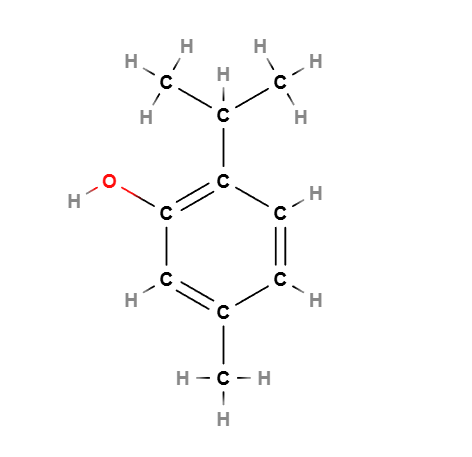
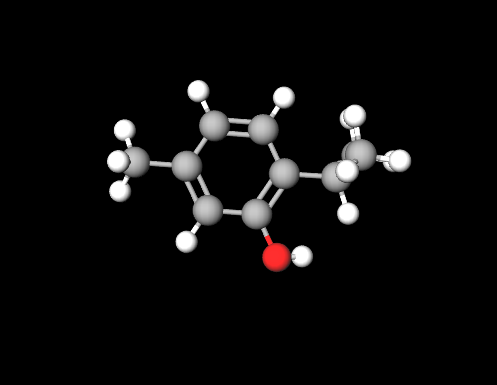
Il Timolo è un fenolo monoterpenico naturale derivato dall'olio di timo, origano e da altre piante aromatiche. È noto per le sue potenti proprietà antimicrobiche, antifungine e antiossidanti, rendendolo un ingrediente prezioso in applicazioni cosmetiche, farmaceutiche e alimentari.
Composizione Chimica e Struttura
La composizione chimica del Timolo include:
- Formula Chimica: C₁₀H₁₄O.
- Gruppi Funzionali: Contiene un gruppo idrossile (–OH) attaccato a un anello fenolico, che contribuisce alle sue proprietà bioattive.
Strutturalmente, il Timolo è caratterizzato dal suo anello aromatico e dalla sua struttura isomerica, che ne migliorano la stabilità e la reattività in varie formulazioni.
Proprietà Fisiche
- Aspetto: Liquido incolore o giallo pallido.
- Solubilità: Solubile in alcol e oli; solubilità limitata in acqua.
- pH: Generalmente neutro, ma può variare a seconda della formulazione.
- Odore: Aroma forte, aromatico e erbaceo caratteristico del timo.
- Stabilità: Sensibile alla luce e all'aria; deve essere conservato in un luogo fresco e buio per mantenere la potenza.
Processo di Produzione
- Estrazione: Il Timolo è tipicamente estratto dall'olio di timo (Thymus vulgaris) attraverso distillazione a vapore.
- Purificazione: L'olio grezzo può subire un processo di purificazione per isolare il Timolo dagli altri componenti.
- Formulazione: Il composto purificato può essere incorporato in vari prodotti, inclusi cosmetici, integratori alimentari e formulazioni alimentari.
Applicazioni
- Medico: Utilizzato nella medicina erboristica per le sue proprietà antimicrobiche e antifungine.
- Cosmetici: Comunemente incluso in prodotti per la pelle per i suoi effetti antiossidanti e la capacità di promuovere la salute della pelle.
Funzioni INCI:
Agente per l'igiene orale. Questo ingrediente può essere inserito nella cavità orale di per migliorare e/o mantenerne l'igiene orale e la salute, per prevenire o migliorare un disturbo dei denti, gengive, mucosa. Fornisce effetti cosmetici alla cavità orale come protettivo, detergente, deodorante.
Agente condizionante della pelle - Misto. Questo ingrediente ha il compito di modificare e migliorare le condizioni della pelle quando è danneggiata o secca, attenuando la desquamazione, ridimensionandone la sfogliatura e restituendone elasticità.
Fragranza. Ha un ruolo decisamente importante nella formulazione di prodotti cosmetici in quanto fornisce la possibilità di migliorare, mascherare o aggiungere profumo al prodotto finale aumentandone la commerciabilità. E' in grado di creare un odore gradevole percepibile, mascherare un cattivo odore. Il consumatore si aspetta sempre di trovare un profumo gradevole o particolare in un prodotto cosmetico.
Denaturante. Rende i cosmetici poco gradevoli. Viene a volte aggiunto ai cosmetici contenenti alcol etilico per renderlo inadatto all'ingestione. Le molecole ioniche o polari di questo ingrediente inserite in formulazioni che interagiscono con i gruppi proteici, modulano le proprietà della soluzione in modo da modificarla per esigenze specifiche.
- Alimentare: Utilizzato come conservante naturale e agente aromatizzante grazie alla sua potente attività antimicrobica.
- Usi Industriali: Applicazioni limitate, principalmente in formulazioni di prodotti naturali.
Considerazioni Ambientali e di Sicurezza
Il Timolo è generalmente considerato sicuro per l'uso nei cosmetici e nei prodotti alimentari quando applicato secondo le linee guida raccomandate. Tuttavia, le persone con specifiche sensibilità dovrebbero esercitare cautela. È essenziale garantire pratiche di approvvigionamento e produzione responsabili per assicurare che il Timolo sia privo di contaminanti nocivi e prodotto in modo sostenibile.
Molecular Formula C10H14O
Molecular Weight 150.22 g/mol
CAS 89-83-8
UNII 3J50XA376E
EC Number 201-944-8
Synonyms:
5-Methyl-2-isopropylphenol
2-Isopropyl-5-methylphenol
Bibliografia__________________________________________________________________________
Peter S, Sotondoshe N, Aderibigbe BA. Carvacrol and Thymol Hybrids: Potential Anticancer and Antibacterial Therapeutics. Molecules. 2024 May 12;29(10):2277. doi: 10.3390/molecules29102277.
Abstract. Cancer is ranked among lethal diseases globally, and the increasing number of cancer cases and deaths results from limited access to effective therapeutics. The use of plant-based medicine has been gaining interest from several researchers. Carvacrol and its isomeric compound, thymol, are plant-based extracts that possess several biological activities, such as antimalarial, anticancer, antifungal, and antibacterial. However, their efficacy is compromised by their poor bioavailability. Thus, medicinal scientists have explored the synthesis of hybrid compounds containing their pharmacophores to enhance their therapeutic efficacy and improve their bioavailability. Hence, this review is a comprehensive report on hybrid compounds containing carvacrol and its isomer, thymol, with potent anticancer and antibacterial agents reported between 2020 and 2024. Furthermore, their structural activity relationship (SAR) and recommended future strategies to further enhance their therapeutic effects will be discussed.
Wang Q, Qi G, Zhou H, Cheng F, Yang X, Liu X, Wang R. Protective effect of thymol on glycerol-induced acute kidney injury. Ren Fail. 2023 Dec;45(1):2227728. doi: 10.1080/0886022X.2023.2227728.
Abstract. Acute kidney injury (AKI) is a syndrome characterized by an accelerating decrease in renal function in a short time. Thymol is one of the main components of thyme species and has a variety of pharmacological effects. Here, we investigated whether thymol could ameliorate rhabdomyolysis (RM)-induced AKI and its related mechanism. Glycerol was used to induce RM-associated AKI in rats. Rats received thymol (20 mg/kg/day or 40 mg/kg/day) gavage 24 h before glycerol injection until 72 h after injection daily. Kidney injury was identified by measuring serum creatinine (Scr) and urea levels and by H&E and PAS staining and immunohistochemistry (the expression of proliferating cell nuclear antigen (PCNA)). Renal superoxide dismutase (SOD), malondialdehyde (MDA), and oxidative stress-related Nrf2/HO-1 signaling pathways were measured. The expression of the inflammatory markers TNF-α, IL-6, MCP-1, and NF-κB was assessed by ELISA and western blotting. Finally, the expression of the PI3K/Akt signaling pathway was detected by western blotting. Glycerol administration induced obvious renal histologic damage and increased Scr, urea, and PCNA expression. Notably, thymol treatment attenuated these structural and functional changes and prevented renal oxidative stress, inflammatory damage and PI3K/Akt pathway downregulation associated with glycerol-induced AKI. In conclusion, thymol might have potential applications in the amelioration of AKI via its antioxidant and anti-inflammatory effects and upregulation of the PI3K/Akt signaling pathway.
Subramaniyam S, Yang S, Diallo BN, Fanshu X, Lei L, Li C, Tastan Bishop Ö, Bhattacharyya S. Oral Phyto-thymol ameliorates the stress induced IBS symptoms. Sci Rep. 2020 Aug 17;10(1):13900. doi: 10.1038/s41598-020-70420-4.
Abstract. Physical stressors play a crucial role in the progression of irritable bowel syndrome (IBS). Here we report a heterogeneous physical stress induced IBS rat model which shows depression and subsequent modulation of IBS by oral treatment of thymol. Oral administration of Thymol reduces the stress induced IBS significantly altering the stress induced gastrointestinal hypermotility, prolonged the whole gut transit time, and increased abdominal withdrawal reflex suggesting gastrointestinal hypermotility and visceral discomfort caused the onset of depression. Immunohistochemical analysis in small intestine and colon of rats shows the decreased 5-HT3AR expression level while thymol treatment normalized the 5-HT3AR expression in the stressed rats. Molecular docking studies showed that thymol competes with endogenous serotonin and an antagonist, Tropisetron and all have similar binding energies to 5-HT3AR. Molecular dynamics simulations revealed that thymol and tropisetron might have similar effects on 5-HT3AR. Our study suggest that thymol improves IBS symptoms through 5-HT3AR, could be useful for the treatment of IBS.