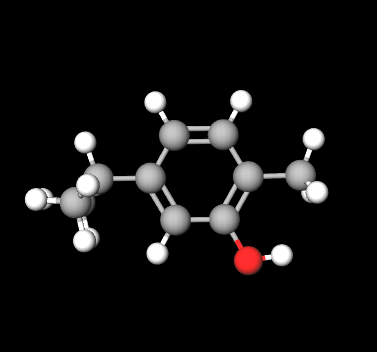
Il Carvacrolo è un composto fenolico naturale monoterpenico presente principalmente nell'olio essenziale di origano e in altre piante aromatiche. È riconosciuto per le sue potenti proprietà antimicrobiche, antiossidanti e antinfiammatorie, rendendolo prezioso in varie applicazioni cosmetiche, farmaceutiche e alimentari.
Composizione Chimica e Struttura
La composizione chimica del Carvacrolo include:
- Formula Chimica: C₁₀H₁₄O.
- Gruppi Funzionali: Contiene un gruppo idrossile (–OH) attaccato a un anello fenolico, che contribuisce alle sue proprietà bioattive.
Strutturalmente, il Carvacrolo è caratterizzato dal suo anello aromatico e da una catena laterale alifatica, che ne migliorano la stabilità e la reattività in varie formulazioni.
Proprietà Fisiche
- Aspetto: Liquido incolore o giallo pallido.
- Solubilità: Solubile in alcol e oli; solubilità limitata in acqua.
- pH: Neutro, ma può variare a seconda della formulazione.
- Odore: Aroma forte, aromatico e caldo, caratteristico dell'origano.
- Stabilità: Sensibile alla luce e all'aria; deve essere conservato in un luogo fresco e buio per mantenere la potenza.
Processo di Produzione
- Estrazione: Il Carvacrolo è tipicamente estratto dall'olio essenziale di origano (Origanum vulgare) attraverso distillazione a vapore.
- Purificazione: L'olio grezzo può subire un processo di purificazione per isolare il Carvacrolo dagli altri componenti.
- Formulazione: Il composto purificato può essere incorporato in vari prodotti, inclusi cosmetici, integratori alimentari e formulazioni alimentari.
Applicazioni
- Medico: Utilizzato nella medicina erboristica per le sue proprietà antimicrobiche e antinfiammatorie.
- Cosmetici: Comunemente incluso in prodotti per la pelle per i suoi effetti antiossidanti e la capacità di promuovere la salute della pelle.
Funzioni INCI:
Profumo. A differenza della fragranza che può contenere anche odori leggermente meno gradevoli o caratteristici, la dizione profumo indica soltanto le profumazioni molto gradevoli. Utilizzato per profumi e materie prime aromatiche.
- Alimentare: Utilizzato come conservante naturale e agente aromatizzante grazie alla sua potente attività antimicrobica.
- Usi Industriali: Applicazioni limitate, principalmente in formulazioni di prodotti naturali.
Considerazioni Ambientali e di Sicurezza
Il Carvacrolo è generalmente considerato sicuro per l'uso nei cosmetici e nei prodotti alimentari quando applicato secondo le linee guida raccomandate. Tuttavia, le persone con specifiche sensibilità dovrebbero esercitare cautela. È essenziale garantire pratiche di approvvigionamento e produzione responsabili per assicurare che il Carvacrolo sia privo di contaminanti nocivi e prodotto in modo sostenibile.
Molecular Formula C10H14O
Molecular Weight 150.22 g/mol
CAS 499-75-2
UNII 9B1J4V995Q
EC Number 207-889-6
Synonyms:
Isopropyl-o-cresol
Antioxine
5-Isopropyl-2-methylphenol
Bibliografia__________________________________________________________________________
Peter S, Sotondoshe N, Aderibigbe BA. Carvacrol and Thymol Hybrids: Potential Anticancer and Antibacterial Therapeutics. Molecules. 2024 May 12;29(10):2277. doi: 10.3390/molecules29102277. PMID: 38792138; PMCID: PMC11123974.
Abstract. Cancer is ranked among lethal diseases globally, and the increasing number of cancer cases and deaths results from limited access to effective therapeutics. The use of plant-based medicine has been gaining interest from several researchers. Carvacrol and its isomeric compound, thymol, are plant-based extracts that possess several biological activities, such as antimalarial, anticancer, antifungal, and antibacterial. However, their efficacy is compromised by their poor bioavailability. Thus, medicinal scientists have explored the synthesis of hybrid compounds containing their pharmacophores to enhance their therapeutic efficacy and improve their bioavailability. Hence, this review is a comprehensive report on hybrid compounds containing carvacrol and its isomer, thymol, with potent anticancer and antibacterial agents reported between 2020 and 2024. Furthermore, their structural activity relationship (SAR) and recommended future strategies to further enhance their therapeutic effects will be discussed.
Suntres ZE, Coccimiglio J, Alipour M. The bioactivity and toxicological actions of carvacrol. Crit Rev Food Sci Nutr. 2015;55(3):304-18. doi: 10.1080/10408398.2011.653458.
Abstract. Carvacrol is a monoterpenic phenol produced by an abundant number of aromatic plants, including thyme and oregano. Presently, carvacrol is used in low concentrations as a food flavoring ingredient and preservative, as well as a fragrance ingredient in cosmetic formulations. In recent years, considerable research has been undertaken in an effort to establish the biological actions of carvacrol for its potential use in clinical applications. Results from in vitro and in vivo studies show that carvacrol possess a variety of biological and pharmacological properties including antioxidant, antibacterial, antifungal, anticancer, anti-inflammatory, hepatoprotective, spasmolytic, and vasorelaxant. The focus of this review is to evaluate the existing knowledge regarding the biological, pharmacological, and toxicological effects of carvacrol.
Wijesundara NM, Lee SF, Davidson R, Cheng Z, Rupasinghe HPV. Carvacrol Suppresses Inflammatory Biomarkers Production by Lipoteichoic Acid- and Peptidoglycan-Stimulated Human Tonsil Epithelial Cells. Nutrients. 2022 Jan 24;14(3):503. doi: 10.3390/nu14030503.
Abstract. Pharyngitis is an inflammation of the pharynx caused by viral, bacterial, or non-infectious factors. In the present study, the anti-inflammatory efficacy of carvacrol was assessed using an in vitro model of streptococcal pharyngitis using human tonsil epithelial cells (HTonEpiCs) induced with Streptococcus pyogenes cell wall antigens. HTonEpiCs were stimulated by a mixture of lipoteichoic acid (LTA) and peptidoglycan (PGN) for 4 h followed by exposure to carvacrol for 20 h. Following exposure, interleukin (IL)-6, IL-8, human beta defensin-2 (HBD-2), epithelial-derived neutrophil-activating protein-78 (ENA-78), granulocyte chemotactic protein-2 (GCP-2), cyclooxygenase-2 (COX-2), tumor necrosis factor-alpha (TNF-α), and prostaglandin (PGE2) were measured by enzyme-linked immunosorbent assays (ELISA). The levels of pro-inflammatory cytokines, IL-6, IL-8, ENA-78, and GCP-2 were decreased in a carvacrol dose-dependent manner. The production of HBD-2 was significantly suppressed over 24 h carvacrol treatments. PGE2 and COX-2 levels in the cell suspensions were affected by carvacrol treatment. TNF-α was not detected. The cell viability of all the tested carvacrol concentrations was greater than 80%, with no morphological changes. The results suggest that carvacrol has anti-inflammatory properties, and carvacrol needs to be further assessed for potential clinical or healthcare applications to manage the pain associated with streptococcal pharyngitis.