Sandalwood (Santalum austrocaledonicum) – nutritional properties, benefits and uses
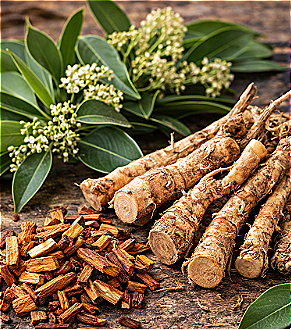
Santalum austrocaledonicum is a tree species belonging to the family Santalaceae, endemic to New Caledonia. It is primarily known for its aromatic wood, rich in high-quality essential oils, widely used in perfumery, aromatherapy, and cosmetic and therapeutic applications. Its slow growth and long lifespan make this species particularly valuable and sensitive from an environmental management standpoint.
Botanical classification
| Characteristic | Classification |
|---|
| Kingdom | Plantae |
| Order | Santalales |
| Family | Santalaceae |
| Genus | Santalum |
| Species | Santalum austrocaledonicum |
Plant characteristics
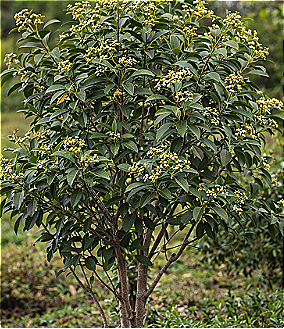
Flowers: small, green-yellow flowers clustered in inflorescences; not showy.
Foliage: alternate, simple, lanceolate leaves with a leathery texture and glossy surface, suited to local environmental conditions.
Growth habit: evergreen tree reaching about 10 m in height, with a dense crown and rough grey-brown bark; slow-growing with a long lifespan.
Soil and light: prefers well-drained soils, from sandy to more clay-rich substrates; adapted to tropical and subtropical climates and favors direct sunlight.
Chemical composition and structure
The chemical composition of Santalum austrocaledonicum is dominated by aromatic and lipid constituents:
Sandalwood essential oil: rich in sesquiterpene alcohols, particularly santalol, responsible for the characteristic aroma and functional properties.
Santalol and santalene: key aromatic constituents with a woody, balsamic profile, central to perfumery and aromatherapy.
Fatty acids and esters: present in smaller amounts, contributing to the sensory profile and oil stability.
| Component | Chemical class | Primary role |
|---|
| Santalol | Sesquiterpene alcohol | Aroma, functional activity |
| Santalene | Sesquiterpene | Woody note |
| Fatty acids / esters | Lipid | Aromatic support |
Uses and benefits
Medicinal
The essential oil is used in traditional medicine for its:
It is used in support of respiratory conditions, infections, and digestive discomfort.
Cosmetic
In cosmetics it is valued for:
Soothing effects
Moisturizing properties
Balancing activity
It is used in creams, lotions, facial treatments, and scented products.
Aromatic and industrial
Widely used in luxury perfumery and aromatherapy
Employed as a fixative in fragrance formulations
Used in diffusers, scented candles, and personal care products
Applications
| Field | Main use |
|---|
| Medicinal | Traditional remedies, topical and inhalation use |
| Cosmetic | Fragrance, soothing activity, skin care |
| Aromatic | Aromatherapy, perfumery |
| Industrial | Luxury perfumes, fragrance fixatives |
INCI functions
Fragrance
Improves, masks, or adds scent to the final product, increasing sensory appeal and marketability.
Perfume
Indicates particularly pleasant fragrances, typical of perfumes and high-value aromatic raw materials.
Flavoring agent (Aroma)
Modifies the aromatic profile of a formulation. It may be isolated or synthesized to replicate naturally occurring sensory characteristics.
Skin conditioning agent – emollient
Supports the skin barrier, reduces transepidermal water loss, and contributes to protection and hydration.
Skin conditioning agent
Helps maintain skin tolerance to external factors, including melanocyte tolerance, by preventing dehydration.
CAS: 91845-48-6
EC number: 295-223-5
Environmental and safety considerations
Environmental impact
Santalum austrocaledonicum is an endemic species with an important role in New Caledonia’s ecosystems. It is essential to adopt sustainable harvesting practices to protect local biodiversity and ensure the long-term availability of the species.
Safety
Generally considered safe at recommended use levels. However, the essential oil should be used with caution, especially around children and pregnant women. High concentrations may cause skin irritation or sensitization; follow safety guidelines and consult a professional when appropriate.
References__________________________________________________________________________
Bottin L, Isnard C, Lagrange A, Bouvet JM. Comparative molecular and phytochemical study of the tree species Santalum austrocaledonicum (Santalaceae) distributed in the New-Caledonian archipelago. Chem Biodivers. 2007 Jul;4(7):1541-56. doi: 10.1002/cbdv.200790134.
Abstract. We have tried to elucidate the origin of phytochemical variation in trees by studying concomitantly the chemical and microsatellite variations in Santalum austrocaledonicum. Eight natural populations were sampled in the New-Caledonian archipelago, a total of 157 individuals being analyzed. The main components, as revealed by gas chromatography (GC), were alpha- and beta-santalol (as in other sandalwood species), although the level of (Z)-lanceol was particularly high. Most of the chemical variation was observed within populations (83.7%). With microsatellites, the variation between populations was more pronounced (32% of the total variation). Although the chemical variation between populations was small, we investigated the effects of genetic drift and migration by comparing the chemical- and molecular-differentiation patterns. The poor congruence between neighbor-joining trees, confirmed by the non-significant Mantel test between the molecular and chemical distance matrices (R=0.26, P=0.12), showed that genetic drift and migration are not the main evolutionary forces acting on chemical differentiation between populations. We could not find any effect of soil and rainfall conditions neither. Although the impact of drift and migration cannot be discounted in rationalizing between-population differentiation, the low variation among populations could result from a stabilizing selection caused by the same phytopathogen charge across the natural range.
Roh, H. S., Kim, J., Shin, E. S., Lee, D. W., Choo, H. Y., & Park, C. G. (2015). Bioactivity of sandalwood oil (Santalum austrocaledonicum) and its main components against the cotton aphid, Aphis gossypii. Journal of Pest Science, 88(3), 621-627.
Abstract. Control efficacy of sandalwood oil (Santalum austrocaledonicum Vieill) and its main components, α- and β-santalol, which have not been tested before against Aphis gossypii Glover (Hemiptera:Aphididae), was investigated in the laboratory, greenhouse and field bioassays. The main constituents of the commercial sandalwood oil were found to be α-santalol (47.5 %), β-santalol (18.7 %), bergamotol (7.2 %) and lanceol (9.1 %) according to GC and GC-MS analyses. The sandalwood oil was fractionated into an α-santalol-rich fraction (RF), β-santalol RF, and a mixture of α- and β-santalols by silica gel column chromatography. The purity of α-santalol RF was 75.4 % (ratio of α-:β-santalol was 94:6) and that of β-santalol RF was 34.6 % (ratio of α-:β-santalol was 16:84). Laboratory bioassay showed that sandalwood oil, α- and β-santalol RFs had the same and significantly higher repellency and control efficacy against A. gossypii than the two control treatments and that a mixture of α- and β-santalols was toxic to the aphid. Santalol was comparable to imidacloprid (a neonicotinoid insecticide) in its efficacy against A. gossypii infesting Rose of Sharon, Hibiscus syriacus L., with 98.8 % mortality. The control efficacies of sandalwood oil (94.0 %), α-santalol RF (84.2 %), β-santalol RF (90.6 %) and a mixture of α- and β-santalols (88.7 %) against the A. gossypii infesting hot peppers were also comparable to each other in the greenhouse bioassay. Considering its control efficacy against A. gossypii, the application of sandalwood oil and its components may open the possibility of environmentally friendly management of A. gossypii.
Dowell, A. (2019). Essential oil of Santalum austrocaledonicum: developing an international standard. In Sandalwood Regional Forum (pp. 11-13).
Abstract. Sandalwood oil is among the world’s most popular essential oil products, being used in perfumery, aromatherapy and traditional/religious practice. Although International Organization for Standardization (ISO) standards have existed for Santalum album and Santalum spicatum (Western Australian sandalwood) for some time, there has to date been no formal standardisation of Santalum austrocaledonicum essential oil. Producers as well as authors regrading S. austrocaledonicum refer to the oil as meeting the ISO standard when in fact they are referring to the ISO standard for Indian sandalwood (S. album) oil, a different product.Two distinct chemotypes are reported for S. austrocaledonicum, with possible sub-chemotypes. The main chemotypes are santalol (Vanuatu and New Caledonia) and nuciferol/lanceol (primarily Vanuatu). Variation in oil quality is influenced by genetic factors, the maturity of timber at the time of harvest, the part of the tree used and/or the influence of host species and other environmental factors on oil formation. Tentative components and composition parameters for oil of S. austrocaledonicum based on values provided from commercial production in New Caledonia include the following: α-bergamotol (3.0 to 8.0%), Z-α-santalol (38.0 to 45.0%), Z-β-santalol (12.0 to 17.0%), Z-nuciferol (1.4 to 21.4%), Z-γcurcumen-12-ol (2.1 to 19.8%), Z-lanceol (4.0 to 13.0%), and epi-β-santalol (2.6 to 4.0%). Additional consultation with stakeholders in both New Caledonia and Vanuatu is required to further inform the development of the proposed standard.