



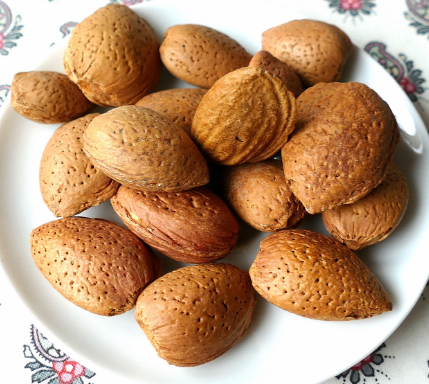
The sweet almond (Prunus amygdalus dulcis), commonly known as , is a variety of almond tree cultivated for its edible seeds or nuts. Native to the Middle East and South Asia, the tree is now widely grown in temperate regions around the world. It produces small, pink or white flowers in the spring, which develop into fruit containing a hard shell with the almond seed inside. Sweet almonds are prized for their flavor, nutritional benefits, and versatile applications in food, cosmetics, and medicine.
Botanical Classification
- Kingdom: Plantae
- Order: Rosales
- Family: Rosaceae
- Genus: Prunus
- Species: P. amygdalus
- Variety: P. amygdalus dulcis
Plant Characteristics
Prunus amygdalus dulcis is a deciduous tree that can grow up to 10 meters (32 feet) in height. It has oval, serrated leaves and produces clusters of small, fragrant flowers in shades of pink or white. The fruit is a drupe with a hard, woody shell that encases the edible seed, known as the almond. The tree requires a temperate climate with cold winters and warm, dry summers to produce high-quality nuts.
Chemical Composition and Structure
Sweet almonds contain several beneficial compounds:
- Fatty Acids: Rich in monounsaturated fats, particularly oleic acid, which supports cardiovascular health.
- Vitamins: Includes vitamin E, a powerful antioxidant, and B vitamins such as riboflavin and niacin.
- Minerals: Contains calcium, magnesium, and potassium, essential for bone health and muscle function.
- Proteins and Fiber: Provides a good source of protein and dietary fiber.
Cultivation
Prunus amygdalus dulcis thrives in well-drained, sandy loam soils and requires full sun exposure. It is propagated from seeds or cuttings and benefits from regular watering, especially during dry periods. The tree is typically pruned to maintain shape and enhance fruit production. It is sensitive to frost, so proper protection is necessary in colder climates.
Uses and Benefits
Culinary: Almonds are used in a wide range of culinary applications, including baking, cooking, and as a snack. Almond oil is used in cooking and as a flavoring in various products.
Medicinal: Almonds are valued for their nutritional content and are used in traditional medicine for their benefits to heart health, skin health, and digestive system. Almond oil is used for its soothing and moisturizing properties.
Cosmetic: Almond oil is a common ingredient in skincare products due to its moisturizing and emollient properties. It is used in creams, lotions, and hair care products.
INCI Functions:
Skin conditioning agent. It is the mainstay of topical skin treatment as it has the function of restoring, increasing or improving skin tolerance to external factors, including melanocyte tolerance. The most important function of the conditioning agent is to prevent skin dehydration, but the subject is rather complex and involves emollients and humectants that can be added in the formulation.
Hair conditioning agent. A significant number of ingredients with specific and targeted purposes may co-exist in hair shampoo formulations: cleansers, conditioners, thickeners, matting agents, sequestering agents, fragrances, preservatives, special additives. However, the indispensable ingredients are the cleansers and conditioners as they are necessary and sufficient for hair cleansing and manageability. The others act as commercial and non-essential auxiliaries such as: appearance, fragrance, colouring, etc. Hair conditioning agents have the task of increasing shine, manageability and volume, and reducing static electricity, especially after treatments such as colouring, ironing, waving, drying and brushing. They are, in practice, dispersants that may contain cationic surfactants, thickeners, emollients, polymers. The typology of hair conditioning agents includes: intensive conditioners, instant conditioners, thickening conditioners, drying conditioners. They can perform their task generally accompanied by other different ingredients.
Skin protectant. It creates a protective barrier on the skin to defend it from harmful substances, irritants, allergens, pathogens that can cause various inflammatory conditions. These products can also improve the natural skin barrier and in most cases more than one is needed to achieve an effective result.
Humectant. Hygroscopic compound used to minimise water loss in the skin and to prevent it from drying out by facilitating faster and greater absorption of water into the stratum corneum of the epidermis. The epidermis is the most superficial of the three layers that make up human skin (epidermis, dermis and hypodermis) and is the layer that maintains hydration in all three layers. In turn, the epidermis is composed of five layers: horny, the most superficial, granular, spinous, shiny, and basal. Humectants have the ability to retain the water they attract from the air in the stratum corneum and have the function of moisturising the skin. They are best used before emollients, which are oil-based.
Applications
Culinary: Incorporated into recipes for baked goods, confectioneries, and savory dishes. Used as a snack and in almond-based beverages like almond milk.
Medicinal: Included in dietary supplements and remedies for cardiovascular health, skin care, and digestive health.
Environmental and Safety Considerations
Prunus amygdalus dulcis is generally safe for consumption and use in cosmetics. However, care should be taken to avoid the consumption of bitter almonds, which contain cyanogenic compounds. Sustainable cultivation practices should be employed to minimize environmental impact and ensure the health of almond trees.
Studies
The sweet almond is rich in monounsaturated fats, fiber, magnesium.
Its components can regulate the homeostasis of glucose. It is hypocholesterolemic (1), has an antioxidant action (2) and is an adjuvant for cardiovascular risks (3).
This study found a statistically significant association between high frequency of peanuts, pine nuts, and almonds consumption and reduced risk of colorectal cancer (4).
From the sweet almond you get :
- almond milk. Energy drink
- almond oil. Soothing and anti-itching
For a rather common industrial by-product of almonds, almond milk, especially sweetened versions, care must be taken because they have a cariogenic potential (5).
While the sweet almond has many beneficial properties for human health, the bitter almond is toxic: even at relatively small doses as 5 or 6 are sufficient to cause poisoning. It can be fatal at higher doses. The bitter taste, connected to a component, the amygdalin, fortunately, discourages from ingestion.
The bitter almond is obtained after purification of the hydrocyanic acid it contains:
- almond oil. Used in cosmetics for skin care
- almond butter. Used in skin care cosmetics
- almond extract Used for shampooing and cosmetics.
This study reviews and comments on almond clinical trials with particular reference to biomarkers of health and the gut micrtobiota (6).

