



Musa acuminata (Musaceae)
Musa acuminata is a species of wild edible banana, native to South and Southeast Asia, and recognized as one of the principal genetic progenitors of modern dessert bananas. Taxonomically, it belongs to the family Musaceae and is classified as an evergreen perennial herb, rather than a true tree, even though its general appearance resembles that of a small palm or tree. The so-called “trunk” is in fact a pseudostem, formed by tightly packed leaf sheaths arising from a corm that is partially or completely underground. The leaves, often very large in wild forms, can reach several metres in length and are arranged in a spiral at the top of the pseudostem, giving the plant the typical fan-like architecture of bananas.
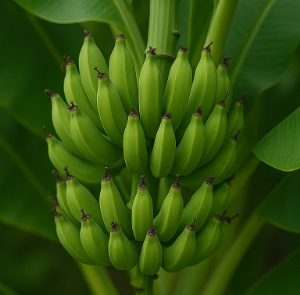 | 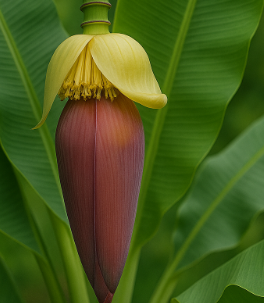 |
The inflorescence emerges from the upper portion of the pseudostem and develops in a horizontal or slightly pendulous position. It consists of a floral axis covered by leathery bracts, under which groups of flowers are borne. Within the same inflorescence, female flowers occupy the basal region, while male flowers are produced towards the tip, with whitish to yellowish perianths typical of the genus. The female flowers develop into elongated berries, commonly called bananas. In wild Musa acuminata, these fruits contain numerous hard seeds, while in the parthenocarpic cultivars derived from this species the fruits are seedless and fully edible at maturity. Reproduction occurs by seeds in wild populations, but in modern cultivation the plant is propagated almost exclusively through suckers or in vitro micropropagation, resulting in genetically uniform clonal lines.
From an ecological perspective, Musa acuminata behaves as a pioneer species, capable of colonising disturbed sites, forest edges and clearings in warm, humid environments with well-drained soils. In many tropical ecosystems it plays the role of a key resource species, providing a quickly renewable supply of food for a wide range of frugivorous animals, including bats, birds, rodents and primates, and contributing to seed dispersal processes of other plant species. Its ability to regenerate after cutting or damage to the pseudostem, thanks to multiple dormant buds in the corm, allows it to maintain stable stands even in habitats subject to periodic disturbance.
The domestication of Musa acuminata represents a crucial chapter in agricultural history. This species is considered one of the earliest domesticated plants, with archaeobotanical evidence indicating cultivation several millennia BCE in regions such as New Guinea. Over time, human selection favoured individuals with parthenocarpy (fruit formation without fertilisation) and seed sterility, giving rise to lineages in which the fruits are rich in pulp and lack fully developed seeds. Subsequent hybridisation and combination of genomes from Musa acuminata and Musa balbisiana produced a broad array of diploid and triploid hybrids, many of which form the genetic basis of today’s main dessert bananas and numerous cooking bananas and plantains.
In terms of nutrition and health, bananas derived from Musa acuminata are an important source of readily available carbohydrates, with a significant proportion of starch and simple sugars that shifts progressively from starch-rich to sugar-rich as the fruit ripens. The pulp provides dietary fibre, potassium, manganese, vitamin B6 and vitamin C, along with various phenolic compounds and carotenoids that contribute to the overall antioxidant profile. Because of these characteristics, bananas are often considered useful in eating patterns that require a moderately rapid energy supply and good digestive tolerability, such as in children, athletes or people with mild gastrointestinal complaints, always within the framework of balanced diets and appropriate professional guidance.
Numerous studies have shown that different parts of the plant (fruit, peel, leaves, pseudostem, flowers) contain bioactive metabolites with potential antioxidant, antidiabetic, hypolipidaemic, antimicrobial and anti-inflammatory properties. Research interest is particularly focused on the possible use of banana-derived extracts to support glucose and lipid metabolism and to mitigate oxidative stress. However, much of this evidence comes from in vitro experiments or animal models, and direct translation into clinical practice requires further confirmation, especially regarding dosage, long-term safety and interactions with pharmacological therapies. It is therefore essential to distinguish between the consumption of bananas as a food, generally regarded as safe as part of a varied diet, and the use of concentrated extracts or preparations for therapeutic purposes, which must be evaluated within an appropriate regulatory and clinical framework.
From an agronomic standpoint, Musa acuminata and its hybrids currently form one of the world’s most important tropical crops, both economically and socially. Cultivars with a predominantly acuminata genome underpin most dessert banana production, whereas hybrids with Musa balbisiana contribute largely to plantain and cooking banana types. Intensive cultivation, however, raises serious challenges related to phytosanitary vulnerability, the low genetic diversity of key commercial lines and the environmental impacts associated with pest management, fertiliser use and large-scale monoculture systems. In this context, the conservation of the genetic diversity of wild Musa acuminata populations is of strategic importance for future breeding programmes, especially for improving resistance to pathogens and adapting to climate change.
Botanical classification (APG IV system)
| Category | Data |
|---|---|
| Common name | banana (wild species and ancestor of dessert bananas) |
| Botanical name | Musa acuminata Colla |
| Kingdom | Plantae |
| Clade | Angiosperms → monocots → commelinids |
| Order | Zingiberales |
| Family | Musaceae |
| Genus | Musa |
| Species | Musa acuminata Colla |
Indicative nutritional values per 100 g (fresh banana from Musa acuminata cultivars)
Values refer to the edible portion of raw banana; they may vary with cultivar, ripeness and growing conditions.
| Component | Approximate value per 100 g |
|---|---|
| Energy | ~ 89 kcal |
| Water | ~ 74–76 g |
| Total carbohydrates | ~ 22.8 g |
| — of which sugars | ~ 12 g (mainly glucose, fructose, sucrose) |
| Dietary fiber | ~ 2.5–3 g |
| Proteins | ~ 1.0–1.1 g |
| Total lipids | ~ 0.3–0.35 g |
| — of which saturated fatty acids (SFA) | ~ 0.10–0.11 g |
| — monounsaturated fatty acids (MUFA) | ~ 0.03 g |
| — polyunsaturated fatty acids (PUFA) | ~ 0.07 g |
| Sodium | very low (~ 1 mg) |
| Main minerals | potassium (~ 350–360 mg), magnesium (~ 25–30 mg), phosphorus (~ 20–25 mg), calcium (~ 5 mg) |
| Relevant vitamins | vitamin B6 (~ 0.4 mg), vitamin C (~ 8–9 mg), small amounts of folate and other B-group vitamins |
In a typical serving (one medium banana of about 100–120 g), the caloric intake is moderate and comes almost entirely from carbohydrates. The main nutritional contributions are potassium, vitamin B6, some dietary fiber, and a small amount of vitamin C.
Lipid profile note
Fresh bananas from Musa acuminata cultivars have a very low fat content. Saturated fatty acids (SFA) are present only in small quantities; when SFA predominate over unsaturated fats in the overall diet, they are generally considered less favourable for cardiovascular health. Monounsaturated (MUFA) and polyunsaturated fatty acids (PUFA) are present in small amounts in banana, but in general are regarded as more favourable when they replace part of SFA in the diet.
In practice, for bananas the absolute lipid impact is negligible, and their nutritional role is mainly related to carbohydrates, potassium, vitamin B6 and fiber.
Plant Characteristics:
Growth Form: Musa acuminata is a perennial herbaceous plant that can reach heights of 2-8 meters. It has a pseudostem made up of tightly stacked leaf bases.
Leaves: The plant has large, elongated leaves that can be up to 2.5 meters long and 60 cm wide. The leaves are smooth with a prominent central rib.
Flowers: Musa acuminata produces clusters of flowers that emerge from the center of the plant. The flowers are typically yellow, pink, or purple and are enclosed by large bracts.
Fruits: The fruit of Musa acuminata is elongated, with a smooth yellow peel when ripe. The pulp is soft and sweet. The plant produces several varieties of bananas, including both dessert and cooking bananas.
Chemical Composition and Structure:
Carbohydrates: The fruit is rich in carbohydrates, primarily starches and sugars such as glucose, fructose, and sucrose.
Vitamins: Provides significant amounts of vitamins, especially vitamin C, vitamin B6, and folates.
Minerals: Musa acuminata bananas are a good source of potassium, magnesium, and manganese.
Fiber: The fruit contains dietary fibers, including pectin and cellulose, beneficial for digestive health.
Cultivation:
Soil: Musa acuminata thrives in well-drained, loamy soils rich in organic matter. It prefers a soil pH between 5.5 and 7.0.
Climate: Requires a tropical or subtropical climate with warm temperatures (ideally between 26-30°C) and high humidity. The plant is sensitive to frost and needs protection from cold temperatures.
Irrigation: Regular and consistent watering is necessary to meet the plant's high water demands. The soil should be kept moist but not soggy.
Fertilization: Apply a balanced fertilizer or one high in potassium to support fruit growth and development. Bananas have high nutritional demands, particularly for potassium.
Pruning: Remove dead or damaged leaves and wilted flowers to prevent diseases and improve air circulation. Pruning helps maintain the health and productivity of the plant.
Uses and Benefits:
Culinary Uses: The bananas produced by Musa acuminata are eaten fresh, cooked, or processed into various products like banana bread, smoothies, and baby foods. They are a staple food in many global diets due to their flavor and versatility.
Medicinal Uses: Traditionally, bananas have been used to alleviate digestive problems and provide relief due to their high potassium content, which supports cardiovascular health and helps maintain blood pressure.
Cosmetic Uses: Plant extracts are used in skincare products for their moisturizing and nourishing properties. They are included in face masks, shampoos, and conditioners.
Applications:
Food Industry: Musa acuminata bananas are widely used in the food industry for their natural sweetness and texture. They are a key ingredient in many processed foods and beverages.
Pharmaceutical Industry: Plant extracts and compounds are studied for their potential health benefits, including effects on digestive and cardiovascular health.
Cosmetic Industry: Banana-derived ingredients are used in skincare products for their moisturizing and anti-aging effects, contributing to creams, serums, and lotions.
Environmental and Safety Considerations:
Environmental Impact: Cultivation of Musa acuminata can be sustainable when managed responsibly. However, large-scale production may contribute to deforestation, biodiversity loss, and soil degradation. Adopting sustainable agricultural practices is advisable to mitigate such impacts.
Safety: The fruit and plant parts are generally safe for consumption. However, individuals with latex allergies should be cautious, as bananas may trigger allergic reactions in sensitive individuals. It is advisable to follow proper handling and hygiene practices to prevent contamination.
Studies:
Bananas are typically harvested in the mature green stage and shipped to wholesale markets, where they are then treated with ethylene to stimulate ripening; this treatment results in a rapid color change from green to yellow and the development of a 'fruity' taste if stored at 16-24°C (1). In another banana family (Musa AAA group), chlorophyll degradation occurs at 35°C (2).
Bananas contain carotenoids (mainly beta-carotene, alpha-carotene, and lutein), phenolic compounds, and phytosterols (3) that possess antioxidant properties.
The leaves of Musa spp. were used as a remedy against tuberculosis in traditional Maya medicine, and their use, in the form of a methanolic extract, as an antibacterial agent has recently been confirmed (4). Despite their less appealing appearance, green bananas are thought to contain a higher level of compounds beneficial to the human body (5).
Since bananas have a good potassium content, it is believed that continuous consumption of bananas can alleviate muscle cramps associated with physical exercise. However, this study considers it unlikely (6).
Another popular belief attributes to banana consumption improvements in blood sugar and cholesterol levels. Although confirmation with a larger group of volunteers is needed, this pilot study demonstrated that daily consumption of bananas (@ 250 g/day) did not yield significantly appreciable results (7).

