



Jasminum officinale (Jasmine) flower/leaf extract: properties, uses, pros, cons, safety
Jasminum officinale flower/leaf extract is an extract obtained from the flowers and leaves of Jasminum officinale (family Oleaceae). In cosmetics it is mainly used as a perfuming and sensorial ingredient, often also associated with skin conditioning and soothing functions in leave-on and rinse-off formulas. Actual technical performance depends on the extract type (solvent, drug-to-extract ratio, standardization), because the compositional profile can vary significantly between suppliers and batches.
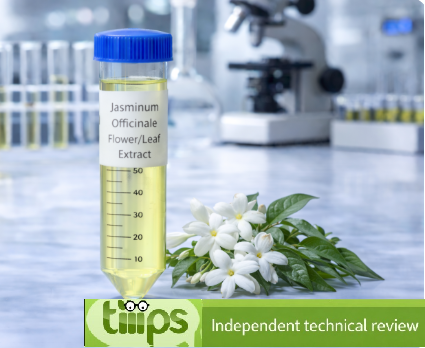
For more information: Jasmine
Definition
It is not a single molecule: it is a mixture of constituents extracted from the plant matrix. Practically, the INCI name does not imply one single method: “extract” may indicate hydroglyceric, hydroalcoholic, or other cosmetically suitable solvent systems, with profiles more oriented toward the polyphenolic fraction (less odorous) or toward the aromatic fraction (more odorous), depending on the process.
Main uses
Food.
It is not a typical food ingredient. The food sector more often uses specific aromatic ingredients (e.g., absolutes/essential oils or standardized natural flavors) with classifications and specifications different from INCI.
Cosmetics.
Frequently used as a perfuming ingredient and as a sensorial support in creams, lotions, cleansers, body/hair products, and sometimes in fragranced products or “botanical profile” concepts. It can contribute to a comfort perception in “soothing/comfort” formulas, but performance depends on concentration and extract type.
INCI functions.
Fragrance. It plays a very important role in the formulation of cosmetic products as it provides the possibility of enhancing, masking or adding fragrance to the final product, increasing its marketability. It is able to create a perceptible pleasant odour, masking a bad smell. The consumer always expects to find a pleasant or distinctive scent in a cosmetic product.
Moisturizing. This ingredient is responsible for preventing the evaporation of moisture from the skin and improving cellular activity. When exposed to cold or hot air currents, the skin absorbs water from its inner layer to compensate for the evaporated water. If the draught phenomenon persists, the stratum corneum is dry and, if at all, damaged.
Skin conditioning agent. It is the mainstay of topical skin treatment as it has the function of restoring, increasing or improving skin tolerance to external factors, including melanocyte tolerance. The most important function of the conditioning agent is to prevent skin dehydration, but the subject is rather complex and involves emollients and humectants that can be added in the formulation.
Soothing. Ingredient with the task of restoring moisture to the skin, helping in the healing process of irritation, inflammation and skin disorders.
Perfuming. Unlike fragrance, which can also contain slightly less pleasant or characteristic odours, the term perfume indicates only very pleasant fragrances. Used for perfumes and aromatic raw materials.
CAS: 90045-94-6 EC number 289-960-1
Key constituents
Depending on the process, the profile may include (with variable percentages):
Polyphenols (flavonoids and phenolic acids), associated with antioxidant capacity in extracts rich in phenolic fraction.
Glycosides and other polar molecules (solvent-dependent).
Aromatic fraction (volatile components in variable amounts): generally more evident in “oil/absolute” ingredients than in hydroalcoholic/hydroglyceric “extracts”, but possible in some extracts.
Practical note: an “intensely perfumed” profile is not guaranteed by the INCI name “extract” alone; it depends on grade and extraction type.
Identification data and specifications
| Characteristic | Value |
|---|---|
| INCI name | Jasminum officinale flower/leaf extract |
| Botanical source | Jasminum officinale (family Oleaceae) |
| Type | botanical extract (mixture) |
| CAS number | 90045-94-6 |
| EC number (EINECS) | 289-960-1 |
| Molecular formula | not applicable (mixture) |
| Molecular weight | not applicable (mixture) |
| Cosmetic functions | perfuming; masking; moisturising; skin conditioning; soothing |
| Variability note | composition depends on solvent, drug/extract ratio, and standardization |
Physico-chemical properties (indicative)
| Characteristic | Indicative value | Note |
|---|---|---|
| Physical state | liquid or semi-liquid | depends on solvent and concentration |
| Color | pale yellow to amber/brown | variable by extract and oxidation |
| Odor | floral/vegetal, variable intensity | often less “powerful” than oil/absolute |
| Water solubility | variable | higher for hydroglyceric/hydroalcoholic extracts |
| Solubility in organic solvents | generally good | depends on product base |
| Viscosity | low to moderate | depends on glycols/glycerin and solids |
| Stability | dependent on light/air/temperature | possible odor drift and color changes |
Functional role and mechanism of action (practical)
In formula, the primary effect is sensorial/olfactive (perfuming and masking of base notes). If the extract is rich in polyphenolic fraction, it may support an antioxidant narrative and system contribution, but practical impact must be evaluated on the finished product (stability, color, odor, compatibility).
Formulation compatibility
Generally compatible with emulsions and cleansers, but real drivers are: extract solvent (water/glycerin/alcohol), interaction with fragrances, impact on base color and odor, and long-term stability. In detergency, haze or incompatibility with certain solubilizers/electrolytes can occur depending on the grade.
Production process
The process varies by supplier, but typically includes operational steps that can be traced back to this scheme:
Harvesting and selection of the botanical material.
Flowers and leaves are harvested and selected based on integrity, foreign matter, and quality conformity.
Preparation.
Cleaning and, where used, size reduction to increase extraction efficiency and improve repeatability.
Extraction.
Maceration/percolation or assisted extraction with cosmetically suitable solvents (e.g., water, hydroalcoholic blends, glycerin/glycols). Solvent choice determines the profile: more polar (more phenolics), more hydroalcoholic (intermediate profile).
Separation and clarification.
Filtration and clarification to remove insolubles and reduce haze; optional deodorization or color treatment depends on grade.
Concentration and standardization (when applicable).
Concentration under controlled conditions and standardization via blending or titration to achieve a repeatable profile.
Packaging and storage.
Filling under conditions minimizing oxidation and contamination; barrier packaging to protect from light and air.
Safety, regulation, and environment
In cosmetics, use is generally linked to perfuming/conditioning functions and grade quality. As with many botanicals and perfuming ingredients, the critical point is natural variability and the possible presence of odorous components with sensitization potential, especially if the material or the associated fragrance oxidizes over time.
Allergen.
It is not a single “allergen” by itself. However, depending on batch and the presence of odorous fractions (or added fragrances in the formula), fragrance allergens may be relevant and should be managed through finished-product assessment and, where applicable, labeling.
Contraindications (brief).
Use caution on highly reactive skin or in leave-on products with high perfuming load. Prefer grades with clear specifications and contaminant controls; avoid altered batches (off-odor/out-of-spec color).
Environment.
Impact depends mainly on agricultural/harvesting practices and solvent choice. Lower-impact solvent processes and traceable supply chains reduce environmental risk; waste and solvent management are key process drivers.
Formulation troubleshooting
Odor changes over time or a “flattened” note.
Action: check oxidation, barrier packaging, compatibility with the fragrance system, and storage conditions.
Color changes in the formula.
Action: evaluate a lighter/standardized grade, reduce light exposure, add compatible antioxidants, and optimize ph.
Haze or precipitates.
Action: verify extract solvent, compatibility with electrolytes and solubilizers, revise addition order and process temperature.
Conclusion
Jasminum officinale flower/leaf extract is a botanical extract used mainly as a perfuming and sensorial ingredient, with INCI functions associated with masking, moisturising, skin conditioning, and soothing. Real performance is driven by extract type and its standardization. The key technical management points are compatibility, stability (odor/color), and sensitization-risk evaluation in the finished product.

