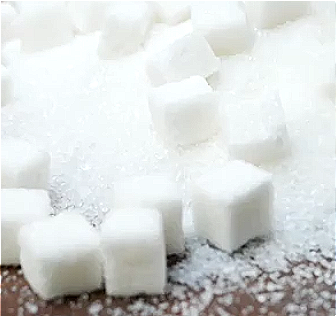
Lo zucchero o saccarosio è l'ingrediente che acquistiamo per addolcire i cibi e quello più comunemente usato nei dolci.
Chimica
In chimica è un disaccaride costituito da una molecola di fruttosio e da una di glucosio. Ogni molecola di zucchero contiene 12 atomi di carbonio, 22 atomi di idrogeno e 11 atomi di ossigeno. Si forma quando gli zuccheri monosaccaridi glucosio e fruttosio reagiscono in una reazione di condensazione. Questa l'equazione della reazione :
C6H12O6 + C6H12O6 = C12H22O11 + H2O
Formula molecolare C12H22O11
Peso molecolare 342.3
CAS 57-50-1
Storia
Scoperto da Cristoforo Colombo nel suo primo viaggio del 1492 in quel territorio che ora è la Repubblica Dominicana dove abbondavano le canne da zucchero. La coltivazione venne esportata in Brasile e nelle colonie inglesi, francesi ed olandesi. Il raccolto rendeva bene, ma occorreva personale per il taglio delle canne e la lavorazione ed era un lavoro molto faticoso. Nel 1505 vennero fatti arrivare i primi schiavi provenienti dall'Africa occidentale allora dominata dai portoghesi che avevano già avviato un florido commercio di pepe, altre spezie e di avorio.
Si stima che, tra il 1500 e il 1900, lo zucchero sia stata la merce più redditizia e diffusa per l'economia europea.
Salute
Un normale apporto di zucchero nel corpo è importante per la salute umana, in particolare per il cervello (1).
Un consumo eccessivo di zucchero o comunque di zuccheri raffinati è associato primariamente al rischio di
- diabete mellito di tipo 2
- aumento di peso con conseguente rischio di obesità
- aumento del colesterolo LDL (colesterolo cattivo)
- carie,
- ipertensione
- steatosi epatica
Per contrastare questa tendenza occorre abbassare i livelli dello zucchero nel sangue.
I flavonoidi sono composti fenolici che si trovano in frutta e verdura ed hanno proprietà che prevengono il diabete e le sue complicazioni. Questo potrebbe migliorare i livelli di zucchero nel sangue (2).
E' opportuna una riduzione del consumo di bevande zuccherate a base di zucchero. Il consumo di questo tipo di bevande nella prima infanzia è associato a maggiori rischi di adiposità e rischio di sovrappeso/obesità (3).
Sullo zucchero sono stati selezionati gli studi più rilevanti con una sintesi dei contenuti:
Zucchero studi
Bibliografia_______________________________________________________________________
(1) Mergenthaler P, Lindauer U, Dienel GA, Meisel A. Sugar for the brain: the role of glucose in physiological and pathological brain function. Trends Neurosci. 2013 Oct;36(10):587-97. doi: 10.1016/j.tins.2013.07.001. Epub 2013 Aug 20. PMID: 23968694; PMCID: PMC3900881.
(2) Al-Ishaq RK, Abotaleb M, Kubatka P, Kajo K, Büsselberg D. Flavonoids and Their Anti-Diabetic Effects: Cellular Mechanisms and Effects to Improve Blood Sugar Levels. Biomolecules. 2019 Sep 1;9(9). pii: E430. doi: 10.3390/biom9090430.
Abstract. Diabetes mellitus (DM) is a prevailing global health metabolic disorder, with an alarming incidence rate and a huge burden on health care providers. DM is characterized by the elevation of blood glucose due either to a defect in insulin synthesis, secretion, binding to receptor, or an increase of insulin resistance. The internal and external factors such as obesity, urbanizations, and genetic mutations could increase the risk of developing DM. Flavonoids are phenolic compounds existing as secondary metabolites in fruits and vegetables as well as fungi. Their structure consists of 15 carbon skeletons and two aromatic rings (A and B) connected by three carbon chains. Flavonoids are furtherly classified into 6 subclasses: flavonols, flavones, flavanones, isoflavones, flavanols, and anthocyanidins. Naturally occurring flavonoids possess anti-diabetic effects. As in vitro and animal model's studies demonstrate, they have the ability to prevent diabetes and its complications. The aim of this review is to summarize the current knowledge addressing the antidiabetic effects of dietary flavonoids and their underlying molecular mechanisms on selected pathways: Glucose transporter, hepatic enzymes, tyrosine kinase inhibitor, AMPK, PPAR, and NF-κB. Flavonoids improve the pathogenesis of diabetes and its complications through the regulation of glucose metabolism, hepatic enzymes activities, and a lipid profile. Most studies illustrate a positive role of specific dietary flavonoids on diabetes, but the mechanisms of action and the side effects need more clarification. Overall, more research is needed to provide a better understanding of the mechanisms of diabetes treatment using flavonoids.
(3) Quah PL, Kleijweg J, Chang YY, Toh JY, Lim HX, Sugianto R, Aris IM, Yuan WL, Tint MT, Bernard JY, Natarajan P, Müller-Riemenschneider F, Godfrey KM, Gluckman PD, Chong YS, Shek LP, Tan KH, Eriksson JG, Yap F, Lee YS, Chong MFF. Br Association of sugar-sweetened beverage intake at 18 months and 5 years of age with adiposity outcomes at 6 years of age: the Singapore GUSTO mother–offspring cohort Nutr. 2019 Sep 3:1-25. doi: 10.1017/S0007114519002253
Abstract. Consumption of sugar-sweetened beverages (SSB) by infants and young children are less explored in Asian populations. The Growing Up in Singapore Towards healthy Outcomes cohort study examined associations between SSB intake at 18 months and 5 years of age, with adiposity measures at 6 years of age. We studied Singaporean infants/children with SSB intake assessed by FFQ at 18 months of age (n 555) and 5 years of age (n 767). The median for SSB intakes is 28 (interquartile range 5·5–98) ml at 18 months of age and 111 (interquartile range 57–198) ml at 5 years of age. Association between SSB intake (100 ml/d increments and tertile categories) and adiposity measures (BMI standard deviation scores (sd units), sum of skinfolds (SSF)) and overweight/obesity status were examined using multivariable linear and Poisson regression models, respectively. After adjusting for confounders and additionally for energy intake, SSB intake at age 18 months were not significantly associated with later adiposity measures and overweight/obesity outcomes. In contrast, at age 5 years, SSB intake when modelled as 100 ml/d increments were associated with higher BMI by 0·09 (95 % CI 0·02, 0·16) sd units, higher SSF thickness by 0·68 (95 % CI 0·06, 1·44) mm and increased risk of overweight/obesity by 1·2 (95 % CI 1·07, 1·23) times at age 6 years. Trends were consistent with SSB intake modelled as categorical tertiles. In summary, SSB intake in young childhood is associated with higher risks of adiposity and overweight/obesity. Public health policies working to reduce SSB consumption need to focus on prevention programmes targeted at young children.




