Zinc stearate: properties, uses, pros, cons, safety
Zinc stearate is the zinc salt of stearic acid, commonly used in various cosmetic and industrial applications. It is valued for its multifunctional properties, including its roles as an anticaking agent, colorant, viscosity controller, and slip modifier.
Chemical Composition and Structure
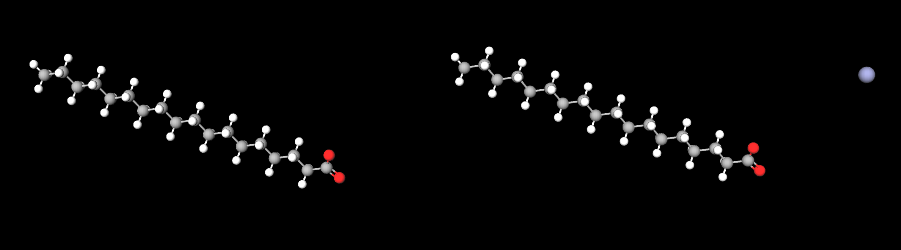
Zinc stearate is an organic compound with the chemical formula Zn(C18H35O2)2. It consists of zinc ions combined with stearic acid, a long-chain fatty acid. This combination gives the compound its unique properties and wide range of applications.
Physical Properties
Zinc stearate typically appears as a white, fine powder. It is insoluble in water but soluble in oils and organic solvents. The compound is known for its stability, resistance to heat, and ability to act as a lubricant, making it highly useful in various formulations.
Chemical Industrial Synthesis Process
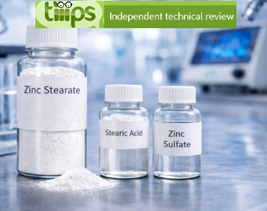
- Preparation of reagents. The main raw materials include stearic acid and a zinc compound such as zinc sulfate (ZnSO₄) or zinc chloride (ZnCl₂).
- Saponification. The stearic acid is heated and treated with a sodium hydroxide (NaOH) solution to form sodium stearate (sodium stearate soap).
- Precipitation of zinc stearate. The zinc sulfate or zinc chloride is slowly added to the sodium stearate solution with constant stirring. This reaction forms a precipitate of zinc stearate.
- Filtration. The resulting suspension is filtered to separate the solid zinc stearate precipitate from the aqueous solution.
- Washing. The zinc stearate precipitate is washed with deionized water to remove any soluble impurities and residual reagents.
- Drying. The washed zinc stearate is dried at controlled temperatures to remove residual moisture and obtain a dry powder.
- Grinding. The dried zinc stearate is ground to obtain a fine and uniform powder. This step may involve the use of ball mills or other grinding machinery.
- Classification. The dried powder is classified to ensure a uniform particle size. This step may involve sieving or the use of air classifiers.
- Stabilization. The zinc stearate powder is stabilized to ensure its stability during transportation and storage, preventing aggregation and degradation.
- Quality control. The zinc stearate undergoes rigorous quality testing to ensure it meets standards for purity, safety, and functionality. These tests include chemical analysis, spectroscopy, and physical tests to determine particle size and rheological properties.
What it is used for and where
Cosmetics
Restricted cosmetic ingredient as IV/150 a Relevant Item in the Annexes of the European Cosmetics Regulation 1223/2009. Substance or ingredient reported:
- Aluminium, zinc, magnesium and calcium stearates
Cosmetics - INCI Functions
- Anticaking Agent: Zinc stearate is used as an anticaking agent in powders and other dry products to prevent clumping and improve flowability. It helps maintain the free-flowing nature of products, enhancing their usability and shelf life.
- Colorant: While zinc stearate itself is not a colorant, it is often used in conjunction with pigments to enhance their dispersion and stability in cosmetic formulations. It helps achieve uniform color distribution in products like foundations and eyeshadows.
- Viscosity Controller: Zinc stearate is used to control the viscosity of various cosmetic and industrial formulations. It helps thicken products, providing the desired consistency and texture in items such as creams, ointments, and paints.
- Slip Modifier: Zinc stearate acts as a slip modifier in cosmetic products, reducing friction and improving the feel of the product on the skin. It is commonly used in products like powders, creams, and lotions to enhance their application and performance.
Other Applications
Pharmaceutical Industry. Used as an excipient in tablets and powders for its lubricating properties, facilitating compression and manufacturing.
Plastic Production. Acts as a stabilizer and lubricant in the plastic manufacturing process, enhancing the material's processing properties.
Rubber Industry. Employed to improve the processing characteristics and performance of rubber products.
Molecular Formula Zn(C18H35O2)2
Molecular Weight 632.3 g/mol
CAS 557-05-1
UNII H92E6QA4FV
EC Number 209-151-9
Synonyms:
Zinc octadecanoate
Zinc distearate
Zn Stearate
Bibliografia__________________________________________________________________________
(1) Jenke D. Extraction of stearate salts from plastic materials used in pharmaceutical applications. PDA J Pharm Sci Technol. 2010 May-Jun;64(3):200-10. PMID: 21502020.
Abstract. Plastic materials are widely used in medical items such as solution containers, infusion sets, transfer tubing, devices, processing equipment and systems, filters, and the like. Components in medical items can leach out of such items when they are contacted by a therapeutic product or product-related solution. Stearic acid and stearate salts are commonly present in medical and food packaging, either as plastic additives, processing aids, or contaminants, and their leaching from plastics is well documented. With a pK(a) in the range of 5.1 to 5.6 and limited aqueous solubility (log P(o/w) greater than 8), the leaching of stearic acid (and its related metal salts) into pharmaceutical products is expected to be strongly dependent on the product's pH and polarity. In order to establish and understand the leaching behavior of stearate-containing materials, three compounds (stearic acid, calcium stearate, and zinc stearate) and four polymeric materials containing these compounds were contacted with aqueous buffers in the pH range of 2.5 to 11. The leached levels of calcium, zinc, stearate, palmitate, and total organic carbon (TOC) were measured in the resulting solutions and are reported. For materials containing only stearic acid or salts themselves, the extraction of these entities is pH-dependent. At low pH, the cation counter-ions of the stearate salts are extracted from the plastic materials by a process that can loosely be termed ion exchange. At intermediate pH, little or no extraction of the stearates occurs. At high pH, the stearates are extracted from the materials to a very limited extent due to the solubility of the acid and/or salts in the extraction medium.
(2) Han W, Zhang M, Li D, Dong T, Ai B, Dou J, Sun H. Design and Synthesis of a New Mannitol Stearate Ester-Based Aluminum Alkoxide as a Novel Tri-Functional Additive for Poly(Vinyl Chloride) and Its Synergistic Effect with Zinc Stearate. Polymers (Basel). 2019 Jun 11;11(6):1031. doi: 10.3390/polym11061031.
Abstract. Thermal stabilizers, lubricant, and plasticizers are three crucial additives for processing poly(vinyl chloride) (PVC). In this study, a new mannitol stearate ester-based aluminum alkoxide (MSE-Al) was designed and synthesized as a novel additive for PVC. The thermal stability and processing performance of PVC stabilized by MSE-Al were evaluated by the Congo red test, conductivity measurement, thermal aging test, ultravioletevisible (UV-Vis) spectroscopy test, and torque rheometer test. Results showed that the addition of MSE-Al could not only markedly improve the long-term thermal stability of PVC, but also greatly accelerate the plasticizing and decrease the balance torque, which demonstrated that MSE-Al possessed a lubricating property. Thus, MSE-Al was demonstrated to be able to provide tri-functional additive roles, e.g., thermal stabilizer, plasticizer, and lubricant. The test results for the thermal stability of PVC indicated that the initial whiteness of PVC stabilized by MSE-Al was not good enough, thus the synergistic effect of MSE-Al with zinc stearates (ZnSt2) on the thermal stability of PVC was also investigated. The results showed that there is an appreciable synergistic effect between MSE-Al and ZnSt2. The thermal stabilization mechanism and synergism effect of MSE-Al with ZnSt2 are then discussed.
(3) Segre N, Monteiro PJ, Sposito G. Surface characterization of recycled tire rubber to be used in cement paste matrix. J Colloid Interface Sci. 2002 Apr 15;248(2):521-3. doi: 10.1006/jcis.2002.8217.
Abstract. The surface modification of tire rubber after treatment with saturated NaOH aqueous solution was investigated by HATR infrared analysis, potentiometric titration, and contact angle measurements. Infrared analysis of the powdered treated rubber showed a decrease in absorption at 1540, 1450, and 1395 cm(-1). This decrease is attributed to the removal of zinc stearate, an additive present in tire formulations that often migrates and diffuses to the surface, resulting in poor adhesion between the rubber and other materials. The potentiometric titration of the suspension of powdered rubber in 0.1 M NaCl showed that more hydrochloric acid was consumed by the untreated rubber, most likely a result of the hyrdrolysis of the zinc stearate to the organic acid. Contact angles of flat tire pieces showed an homogeneity enhancement of the treated rubber surface. The decrease of the zinc stearate on the treated rubber surface explains the improvement in the adhesion of this material to the cement matrix, observed in a previous research. The promising results of this study are a starting point for future research on incorporating rubber particles into cementitious materials as a means of successfully utilizing the vast amounts of tire waste currently in landfills.