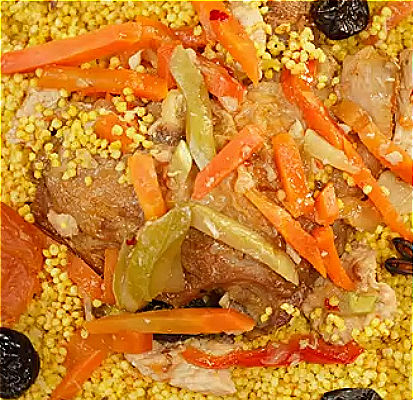
Il couscous è un alimento tradizionale nordafricano, composto da granelli di semola di grano duro che sono stati cotti al vapore e poi essiccati. Ha una consistenza leggera e soffice ed è apprezzato per la sua versatilità in molte cucine, poiché può essere servito come base per piatti principali, contorno o persino utilizzato nelle insalate. Grazie alla sua rapida preparazione, è un ingrediente pratico e nutriente.
Profilo Nutrizionale (per 100 grammi):
- Calorie Circa 376 kcal.
- Proteine Circa 12,8 grammi, offrendo una buona quantità di proteine vegetali.
- Grassi Circa 0,6 grammi, molto basso in grassi.
- Carboidrati Circa 77 grammi, prevalentemente sotto forma di amido.
- Fibre Circa 5 grammi, fornendo un apporto moderato di fibre.
- Vitamine e Minerali Contiene vitamine del gruppo B, tra cui tiamina, niacina e acido folico, oltre a minerali come ferro, magnesio, fosforo e zinco.
Il couscous è apprezzato per la sua capacità di assorbire i sapori dei piatti con cui viene servito. Può essere cucinato facilmente, semplicemente aggiungendo acqua bollente o brodo, e poi lasciando riposare per pochi minuti. È una scelta popolare per chi cerca un contorno rapido e sano.
Considerazioni
Uso in cucina Può essere servito come base per piatti di carne o pesce, usato come contorno o in insalate fredde. Il couscous integrale può essere una scelta più nutriente grazie al suo maggiore contenuto di fibre.
Benefici per la salute Fornisce una buona fonte di energia, supporta la salute digestiva e contribuisce a una dieta equilibrata. Ha un buon contenuto di polifenoli (1) e un maggior effetto glicemico rispetto alla pasta nonostante la composizione fitochimica simile (2).
Conservazione Conservare in un contenitore ermetico in un luogo fresco e asciutto per mantenerne la freschezza.
Bibliografia_____________________________________________________________________
(1) Carcea M, Narducci V, Turfani V, Giannini V. Polyphenols in Raw and Cooked Cereals/Pseudocereals/Legume Pasta and Couscous. Foods. 2017 Sep 11;6(9):80. doi: 10.3390/foods6090080.
Abstract. Pasta and couscous are popular foods manufactured (in their traditional form) from durum wheat semolina. In recent years, the consumers' quest for novel, functional, gluten-free, wholegrain foods has prompted the industry to manufacture new pasta and couscous products in which durum wheat has been partially or totally replaced by other vegetable flours. Besides dietary fibre, these raw materials might be an interesting source of phytochemicals. In this work, 16 commercial samples of pasta and four samples of couscous representative of the new products and made of refined and wholegrain flours of different species of cereals, pseudocereals and legumes were analysed for free, hydrolysable bound and total polyphenol content by means of the Folin-Ciocalteu procedure. Analyses were repeated on cooked samples to assess the quantity of polyphenols ingested by the consumers. The raw legume and pseudocereal products had a total polyphenol content higher than most cereal products (up to 1743.4 mg of Gallic Acid Equivalent (GAE) per 100 g dry weight). Wholegrain products had higher contents than refined products. The free fraction underwent up to 46% loss with cooking, probably because of solubility in water. The water absorption of pasta and couscous during cooking was in a ratio of 2:3, resulting in higher dilution of polyphenols in the cooked couscous.
(2) Jamel N, Hajri S, Jenkins DJ, Bousnina S, Naggati K, Jedidi H, Boukhris R, Bennaceur B. Comparative effects of couscous and pasta on glycemia in normal subjects and type I diabetics. Diabete Metab. 1990 Jan-Feb;16(1):37-41. French. PMID: 2332095.
Abstract. 8 healthy subjects have eaten in the morning, after an overnight fast, in two separated occasions and in a randomised order 50 gr of CHO as pasta or couscous. Blood glucose after pasta ingestion was lower at 30 mn (p less than 0.05) at 45 mn (p less than 0.01) and at 60 mn (p less than 0.05). Area under the curve after pasta was significantly reduced (p less than 0.01). In a second time 6 IDDM patients have eaten in a randomised order a meal made of pasta with tomato sauce (P = 11%, F = 30%, G = 59%) or couscous with vegetables and sauce (P = 10%, F = 37%, G = 53%). Blood glucose after the pasta was lower than couscous at 90 mn (p less than 0.05) the area under the curve after the pasta ingestion was reduced of 38% but did'nt reach significance. In conclusion couscous has a higher glycemic effect than pasta although it has a similar composition. This phenomenon is still observed when the cereal products are mixed with other foods and ingested by IDDM patients.




