Hydroxyproline: properties, uses, and INCI functions
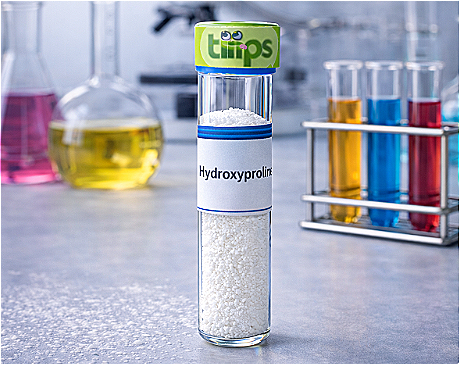
Hydroxyproline is an amino acid derived from proline, an important component for collagen formation and maintaining skin integrity.
Industrial Production Process
- Collection of raw materials. Raw materials, often collagen or gelatin from animal sources, are collected for amino acid extraction.
- Enzymatic hydrolysis. The collagen or gelatin is treated with specific enzymes to break down the proteins into their amino acid units.
- Isolation of proline. During the hydrolysis process, proline is isolated from other amino acids using chromatography or other separation methods.
- Oxidation. The proline undergoes an oxidation process with oxidizing agents like ascorbic acid or other catalysts to convert proline to hydroxyproline.
- Purification. The hydroxyproline is purified through techniques like crystallization or chromatography to remove impurities.
- Quality control. The final product undergoes rigorous quality testing to ensure its purity and compliance with required standards.
What it is used for and where
Cosmetics - INCI Functions
- Antistatic agent. Static electricity build-up has a direct influence on products and causes electrostatic adsorption. The antistatic ingredient reduces static build-up and surface resistivity on the surface of the skin and hair.
- Hair conditioning agent. A significant number of ingredients with specific and targeted purposes may co-exist in hair shampoo formulations: cleansers, conditioners, thickeners, matting agents, sequestering agents, fragrances, preservatives, special additives. However, the indispensable ingredients are the cleansers and conditioners as they are necessary and sufficient for hair cleansing and manageability. The others act as commercial and non-essential auxiliaries such as: appearance, fragrance, colouring, etc. Hair conditioning agents have the task of increasing shine, manageability and volume, and reducing static electricity, especially after treatments such as colouring, ironing, waving, drying and brushing. They are, in practice, dispersants that may contain cationic surfactants, thickeners, emollients, polymers. The typology of hair conditioning agents includes: intensive conditioners, instant conditioners, thickening conditioners, drying conditioners. They can perform their task generally accompanied by other different ingredients.
- Skin conditioning agent. It is the mainstay of topical skin treatment as it has the function of restoring, increasing or improving skin tolerance to external factors, including melanocyte tolerance. The most important function of the conditioning agent is to prevent skin dehydration, but the subject is rather complex and involves emollients and humectants that can be added in the formulation.
- Surfactant - Cleansing agent. Cosmetic products used to cleanse the skin utilise the surface-active action that produces a lowering of the surface tension of the stratum corneum, facilitating the removal of dirt and impurities.
Cosmetic Applications
Anti-aging Properties. Hydroxyproline stimulates collagen production, helping to improve skin elasticity and firmness, thus reducing the appearance of wrinkles and fine lines.
Skin Regeneration. It supports skin regeneration, helping repair skin damage and promoting a brighter and more even complexion.
Hydration. As a humectant, it attracts moisture to the skin, keeping it hydrated and soft.
Soothing Effects. It reduces inflammation and soothes irritated skin, making it suitable for post-procedure treatments or sensitive skin.
Versatile Applications. It can be incorporated into a variety of skincare products, including serums, creams, and lotions, due to its benefits for skin health and appearance.
Other Applications
Clinical Research. It is used as a biochemical marker in tests to assess collagen degradation (1) and connective tissue health (2) in various clinical conditions.
Dietary Supplements. It is sometimes added to supplements to support joint health and collagen production.
Bone Health Research. It is studied for its potential impact on the prevention and treatment of osteoporosis and other bone disorders (3).
Molecular Formula C5H9NO3
Molecular Weight 131.13 g/mol
CAS 51-35-4
UNII RMB44WO89X
EC Number 200-091-9
DTXSID10883225
Synonyms:
L-Hydroxyproline
trans-4-Hydroxy-L-proline
Bibliografia_____________________________________________________________________
(1) Li P, Wu G. Roles of dietary glycine, proline, and hydroxyproline in collagen synthesis and animal growth. Amino Acids. 2018 Jan;50(1):29-38. doi: 10.1007/s00726-017-2490-6. Epub 2017 Sep 20. PMID: 28929384.
Abstract. Glycine, proline, and hydroxyproline (Hyp) contribute to 57% of total amino acids (AAs) in collagen, which accounts for one-third of proteins in animals. As the most abundant protein in the body, collagen is essential to maintain the normal structure and strength of connective tissue, such as bones, skin, cartilage, and blood vessels. Mammals, birds, and fish can synthesize: (1) glycine from threonine, serine, choline, and Hyp; (2) proline from arginine; and (3) Hyp from proline residues in collagen, in a cell- and tissue-specific manner. In addition, livestock (e.g., pigs, cattle, and sheep) produces proline from glutamine and glutamate in the small intestine, but this pathway is absent from birds and possibly most fish species. Results of the recent studies indicate that endogenous synthesis of glycine, proline, and Hyp is inadequate for maximal growth, collagen production, or feed efficiency in pigs, chickens, and fish. Although glycine, proline and Hyp, and gelatin can be used as feed additives in animal diets, these ingredients except for glycine are relatively expensive, which precludes their inclusion in practical rations. Alternatively, hydrolyzed feather meal (HFM), which contains 9% glycine, 5% Hyp, and 12% proline, holds great promise as a low cost but abundant dietary source of glycine, Hyp, and proline for ruminants and nonruminants. Because HFM is deficient in most AAs, future research efforts should be directed at improving the bioavailability of its AAs and the balance of AAs in HFM-supplemented diets. Finally, HFM may be used as a feed additive to prevent or ameliorate connective tissue disorders in domestic and aquatic animals.
(2) Williams PE, Goldspink G. Connective tissue changes in immobilised muscle. J Anat. 1984 Mar;138 ( Pt 2)(Pt 2):343-50.
Abstract. The reduction in fibre length of muscles immobilised in a shortened position is accompanied by reduced compliance of the muscle. Since the intramuscular connective tissue framework distributes the forces passively imposed on a muscle by stretching, it was decided to investigate the amount and distribution of connective tissue in immobilised muscles. Biochemical analysis of the hydroxyproline content of muscles immobilised in the shortened position for different periods of time showed an increase in the ratio of collagen to muscle fibre tissue. This occurred during the first few days of immobilisation, before there was any significant loss of sarcomeres. Thus the increase in connective tissue appeared to result directly from immobilisation rather than from redistribution of connective tissue, following shortening of the fibres. A detailed histological analysis of muscle sections stained for connective tissue with Sirius Red showed that the early increase in connective tissue in immobilised muscles occurred in the perimysium rather than the endomysium, although after a longer period of immobilisation there was also a thickening of the endomysium. Ultrastructural analysis of the perimysium in normal muscle showed that the angle the collagen fibres made with the muscle fibres changed with the state of stretch of the muscle; when the muscle was shortened, the angle was larger than when the muscle was lengthened. In immobilised muscle, collagen fibres were found to be arranged at a more acute angle to the axis of the muscle fibres than was found in normal muscle; this would be expected to affect the compliance of the muscle. The experiments described indicate that the increased stiffness of immobilised muscles could result from both quantitative and qualitative changes in the connective tissue.
(3) Zaitseva OV, Shandrenko SG, Veliky MM. Biochemical markers of bone collagen type I metabolism. Ukr Biochem J. 2015 Jan-Feb;87(1):21-32. doi: 10.15407/ubj87.01.021.
Abstract. This review focuses on the analysis of diagnostic value of the major bone remodeling markers, in particular synthesis and degradation markers of collagen type I. These include carboxy- and aminoterminal telopeptide, carboxy- and aminoterminal propeptide of procollagen type I, hydroxyproline, hydroxylysine, pyridinoline and deoxypyridinoline. Their measurement allows evaluating the structural and functional conditions and also the rate of metabolic processes in the bone tissue. The advantages and disadvantages of determination of these markers in the condition of different bone diseases were examined. It is shown that determination of bone collagen type I metabolism markers is the most informative for assessment of bone resorption, formation and turnover.
Zorab PA, Clark S, Cotrel Y, Harrison A. Bone collagen turnover in idiopathic scoliosis estimated from total hydroxyproline excretion. Arch Dis Child. 1971 Dec;46(250):828-32. doi: 10.1136/adc.46.250.828.
Abstract. The turnover of bone collagen is reflected by the 24-hour excretion of urinary total hydroxyproline. In idiopathic scoliosis there is an increase above normal in the turnover of bone collagen throughout adolescence. Spinal immobilization in plaster-of-Paris, spinal traction, and spinal fusion are all accompanied by increases in the turnover of bone collagen. It is suggested that estimation of the urinary total hydroxyproline excretion is useful in monitoring spinal changes during the treatment of children with idiopathic scoliosis and may reflect otherwise unsuspected changes in the bone collagen.




