



Tripeptide-32: properties, uses, INCI functions, safety
Tripeptide-32 – synthetic peptide (tripeptide) commonly described with the sequence Ser–Thr–Pro–NH₂ (serine, threonine and proline)
Synonyms: Tripeptide 32, Chronolux (trade name), STP-NH₂ (sequence abbreviation, technical use), seryl-threonyl-prolinamide (structural description)
INCI / Functions (EU databases): skin conditioning
Definition
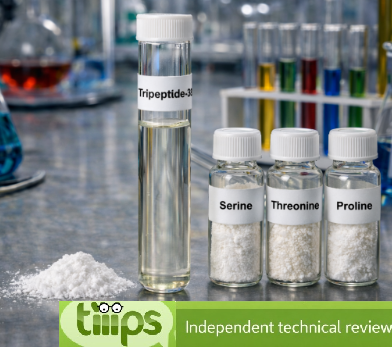
Tripeptide-32 is a synthetic peptide composed of three amino acids (serine, threonine, and proline) linked by peptide bonds; in technical and patent literature it is often indicated as Ser–Thr–Pro–NH₂. In cosmetics it is positioned as a “peptide” ingredient supporting anti-aging and skin quality maintenance formulations, typically used at low concentrations.
Peptides are substances consisting of two or more amino acids linked together by a linear chain. Synthetic peptides can be generated as copies of protein fragments by incorporating non-proteinogenic amino acids and modified so as to also increase the proteolytic stability of the molecules.
Conceptually, Tripeptide-32 is frequently associated (particularly in patents and industry reviews) with a skin chronobiology rationale: it is described as a peptide able to interact with pathways connected to the circadian rhythm (e.g., CLOCK/PER1). In a cosmetic technical report, it is prudent to treat this as a proposed mechanism (not a clinical promise), to be validated on the finished product with testing that is consistent with the positioning and claim constraints.
Main uses
Cosmetics
In cosmetics, Tripeptide-32 is mainly used in leave-on products (serums, creams, eye area products) where the formulation aims to support aspects of skin quality (more even appearance, fine lines, perceived resilience) and/or to support routines aligned with the concept of night-time repair. The function officially listed in EU databases is skin conditioning; in practice, the ingredient is often integrated into multi-active systems (humectants, antioxidants, barrier-support actives, soothing agents) where the peptide’s contribution is part of an overall strategy. From a development standpoint, it is essential to verify stability (pH/temperature), compatibility with preservatives and polymers, and the alignment of claims with available evidence.
- Skin conditioning agent. It is the mainstay of topical skin treatment as it has the function of restoring, increasing or improving skin tolerance to external factors, including melanocyte tolerance. The most important function of the conditioning agent is to prevent skin dehydration, but the subject is rather complex and involves emollients and humectants that can be added in the formulation.
Tripeptide-32 is known for its ability to regulate and enhance the skin’s repair cycles during sleep. It works by temporarily activating key cellular functions that are responsible for skin hydration and repair. This ingredient is commonly used in cosmetic products designed to be applied at night, helping the skin to maximize its recovery and renewal potential during resting hours. With these properties, Tripeptide-32 helps to improve skin texture, increase elasticity, and reduce the visibility of fine lines and wrinkles, contributing to a younger and healthier appearance.
Identification data and specifications
| Identifier | Value |
|---|---|
| INCI name | Tripeptide-32 |
| Composition (description) | synthetic tripeptide: serine + threonine + proline (often stated as Ser–Thr–Pro–NH₂) |
| Molecular formula (indicative) | C12H22N4O5 |
| Molecular weight (indicative) | ~302.33 g/mol |
| CAS number | 1185583-20-3 |
| EC/EINECS number | Not available / not reported in CosIng (not assigned in major public lists) |
| Typical commercial appearance | white to off-white powder (grade-dependent) |
Chemical-physical properties (indicative)
| Property | Value | Note |
|---|---|---|
| Solubility | good in polar solvents; often declared soluble in DMSO | in water it may depend on pH, ionic strength, and concentration |
| Thermal stability in formulation | cold-process addition is preferred (cool-down) | common precautionary approach for cosmetic peptides |
| Sensitivity | possible degradation/hydrolysis under extreme conditions | avoid very acidic or very alkaline pH and prolonged thermal stress |
Functional role and practical mechanism
| Function | What it does in formula | Technical note |
|---|---|---|
| Skin conditioning | supports “peptide/skin quality” positioning, in synergy with other actives | perceived outcome depends on the system and use level |
| Anti-aging support (use rationale) | associated in technical literature with circadian rhythm pathways (CLOCK/PER1) | treat as proposed mechanism; claims only if supported by finished-product evidence |
Formulation compatibility
Tripeptide-32, like many peptides, requires attention to three drivers: pH, process temperature, and interactions with preservative/polymeric systems.
pH. It is good practice to formulate within a range compatible with peptide stability and skin physiology. Extreme pH can accelerate hydrolysis or instability, with impacts on performance and product quality (haze, loss of expected contribution, color changes).
Temperature and process. To minimize thermal stress, peptide addition is generally best performed during cool-down (typically <40 °C), with controlled solubilization and short hold times.
Formulation architecture. In complex matrices (structured emulsions, polymer gels, high ionic strength systems), opalescence or interactions that reduce peptide availability can occur. A recommended test package includes accelerated stability, thermal cycling, and compatibility checks with preservatives (especially more reactive systems) and with any chelators/antioxidants.
In summary, compatibility should not be assumed “by principle”, but verified experimentally on prototypes, because the outcome depends on the specific formulation architecture.
Use guidelines (indicative)
| Application | Typical range | Technical note |
|---|---|---|
| Leave-on face serums/creams | 0.001–0.05% | depends on raw material quality, positioning, and substantiation |
| Eye-area products | 0.001–0.05% | pay attention to finished-product tolerability and preservative system |
| Leave-on hair products (if used) | 0.001–0.02% | less typical; check compatibility with film formers and alcohol |
Quality, grades, and specifications
| QC parameter | What to check |
|---|---|
| Identity | analytical confirmation (e.g., HPLC/MS) and sequence consistency |
| Purity | purity % and impurity profile (truncated peptides, synthesis residues) |
| Moisture/hygroscopicity | impacts weighing, solubility, and stability |
| CoA and traceability | batch, methods, acceptance criteria |
| Storage | recommended conditions (light/humidity/temperature) and stability |
Safety, regulatory, and environment
In cosmetics, Tripeptide-32 belongs to the category of synthetic peptides used at low concentrations. Safety must be assessed on the finished product, considering: use level, application frequency, treated area, target population, and the overall ingredient profile (preservatives, solvents, fragrance, etc.). Operationally, any risk signal, where present, is often driven more by the overall formulation than by the single peptide, but this does not remove the need for a formal and documented assessment.
From a regulatory standpoint, the primary framework is EU cosmetics compliance (safety assessment, PIF, claim support). In manufacturing and quality control, applying GMP is a key lever for managing variability. In regulated supply chains, HACCP concepts may be referenced as a risk-control methodology, even if it is not the primary standard for cosmetics (context-dependent).
Formulation troubleshooting
| Issue | Possible cause | Recommended intervention |
|---|---|---|
| Haze/opalescence | interaction with polymers, salts, or preservatives; incomplete solubilization | adjust addition order, reduce ionic strength, verify pH and solvents |
| Stability loss over time | thermal stress, unsuitable pH, oxidation/hydrolysis | cold-process addition, optimize pH, reduce stress, evaluate chelators |
| Lot-to-lot variability | differences in purity/moisture or supplier specifications | tighten specs, request detailed CoA, qualify supplier |
| Claims not “visible” | low use level or unfavorable matrix | reconsider actives strategy and finished-product efficacy measurements |
Conclusion
Tripeptide-32 is a synthetic peptide (Ser–Thr–Pro–NH₂) used as a skin conditioning ingredient and often integrated into anti-aging cosmetic strategies. Key technical control points are pH, low-temperature processing, and compatibility with the overall formulation architecture. Any circadian-pathway rationale (CLOCK/PER1) should be treated as a proposed mechanism, translated into claims only through relevant evidence and testing on the finished product.
Mini-glossary
INCI: international standard nomenclature for cosmetic ingredient labeling.
CAS: unique numeric identifier for registered chemical substances.
EC/EINECS: European inventory number (when available/assigned).
HPLC/MS: analytical techniques for identity and purity (liquid chromatography/mass spectrometry).
GMP: Good manufacturing practice, manufacturing quality system; benefit: reduces variability and operational risk.
HACCP: Hazard analysis and critical control points, risk analysis and critical control methodology; benefit: improves preventive risk management in regulated supply chains.

