Earl Grey è un tipo di tè nero aromatizzato con l'olio essenziale di bergamotto, un agrume il cui sapore è una combinazione unica di limone, arancia e note floreali leggermente amare. Questo tè prende il nome dal secondo conte Grey, un Primo Ministro britannico del XIX secolo, e si è guadagnato una reputazione mondiale per il suo gusto distintivo e rinfrescante. L'Earl Grey è composto principalmente da tè nero, proveniente da varie regioni come l'India, lo Sri Lanka o la Cina, aromatizzato con l'olio di bergamotto.
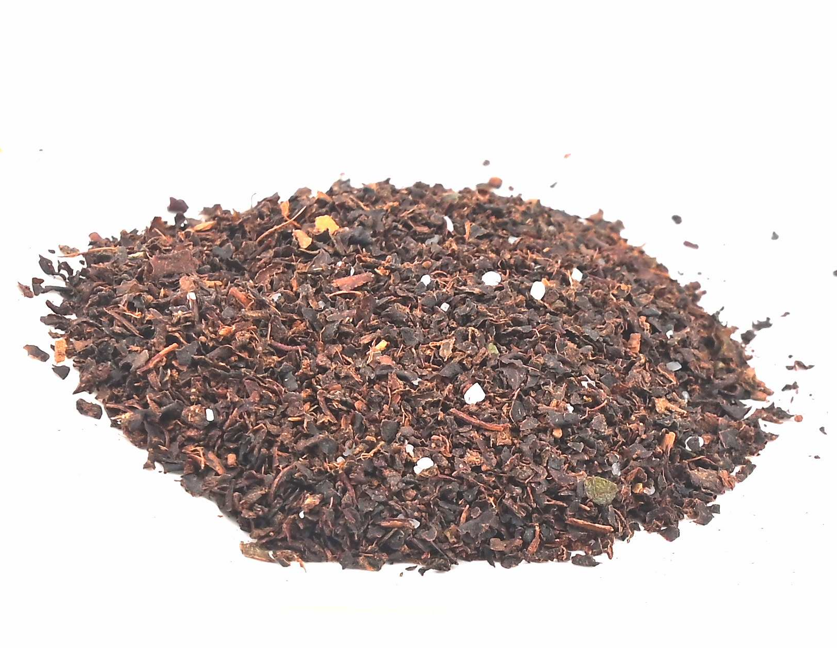
Proprietà. Oltre al suo profilo aromatico dovuto all'essenza di bergamotto e a sostanze aromatizzanti come acetato di linalile e linalolo (1), l'Earl Grey offre benefici per la salute grazie agli antiossidanti presenti nel tè nero, che possono aiutare a ridurre l'infiammazione e a migliorare la salute del cuore.
Preparazione. Tradizionalmente, si prepara infondendo le foglie di tè in acqua calda per circa 3-5 minuti, a seconda dell'intensità desiderata. Può essere gustato da solo o con un po' di latte o limone per esaltarne il sapore. A me piace puro.
Varianti. Esistono diverse varianti di Earl Grey, inclusi tè che utilizzano basi diverse dal tè nero, come il tè verde o il tè bianco, e versioni che includono altri aromi oltre al bergamotto.
Cultura e tradizione. L'Earl Grey ha una lunga storia e occupa un posto speciale nella cultura del tè, essendo una scelta popolare per il pomeriggio o la mattina grazie al suo profumo rinvigorente e al gusto equilibrato.
Ricerca. Sebbene la maggior parte dei benefici per la salute attribuiti all'Earl Grey derivi dalle proprietà del tè nero, la ricerca continua a esplorare l'impatto specifico dell'aggiunta di bergamotto.
Considerazioni ambientali. La sostenibilità nella produzione di Earl Grey riguarda sia la coltivazione del tè che la produzione di olio di bergamotto, con un crescente interesse verso pratiche che rispettano l'ambiente e promuovono la responsabilità sociale.
Sicurezza
Come spesso accade nei prodotti aromatizzati, anche nell'Earl Grey sono stati trovati idrocarburi policiclici aromatici (IPA) che possono causare problemi alla salute (2).
Occorre non esagerare nell'assunzione in quanto si sono verificati casi di intossicazione da eccessiva ingestione di Earl grey (3).
Bibliografia_____________________________________________________________________
(1) Orth AM, Poplacean I, Fastowski O, Engel KH. Assessment of dietary exposure to flavouring substances via consumption of flavoured teas. Part II: transfer rates of linalool and linalyl esters into Earl Grey tea infusions. Food Addit Contam Part A Chem Anal Control Expo Risk Assess. 2014;31(2):207-17. doi: 10.1080/19440049.2013.866717. Epub 2014 Jan 21. PMID: 24237351.
Abstract. The assessment of dietary exposure via the consumption of flavoured foods is a key element of the safety evaluation of flavouring substances. Linalyl acetate and linalool are the major flavouring substances in Earl Grey teas; the objective of this study was to determine their transfer rates from the tea leaves into the tea beverage upon preparation of a hot water infusion. Spiking experiments revealed a transfer rate of 66% for linalool. In contrast, the transfer rate for linalyl acetate was only 1.9%; in turn, the hydrolysis product linalool (17.0%) and a spectrum (19.9%) of degradation and rearrangement products (monoterpene alcohols, esters and hydrocarbons) were present in the tea beverage. The transfer rates were shown to be proportional to the length of the infusion. The impact of the hot water treatment on the enantiomeric compositions of linalyl acetate and linalool was determined, and structure-dependent experiments were performed by variation of the acyl and the alcohol moiety of the monoterpene ester. Comparative dietary exposure assessments demonstrated the need to take correction factors based on the experimentally determined transfer rates into account. Based on tea consumption data from the UK National Diet and Nutrition Survey (2000/2001), the exposure to linalyl acetate ranges from 0.2 mg day(-1) (average) to 1.8 mg day(-1) (high). The corresponding values for linalool are 4.2 mg day(-1) (average) and 46.6 mg day(-1) (high). The exposure of linalool via consumption of the tea beverage is approximately 26 times higher than that of linalyl acetate, although in the flavoured tea leaves the median content of linalyl acetate is approximately 1.8 times higher than that of linalool.
(2) Adisa A, Jimenez A, Woodham C, Anthony K, Nguyen T, Saleh MA. Determination of polycyclic aromatic hydrocarbons in dry tea. J Environ Sci Health B. 2015;50(8):552-9. doi: 10.1080/03601234.2015.1028832. PMID: 26065515; PMCID: PMC4881431.
Abstract. Twenty-eight different tea samples sold in the United States were evaluated using high-performance liquid chromatography (HPLC) with fluorescence detection (FLD) for their contamination with polycyclic aromatic hydrocarbons (PAHs). Many PAHs exhibit carcinogenic, mutagenic, and teratogenic properties and have been related to several kinds of cancer in man and experimental animals. The presence of PAHs in environmental samples such as water, sediments, and particulate air has been extensively studied, but food samples have received little attention. Eighteen PAHs congeners were analyzed, with percentage recovery higher than 85%. Contamination expressed as the sum of the 18 analyzed PAHs was between 101 and 1337 μg/kg on dry mass and the average contents in all of the 28 examined samples was 300 μg/kg on dry mass. Seven of the congeners were found in all samples with wide ranges of concentrations as follows: fluorene (7-48 μg/kg), anthracene (1-31 μg/kg), pyrene (1-970 μg/kg), benzo(a)anthracene (1-18 μg/kg) chrysene (17-365 μg/kg), benzo(a)pyrene (1-29 μg/kg), and indeno(1,2,3-cd)pyrene (4-119 μg/kg). The two most toxic congeners benzo(a)pyrene and dibenzo(a,h)anthracene were found at high concentrations only in Earl Grey Twinnings, Earl Grey Harney& Sons Fine Teas, and Chai Ultra Spice Black Tea Twinnings. Six PAH congeners are considered as suspected carcinogens (U.S.EPA), formed the basis of the estimation of the toxic equivalent (TEQ), Chai Ultra-Spice Black Tea Twinnings had the highest TEQ (110.9) followed by two grey tea samples, Earl Grey Harney & Sons Fine Tea (57.7) and Earl Grey Twinnings (54.5). Decaffeinated grey teas had the lowest TEQs, decaffeinated Earl Grey Bigelow (9.4) and Green Tea Honey Lemon Decaffeinated Lipton (9.6).
(3) Finsterer J. Earl Grey tea intoxication. Lancet. 2002 Apr 27;359(9316):1484. doi: 10.1016/S0140-6736(02)08436-2. PMID: 11988248.




