



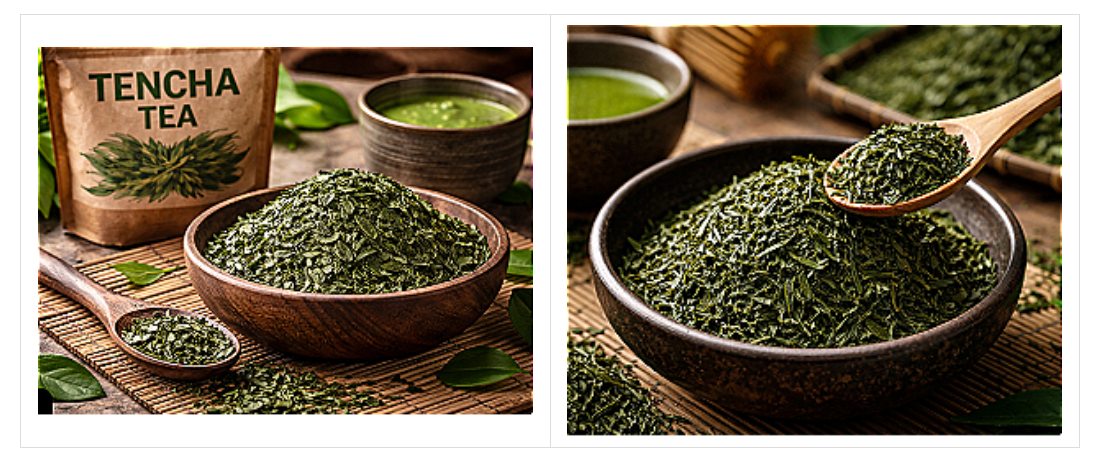
Tencha is a variety of Japanese green tea that serves as the base for producing matcha. Unlike other green teas, tencha leaves are not rolled during the production process.
After harvesting, tencha leaves are briefly withered under the sun, then steamed to stop oxidation. Afterwards, the leaves are dried without being rolled, which distinguishes them from most other green teas. Before being ground into powder to become matcha, tencha leaves are stripped of veins and stems.
Habitat and Cultivation
Tencha is primarily grown in the regions around Uji, near Kyoto, and other areas of Japan with similar climatic conditions. Like matcha, tencha requires the plants to be shaded for several weeks before harvest to increase chlorophyll content and reduce bitterness.
Industrial Production Process
- Cultivation. Cultivating Tencha requires shading the tea plants (Camellia sinensis) for about 3-4 weeks before harvest to reduce direct sunlight exposure. This increases chlorophyll and amino acid content in the leaves, giving Tencha a sweet flavor and deep green color.
- Harvesting. Tencha leaves are handpicked, selecting only the young and high-quality leaves. Harvesting occurs in spring, at the peak of the leaves' freshness.
- Steaming. Immediately after harvesting, the leaves are briefly steamed to deactivate enzymes and prevent oxidation, thus preserving the green color and nutritional properties.
- Drying. After steaming, the leaves are dried. Unlike other green teas, Tencha leaves are not rolled but left flat to preserve their shape and structure.
- Cooling. The dried leaves are evenly cooled to stabilize the flavor and aroma.
- Removal. Before grinding into Matcha or being used as Tencha, stems and veins are removed to ensure the quality of the final product.
- Packaging. Tencha is carefully packaged to preserve freshness, color, and properties until consumption or further processing into Matcha.
Nutritional Properties and Benefits
Tencha shares many of the nutritional properties and health benefits of matcha, being rich in antioxidants, vitamins, and minerals. It has the highest level of flavonoids among some green teas examined (1). It promotes overall well-being, supports the immune system, and helps improve concentration and relaxation due to the presence of L-theanine.
Uses
Matcha Production: The primary use of tencha is its transformation into matcha through a fine grinding process.
Direct Consumption: Although less common, tencha can also be directly infused as a green tea, offering a delicate and nuanced flavor.
Environmental Impact
The cultivation of tencha, like that of matcha, can have an environmental impact related to water use and soil management. Sustainable and organic production is encouraged to minimize these impacts.
Conservation
Tencha should be stored under similar conditions to matcha, in an airtight container and away from light and moisture, to preserve its freshness and organoleptic properties.

