



E442 (Ammonium phosphatides): properties, uses, pros, cons, safety
E442 (Ammonium phosphatides) is a chemical compound, produced by esterification of glycerol and ammonia is used to neutralise the phosphoric acid part.
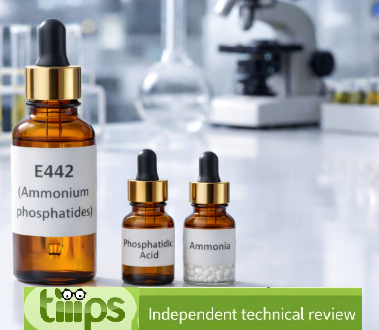
Ammonium phosphatides refers to a group of substances derived from the reaction of phosphoric acid with ammonia. These substances are often used as emulsifiers in the food industry.
The name describes the structure of molecules.
- "Ammonium" refers to the ammonium ion (NH4+)
- "Phosphatides" refers to the phosphatidyl group, which is a key component of phospholipids, a class of lipids that are an important component of all cell membranes.
Description of the raw materials used in their production:
- Phosphatidic Acid - Phosphatidic acid is a phospholipid naturally present in various plant-based oils, including soybean oil. It serves as the primary raw material for the production of ammonium phosphatides.
- Ammonia - Ammonia (NH3) is a chemical compound used in the production of ammonium phosphatides. It reacts with phosphatidic acid to form the ammonium salt of phosphatidic acid.
The synthesis process takes place in several stages:
- Step 1: Preparation of raw materials, phosphoric acid and ammonia.
- Step 2: Reaction. Phosphoric acid is reacted with ammonia in a controlled environment to form ammonium phosphatides. This reaction is typically carried out in a reactor vessel at controlled temperature and pressure.
- Step 3: Purification. The resulting ammonium phosphates are purified to remove any unreacted phosphoric and ammoniac acids by various techniques such as distillation and filtration.
- Step 4: Drying. Purified ammonium phosphates are dried to remove any residual solvent.
It comes in the form of white granules

Food
Ingredient included in the list of European food additives such as E442 with emulsifying function developed to replace lecithin, in particular in chocolate.
Other uses
Fertilisers, textile industry.
Safety
Ammonium phosphatides (E442) is authorised as a food additive in the European Union (EU) in accordance with Annex II and Annex III to Regulation (EC) No 1333/2008 on food additives and specific purity criteria have been defined in the Commission Regulation (EU) No 231/2012.
Following a request from the European Commission, the EFSA Panel on Food Additives and Nutrient Sources added to Food (ANS) was asked to re‐evaluate the safety of ammonium phosphatides (E442) when used as a food additive.
Toxicological data for ammonium phosphatides were evaluated by the Scientific Committee on Food (SCF) in 1978. The Committee established an acceptable daily intake (ADI) of 30 mg/kg body weight (bw) per day.
Based on the available database, the Panel considered that there is no reason to revise the current ADI for ammonium phosphatides of 30 mg/kg bw per day derived from a NOAEL of 3,000 mg/kg bw per day in the rat carcinogenicity study and applying an uncertainty factor of 100.

